论文:A Protocol for Packet Network Intercommunication
本篇整理 Vinton G. Cerf 与 Robert E. Kahn 的《A Protocol for Packet Network Intercommunication》。每一页保留 IEEE 论文 PDF 的原始页面图;下面按 PDF 页序逐段翻译,保留 figures、协议字段、公式、脚注、版权声明、作者简介和 References。TCP、GATEWAY、HOST、process、port、segment、association 等约定俗成的术语保留 English 或中英并列。
论文:A Protocol for Packet Network Intercommunication
相关文章:论文:End-to-End Arguments in System Design · 论文:Implementing Fault-Tolerant Services Using the State Machine Approach · 论文:Time, Clocks, and the Ordering of Events in a Distributed System
TL;DR
- 问题:如何让多个具有不同 packet size、addressing、routing、failure 和 flow-control 机制的 packet switching networks 互相通信,并让不同网络中的 processes 共享资源。
- 核心结构:在 network 边界使用尽可能简单的 GATEWAY;在 HOST/process 端使用共同的 internetwork protocol,由 TCP 处理 multiplexing、sequencing、acknowledgement、retransmission 和 flow control。
- 关键机制:internetwork header 携带 source/destination、sequence number、byte count、flags 和 end-to-end checksum;GATEWAY 可以 fragmentation,但 destination HOST 负责 reassembly。
- 协议判断:把 process header 放入每个 packet,能够避免共享 byte stream 中的 interprocess interference;sequence-number window 同时支持乱序重组、duplicate detection 和 retransmission。
- 边界:本文是 1974 年 TCP 早期设计论文,不等同于后来标准化的 TCP/IP;地址字段、window、SYN/REL 和 association 语义应按本文历史版本理解。
名词解释
| 名词 | 含义 | 本文对应物 |
|---|---|---|
| packet switching network | 由 HOST、packet switch 和 communication media 组成、以 packets 传输数据的网络 | network A、B、C |
| internetwork | 多个 packet switching networks 互联形成的 composite network | 通过 GATEWAY 连接的网络集合 |
| GATEWAY | 在不同 networks 之间转发、重新格式化和路由 internetwork packets 的接口 | M、N |
| HOST | 运行 processes 与 TCP 的计算机 | source/destination computer |
| TCP | 代表 HOST 内 processes 发送、接收和重组 messages 的 transmission control program | HOST level protocol module |
| segment | TCP 从 message 中切出的、用于 process-level 传输的片段 | segment text + process header |
| port | 与 process 关联、用于区分不同 message streams 的 designator | 16-bit internetwork port identifier |
| association | 两个或多个 ports 已经具备互相通信所需的 addressing 与 sequencing 状态 | 不要求存在固定 network path |
| TCB / RCB | transmit control block / receive control block | process 与 TCP 之间的控制信息 |
| SYN / REL | 用于同步新 association / 释放 association 的 flags | internetwork header flag field |
目录
| 章节 | 内容 |
|---|---|
| 版本与来源 | 论文版本、来源 PDF 与固定信息 |
| 原文页面与逐页翻译 | 13 个 PDF 页面按原页保留并翻译 |
| 协议机制索引 | GATEWAY、packet、TCP、window 和 association 的关系 |
| 设计判断与边界 | 早期 internetwork protocol 的关键取舍 |
| 本篇验收 | 页面、图片、章节和 References 覆盖范围 |
版本与来源
- 论文标题:A Protocol for Packet Network Intercommunication。
- 作者:Vinton G. Cerf、Robert E. Kahn。
- 发表信息:IEEE Transactions on Communications,Vol. COM-22,No. 5,May 1974,pp. 637–648;DOI:
10.1109/TCOM.1974.1092259。 - 页面版权声明:原 PDF 页面保留 “© 1974 IEEE. Reprinted, with permission, from IEEE Trans on Comms, Vol Com-22 No 5 May 1974”。
- 本地固定来源:University of Michigan PDF mirror;书目信息可由 IEEE DOI 核对。
- 历史对照:RFC 675: Specification of Internet Transmission Control Program 记录了同年后续的 TCP specification;它不是本篇的替代版本。
- 本地固定文件:
source/a-protocol-for-packet-network-intercommunication.pdf。 - PDF 固定信息:13 页;SHA-256:
f7c614a116516e0efec906885fa3ffd9261c5101900d117b72d26d92de96d2f1。 - 附件处理:每页按 PDF 页面矩形以 2× 渲染为
1190×1684PNG,存放于assets/51 A Protocol for Packet Network Intercommunication/,正文按600宽度嵌入。 - 笔记类型:深度分析;理由是本文不仅描述协议字段,还需要解释异构 networks、GATEWAY、TCP、reassembly、window 和 association 之间的机制边界。
原文页面与逐页翻译
第 1 页:Abstract、Introduction 与 internetwork 问题
A Protocol for Packet Network Intercommunication
作者:Vinton G. Cerf、Robert E. Kahn,IEEE Member。
Abstract
本文提出一种 protocol,用来支持共享存在于不同 packet switching networks 中的 resources。
该 protocol 支持 individual networks 在 packet size、transmission failures、sequencing、flow control、end-to-end error checking 方面的差异,并支持创建和销毁 logical process-to-process connections。本文还讨论若干 implementation issues,并揭示 internetwork routing、accounting 和 timeouts 等问题。
Introduction
过去几年,人们在 packet switching networks 的设计和实现上投入了大量 effort [1]–[7]、[14]、[17]。开发这类 networks 的一个主要原因,是促进 computer resources 的共享。
packet communication network 提供一种 transportation mechanism,负责在 computers 之间,或 computers 与 terminals 之间 delivery data。为了让 data 具有 meaning,computers 和 terminals 必须共享一个 common protocol,也就是一组双方同意的 conventions。为此,已经开发出若干 protocols [8]–[12]、[16]。不过,这些 protocols 只解决同一 network 内的 communication 问题。
本文提出一种 protocol design 和 design philosophy,用来支持共享存在于不同 packet switching networks 中的 resources。
在简要介绍 internetwork protocol issues 后,我们会描述 GATEWAY 作为 networks 之间 interface 的 function,并讨论它在 protocol 中的 role。随后讨论 protocol 的各种 details,包括 addressing、formatting、buffering、sequencing、flow control、error control 等。最后,我们描述一种 interprocess communication mechanism,并说明如何由 internetwork protocol 支持它。
即使单个 packet switching network 的设计必须解决许多不同而复杂的问题,当不相同的 networks 被互联时,这些问题也会明显叠加。此时会出现一些在单个 network 中没有直接对应物的 issues,而这些 issues 会强烈影响 internetwork communication 的方式。
典型的 packet switching network 由以下部分组成:一组称为 HOSTS 的 computer resources;一个或多个 packet switches;以及连接这些 packet switches 的 communication media。我们假设,每个 HOST 内部都存在一些 processes,它们需要与本 HOST 或其他 HOSTS 中的 processes 通信。对于本文目的,任何当前的 process 定义都足够 [13]。
这些 processes 通常是 network 中 data 的 ultimate source 和 destination。通常,在一个 individual network 内部,存在一个 protocol,规定任意 source process 与 destination process 如何通信;只有 source 和 destination processes 需要知道这套 convention,通信才能发生。两个不同 networks 中的 processes 通常会使用不同的 protocols。
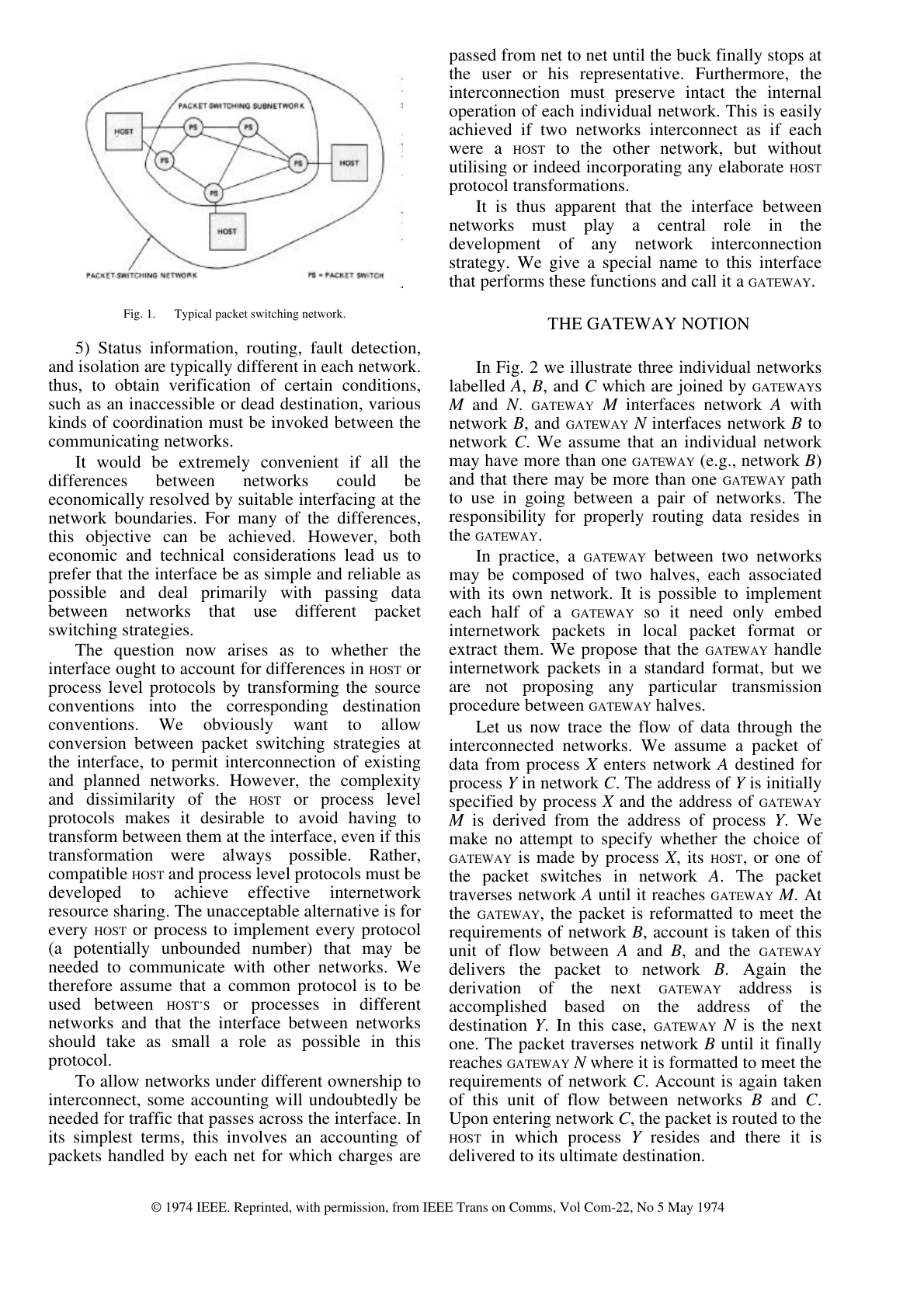
packet switches 和 communication media 的整体称为 packet switching subnet。Fig. 1 说明了这些 concepts。
在典型的 packet switching subnet 中,network 接受来自 source HOST、并带有 formatted destination address 的 fixed maximum size data,然后以 store-and-forward 的方式路由它。传输这些 data 所需的 time 通常取决于 network 内部的 parameters,例如 communication media data rates、buffering 和 signalling strategies、routeing、propagation delays 等。
此外,network 通常还具有某种机制,用于 error handling 以及确定 network components 的 status。
不同的 individual packet switching networks 可能在以下方面存在差异:
- 每个 network 可能以不同方式 address receiver,因此需要创建一种每个 individual network 都能理解的 uniform addressing scheme。
- 每个 network 接受的 data maximum size 可能不同。于是,要么所有 networks 都只能按最小的 maximum size 处理 data(这个 size 可能小到不切实际),要么需要一种 procedure,允许跨越 network boundary 的 data 被重新格式化为更小的 pieces。
- 每个 network 中 transmission 的 success/failure 及其 performance,受接受、delivery 和 transport data 时不同的 time delays 支配。因此,必须仔细设计 internetwork timing procedures,确保 data 能够成功穿过不同 networks 被 delivery。
- 在每个 network 内,communication 可能因 data 的 unrecoverable mutation 或 missing data 而中断。需要 end-to-end restoration procedures,才能从这些 conditions 中完整 recovery。
论文页脚保留的出版信息包括:本文由 IEEE Communications Society Data Communications Associate Editor 批准发表,无需口头 presentation;manuscript received 于 November 5, 1973;研究部分由 Defense Advanced Research Projects Agency Contract DAHC 15-73-C-0370 支持。论文页脚还给出两位作者当时的 affiliation:Cerf 为 Stanford University Department of Computer Science and Electrical Engineering;Kahn 为 Advanced Research Projects Agency Department of Defense 的 Information Processing Technology Office。
第 2 页:网络接口、HOST protocol 与 GATEWAY notion
- 每个 network 的 status information、routing、fault detection 和 isolation 通常都不同。因此,为了 verification 某些 conditions,例如 destination 不可访问或已经 dead,必须在 communicating networks 之间进行各种 coordination。
如果能够通过在 network boundaries 做适当 interfacing,以较低 cost 解决 networks 之间的所有差异,那会非常 convenient。对于许多差异,这个目标确实可以实现。然而,economic 和 technical considerations 使我们倾向于让 interface 尽可能 simple、reliable,并主要负责在使用不同 packet switching strategies 的 networks 之间 passing data。
此时出现一个问题:interface 是否也应该处理 HOST 或 process level protocols 之间的差异,把 source conventions 转换为相应的 destination conventions?
我们显然希望 interface 能够在不同 packet switching strategies 之间进行 conversion,以便互联现有和计划中的 networks。然而,HOST 或 process level protocols 的 complexity 和 dissimilarity,使得我们最好避免让 interface 负责在它们之间做 transformation,即使这种 transformation 总是 possible。
更合理的方式,是开发 compatible HOST 和 process level protocols,从而实现 effective internetwork resource sharing。不可接受的 alternative 是让每个 HOST 或 process 都实现所有可能用于与其他 networks 通信的 protocols——这个数量可能没有上限。
因此,我们假设:不同 networks 中的 HOSTS 或 processes 之间使用一种 common protocol;而 networks 之间的 interface 在这个 protocol 中应承担尽可能小的 role。
为了让不同 owners 管理的 networks 能够互联,跨越 interface 的 traffic 无疑需要某种 accounting。最简单地说,就是统计每个 network 处理了多少 packets,然后把 charges 从一个 network 传递到下一个 network,直到最终由 user 或 user 的 representative 承担。
同时,互联必须保持每个 individual network 的内部 operation 不受破坏。如果两个 networks 互联时,各自把对方看作一个 HOST,这件事很容易做到,而且不需要使用、甚至不需要包含复杂的 HOST protocol transformations。
因此很明显,networks 之间的 interface 必须在任何 network interconnection strategy 的发展中扮演 central role。我们给这个执行上述 functions 的 interface 一个特殊名称:GATEWAY。
THE GATEWAY NOTION
Fig. 2 展示三个分别标记为 A、B、C 的 individual networks,它们由 GATEWAYS M 和 N 连接。GATEWAY M 把 network A 与 network B interfacing;GATEWAY N 把 network B 与 network C interfacing。
我们假设一个 individual network 可以拥有多个 GATEWAYS(例如 network B),并且一对 networks 之间可以存在多条可用的 GATEWAY paths。正确 routing data 的 responsibility 位于 GATEWAY。
实践中,两个 networks 之间的 GATEWAY 可能由两个 halves 构成,每个 half 分别与一个 network 关联。GATEWAY 的每个 half 可以只负责把 internetwork packets embed 到 local packet format 中,或从 local format 中 extract 它们。
我们建议 GATEWAY 使用一种 standard format 处理 internetwork packets,但不对 GATEWAY halves 之间采用何种 transmission procedure 作出规定。
现在追踪 data 经过 interconnected networks 的 flow。假设一个来自 network A 中 process X 的 data packet,要发送给 network C 中 process Y。
Y 的 address 最初由 process X 指定;GATEWAY M 的 address 则从 process Y 的 address 推导出来。我们不试图规定 GATEWAY 的选择由 process X、它所在的 HOST,还是 network A 中的某个 packet switch 完成。
packet 穿过 network A,直到抵达 GATEWAY M。在 GATEWAY M,packet 被重新格式化,以满足 network B 的 requirements;GATEWAY 对 A 到 B 之间的这一 flow unit 做 accounting,然后把 packet delivery 到 network B。
接下来,仍然依据 destination Y 的 address 推导下一个 GATEWAY 的 address。本例中下一个 GATEWAY 是 N。packet 穿过 network B,最终抵达 GATEWAY N;在那里,它被格式化为满足 network C 的 requirements。GATEWAY N 再次对 network B 到 C 之间的这一 flow unit 做 accounting。
packet 进入 network C 后,被路由到 process Y 所在的 HOST,并 delivery 到它的 ultimate destination。
第 3 页:Internetwork packet、header 与 fragmentation
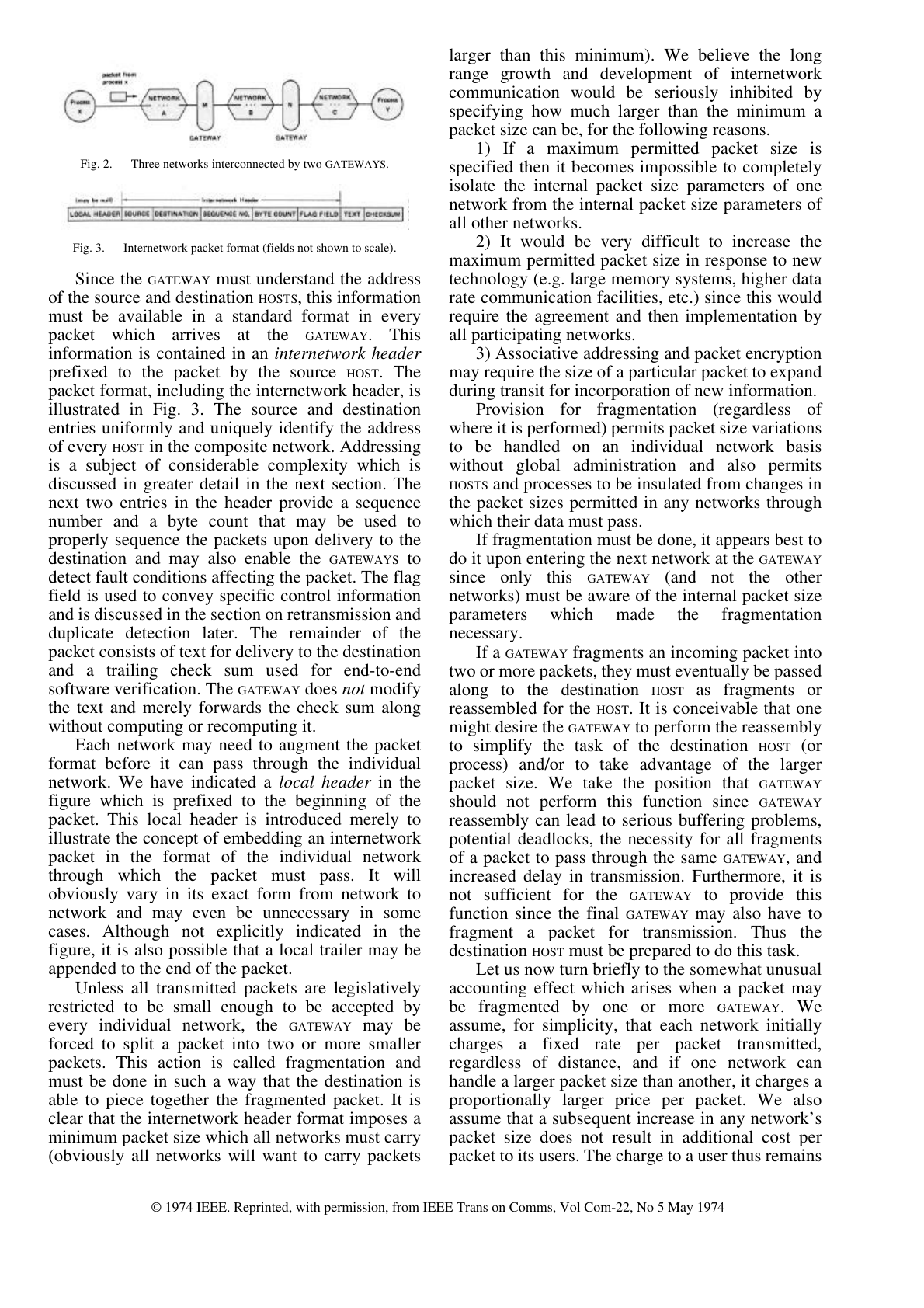
由于 GATEWAY 必须理解 source 和 destination HOSTS 的 addresses,因此每个抵达 GATEWAY 的 packet 都必须以 standard format 提供这些信息。
这些信息位于 internetwork header 中;source HOST 会把这个 header prefix 到 packet 前面。包含 internetwork header 的 packet format 如 Fig. 3 所示。
header 中的 source 和 destination entries,以 uniform 且 unique 的方式标识 composite network 中每个 HOST 的 address。Addressing 是一个相当 complex 的 subject,下一节会更详细讨论。
header 接下来的两个 entries 是 sequence number 和 byte count。它们可以用于在 destination 交付时正确地 sequence packets,也可以帮助 GATEWAYS 检测影响 packet 的 fault conditions。
flag field 用于传递 specific control information,后文 retransmission and duplicate detection 一节会讨论它。packet 的其余部分是要 delivery 给 destination 的 text,末尾是一个用于 end-to-end software verification 的 trailing checksum。
GATEWAY 不修改 text,只是把 checksum 原样 forward,而不会计算或重新计算 checksum。
每个 network 在 packet 穿过自身之前,可能需要扩展 packet format。图中显示了一个 local header,它被 prefix 到 packet 开头。这个 local header 只是用来说明:如何把一个 internetwork packet embed 到它所穿过的 individual network 的 format 中。
local header 的具体形式显然会因 network 而异;在某些 cases 中甚至不需要它。虽然图中没有明确画出,但 packet 末尾也可以追加 local trailer。
除非所有 transmitted packets 都被限制得足够小,以便每个 individual network 都能接受,否则 GATEWAY 可能被迫把一个 packet split 成两个或更多 smaller packets。这个 action 称为 fragmentation,而且必须以一种让 destination 能够重新拼接 fragments 的方式完成。
显然,internetwork header format 为所有 networks 必须支持的 packet size 规定了一个 minimum packet size;当然,所有 networks 都希望支持大于这个 minimum 的 packets。
我们认为,如果规定 packet size 可以比 minimum 大多少,将严重抑制 internetwork communication 的长期 growth 和 development,原因如下:
- 如果指定一个 maximum permitted packet size,就不可能把一个 network 的 internal packet-size parameters 完全隔离于所有其他 networks 的 internal packet-size parameters。
- 当新 technology 出现时(例如 larger memory systems、higher data-rate communication facilities 等),很难增加 maximum permitted packet size,因为这需要所有 participating networks 达成 agreement 并完成 implementation。
- Associative addressing 和 packet encryption 可能要求 packet 在 transit 过程中扩大,以便容纳新增 information。
无论 fragmentation 在哪里执行,只要提供 fragmentation,就可以在 individual network 层面处理 packet-size variations,而不需要 global administration;同时也能让 HOSTS 和 processes 不必感知 data 经过的 networks 所允许的 packet sizes 发生的变化。
如果必须进行 fragmentation,那么看起来最好在 packet 进入下一个 network 时、由 GATEWAY 执行 fragmentation,因为只有这个 GATEWAY(而不是其他 networks)需要知道导致 fragmentation 的 internal packet-size parameters。
如果 GATEWAY 把 incoming packet fragment 成两个或更多 packets,那么这些 packets 最终必须以 fragments 的形式继续传递到 destination HOST,或者先 reassemble 后再传递给 HOST。
有人可能希望 GATEWAY 执行 reassembly,以简化 destination HOST(或 process)的工作,或者利用更大的 packet size。我们的立场是:GATEWAY 不应执行这个 function,因为 GATEWAY reassembly 可能导致:
- serious buffering problems;
- potential deadlocks;
- 要求一个 packet 的所有 fragments 都经过同一个 GATEWAY;
- 增加 transmission delay。
此外,仅由 GATEWAY 提供这个 function 也不够,因为最终的 GATEWAY 可能还需要为 transmission 再次 fragment packet。因此,destination HOST 必须准备好执行这项 task。
下面简要讨论 packet 可能被一个或多个 GATEWAYS fragment 时产生的 unusual accounting effect。为简单起见,假设每个 network 最初按照 transmitted packet 数量收取 fixed rate,与 distance 无关;如果一个 network 能处理更大的 packet size,它就按比例对每个 packet 收取更高 price。还假设某个 network 的 packet size 增加不会给该 network 的 users 带来额外的 per-packet cost。于是,user 在任何必须 fragmentation 的 network 中承担的 charge 基本保持 constant。
第 4 页:Accounting、process-level communication 与 segment multiplexing
当一个 packet 被 fragment 成 smaller packets,而这些 smaller packets 随后必须经过一个 packet size 比原始 unfragmented packet 更大的 network 时,就会出现 unusual effect。
我们预期,大多数 networks 会自然选择彼此接近的 packet sizes;不过无论如何,一个 network 的 packet size 增加,即使会引起 fragmentation,也不会增加 transmission cost,甚至可能降低 cost。
如果采用不同于我们建议的其他 packet charging policies,cost differences 可以被用作 economic lever,推动 individual network performance 的 optimization。
PROCESS LEVEL COMMUNICATION
我们假设 processes 希望与 correspondent 进行 full-duplex communication,传输长度 unbounded 但 finite 的 messages。
一个 character 可以构成 process 与 terminal 之间 message 的 text;一整页 characters 可以构成 file 与 process 之间 message 的 text;一个 data stream(例如 continuous generated bit string)可以表示为一系列 finite-length messages。
我们假设每个 HOST 内存在一个 transmission control program(TCP),代表它所服务的 processes 处理 messages 的 transmission 和 acceptance。TCP 由连接到所在 HOST 的一个或多个 packet switches 提供 service。
希望通信的 processes 把 messages 交给 TCP transmission;TCP 则把 incoming messages delivery 给适当的 destination processes。
我们允许 TCP 把 messages 拆成 segments,原因包括:destination 可能限制可以接收的 data 量;local network 可能限制 maximum transmission size;或者 TCP 需要在多个并发 processes 之间共享 resources。
此外,我们规定 segment length 必须是 8-bit bytes 的 integral number。对于 natural word lengths 不同的 HOST machines,这种 uniformity 最有助于简化 software。
如果 message 的长度不是 integral number of bytes,process level 可以负责 padding;它还可以标识接收到的 bytes 中哪些 text 包含 receiving process 感兴趣的信息。
segments 在 processes 之间的 multiplexing 和 demultiplexing,是 TCP 的 fundamental tasks。
在 transmission 时,TCP 必须把不同 source processes 的 segments multiplex 到一起,并生成 internetwork packets,交给它所服务的一个或多个 packet switches。
在 reception 时,TCP 从所服务的 packet switch(es) 接收一系列 packets(通常来自不同 HOSTS)。TCP 必须根据这些 arriving packets 重建 messages,并将它们 delivery 给正确的 destination processes。
我们假设每个 segment 都会增加 additional information,使 transmitting 和 receiving TCP 分别能够识别 destination 和 source processes。
此时必须面对一个 major issue:source TCP 应该如何格式化那些发往同一个 destination TCP 的 segments?我们考虑两种 cases。
Case 1:共享 TCP-to-TCP byte stream
如果认为 segment boundaries 不重要,并且可以把发往同一个 TCP 的 segments 组成一个 byte stream,那么可以通过任意地把这个 stream parcel 成 packets,让许多 segments 共享一个 internetwork packet header,从而提高 transmission efficiency 和 resource sharing。
但这种立场要求 destination 精确且按顺序地 reconstruct source TCP 产生的 text byte stream。destination 必须先把这个 stream parse 成 segments,再利用这些 segments 重构 messages,并把 messages delivery 给适当的 processes。
这种 strategy 存在由 packets 可能 out of order 到达 destination 导致的 fundamental problems。最关键的问题,似乎是共享同一个 TCP-to-TCP byte stream 的 processes 之间可能产生的 interference;这在 receiving end 尤其严重。
首先,TCP 可能需要付出相当多的 effort 来 parse stream、恢复 segments,并把它们 distribution 到用于 reassemble messages 的 buffers 中。如果不容易立即判断某个 segment 是否已经全部到达(记住,它可能由多个 packets 组成),receiving TCP 可能不得不暂时 suspend parsing,直到更多 packets 到达。
其次,如果一个 packet missing,那么即使 succeeding segments 可以被识别,也不一定清楚它们能否 delivery 给 receiving process,除非 TCP 知道某种 process-level sequencing scheme。这个 knowledge 可以让 TCP 判断 succeeding segment 是否能够 delivery 给正在等待的 process。
当 byte stream 中存在 gaps 时,寻找 segment 的 beginning 也可能很困难。
第 5 页:Case 2、address formats 与 segment format
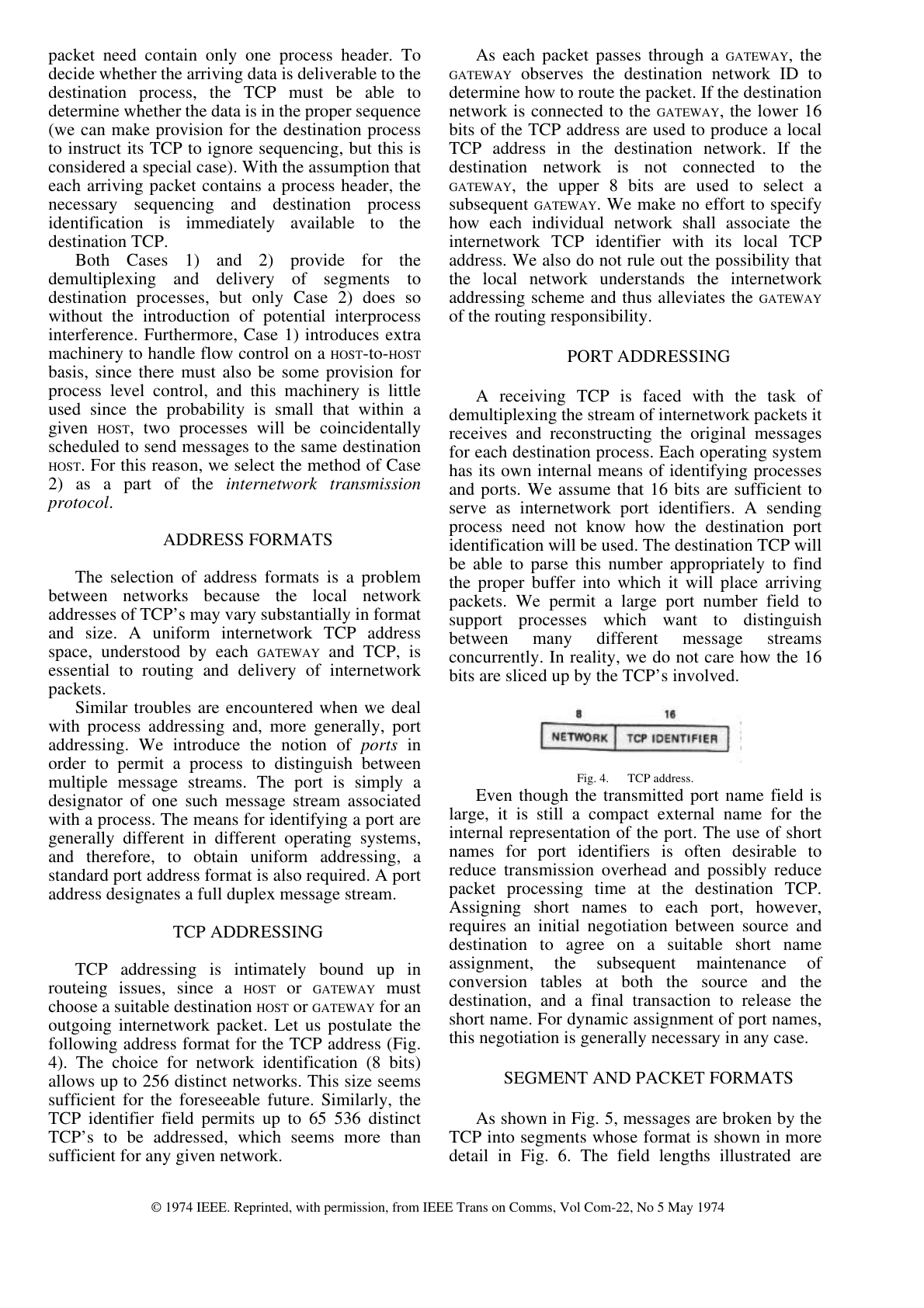
Case 2:每个 packet 直接携带 process header
另一种立场是:destination TCP 应当能够在 packet 到达时、无需 additional information,就判断这个 packet 是发给哪个 process 或哪些 processes 的,并判断它是否可以立即 delivery。
如果 TCP 要判断 arriving packet 的 destination process,那么每个 packet 都必须包含一个 process header。这个 header 与 internetwork header 不同,并且要完整标识 destination process。
为简单起见,我们假设每个 packet 只包含一个 source process 的 text,并且该 text 只发给一个 destination process。这样,每个 packet 只需要包含一个 process header。
为了决定 arriving data 是否可以 delivery 给 destination process,TCP 必须能够判断 data 是否处于正确 sequence。我们可以允许 destination process 指示其 TCP 忽略 sequencing,但这被视为 special case。
在每个 arriving packet 都带有 process header 的假设下,destination TCP 可以立即获得必要的 sequencing information 和 destination-process identification。
Case 1 和 Case 2 都支持把 segments demultiplex 并 delivery 给 destination processes;但只有 Case 2 不会引入 potential interprocess interference。
此外,Case 1 还引入了额外 machinery,用来处理 HOST-to-HOST basis 的 flow control,因为还必须为 process level control 做 provision。由于在给定 HOST 内,两个 processes 恰好同时向同一个 destination HOST 发送 messages 的 probability 很小,这些 machinery 很少被使用。
基于这个 reason,我们选择 Case 2,作为 internetwork transmission protocol 的一部分。
ADDRESS FORMATS
address formats 的选择是 networks 之间的一个问题,因为不同 TCP 的 local network addresses 在 format 和 size 上可能差异很大。
uniform internetwork TCP address space 是 routing 和 delivery 的 essential condition;每个 GATEWAY 和 TCP 都必须理解这个 address space。
当我们处理 process addressing,以及更一般的 port addressing 时,也会遇到类似的问题。我们引入 port 的 notion,是为了让一个 process 能够区分多个 message streams。
port 只是与某个 process 关联的一个 message stream 的 designator。不同 operating systems 通常使用不同方式识别 processes 和 ports,因此,要获得 uniform addressing,也需要 standard port address format。
一个 port address designates 一个 full-duplex message stream。
TCP ADDRESSING
TCP addressing 与 routeing issues 紧密相连,因为 HOST 或 GATEWAY 必须为 outgoing internetwork packet 选择合适的 destination HOST 或 GATEWAY。
我们假设 TCP address 采用 Fig. 4 所示的 format。network identification 使用 8 bits,因此最多可以标识 256 个 distinct networks;这个数量看起来足够应对 foreseeable future。
同样,TCP identifier field 可以标识最多 65,536 个 distinct TCPs;对于任意一个 network 来说,这也看起来绰绰有余。
每个 packet 经过 GATEWAY 时,GATEWAY 观察 destination network ID,决定如何 route packet。如果 destination network 与该 GATEWAY directly connected,那么 TCP address 的 lower 16 bits 被用于生成 destination network 中的 local TCP address。
如果 destination network 没有连接到该 GATEWAY,那么 upper 8 bits 被用于选择下一个 GATEWAY。
我们不规定每个 individual network 应该如何把 internetwork TCP identifier 与它的 local TCP address 关联起来。我们也不排除一种可能:local network 理解 internetwork addressing scheme,从而让 GATEWAY 不再承担 routing responsibility。
PORT ADDRESSING
receiving TCP 面临的 task,是把接收到的 internetwork packets demultiplex,并为每个 destination process reconstruct 原始 messages。
每个 operating system 都有自己识别 processes 和 ports 的 internal means。我们假设 16 bits 足够作为 internetwork port identifiers。
sending process 不必知道 destination port identification 将如何使用。destination TCP 能够适当地 parse 这个 number,找到放置 arriving packets 的正确 buffer。
我们允许使用较大的 port number field,以支持希望同时区分许多 message streams 的 processes。实际上,我们并不关心 involved TCPs 如何切分这 16 bits。
即使 transmitted port name field 很大,它仍然是 internal port representation 的 compact external name。使用 short names 作为 port identifiers,通常有助于减少 transmission overhead,也可能减少 destination TCP 的 packet processing time。
不过,为每个 port 分配 short name,需要 source 和 destination 之间进行 initial negotiation,以同意 short-name assignment;随后 source 和 destination 都要维护 conversion tables;最后还需要一个 transaction 来 release short name。
对于 dynamic assignment of port names,这种 negotiation 无论如何通常都是必要的。
SEGMENT AND PACKET FORMATS
如 Fig. 5 所示,messages 被 TCP 切分成 segments;segment 的 format 在 Fig. 6 中进一步展示。图中表示的 field lengths 只是 suggestive,并非固定要求。
segment format 中的前两个 fields(source port 和 destination port)已经在前面的 addressing 一节讨论过。第三和第四个 fields(window 和 acknowledgement)的用途,将在后面的 retransmission and duplicate detection 一节讨论。
回顾 Fig. 3,internetwork header 包含 sequence number、byte count、flag field 和 checksum。下一节会解释这些 fields 的用途。
第 6 页:Reassembly、sequencing 与 flags
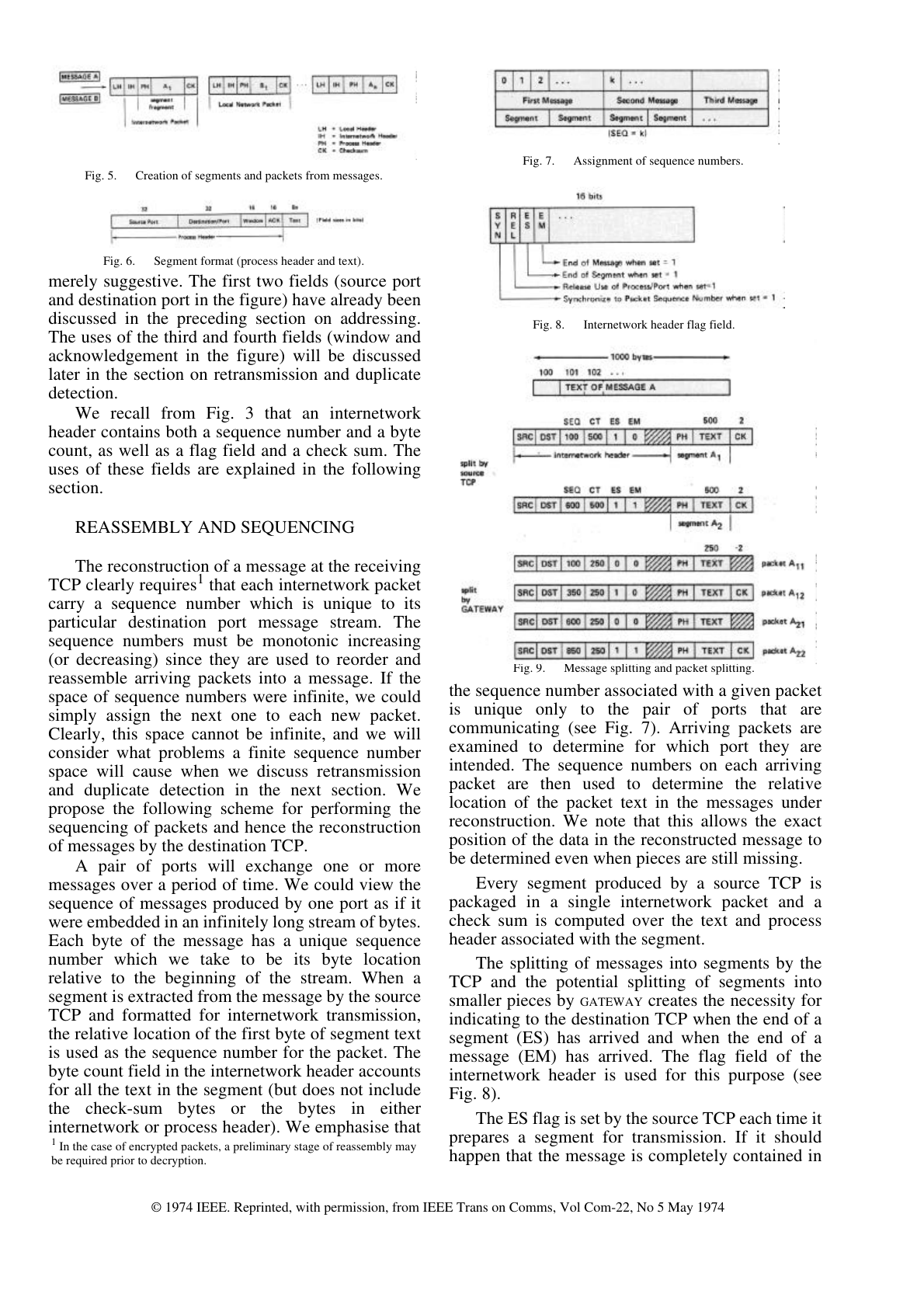
REASSEMBLY AND SEQUENCING
在 receiving TCP reconstruct message 时,显然要求每个 internetwork packet 携带一个 sequence number;这个 sequence number 必须在特定 destination port 的 message stream 内 unique1。
sequence numbers 必须 monotonic increasing(或 monotonic decreasing),因为它们用于把 arriving packets reorder,并把它们 reassemble 成 message。
如果 sequence-number space 是 infinite 的,我们可以简单地为每个 new packet 分配下一个 number。显然,这个 space 不可能 infinite,因此 finite sequence-number space 会导致哪些 problems,需要在后面的 retransmission and duplicate detection 一节讨论。
本文提出如下 scheme,用于对 packets sequencing,从而让 destination TCP 能够 reconstruct messages。
一对 ports 会在一段时间内 exchange 一个或多个 messages。我们可以把一个 port 产生的 messages sequence,看成嵌入一个 infinitely long stream of bytes 中。
每个 message byte 都有一个 unique sequence number;这个 number 是它相对于 stream beginning 的 byte location。
当 source TCP 从 message 中 extract 一个 segment,并将其格式化为 internetwork transmission 时,segment text 的 first byte 的 relative location 被用作 packet 的 sequence number。
internetwork header 中的 byte count field 统计 segment 中的全部 text,但不包括 checksum bytes,也不包括 internetwork header 或 process header 中的 bytes。
必须强调:某个 packet 关联的 sequence number,只在进行通信的那一对 ports 中 unique(见 Fig. 7)。
arriving packets 会先被检查,以确定它们 intended for 哪个 port。随后,TCP 使用每个 arriving packet 的 sequence number,确定 packet text 在正在 reconstruct 的 messages 中的 relative location。
即使某些 pieces 仍然 missing,这也允许准确确定 reconstructed message 中 data 的 exact position。
source TCP 产生的每个 segment 都被打包进一个 single internetwork packet;checksum 则针对该 segment 的 text 和 process header 计算。
TCP 将 messages 拆成 segments,而 GATEWAY 又可能将 segments 拆成 smaller pieces,因此必须有办法告诉 destination TCP:segment 的 end 何时到达,以及 message 的 end 何时到达。
internetwork header 的 flag field 用于此目的(见 Fig. 8)。
每当 source TCP 准备 transmission 一个 segment 时,就设置 ES flag。如果 message 完整地包含在这个 segment 中,那么还会设置 EM flag。
如果 message 无法放入一个 segment,那么 message 的 last segment 也会设置 EM flag。
destination TCP 使用这两个 flags:ES 用于发现给定 segment 的 checksum 存在;EM 用于发现一个 complete message 已经到达。
internetwork header 中的 ES 和 EM flags 对 GATEWAY 可见。当 packet 因为要经过下一个 local network 而必须被 split 时,它们尤其重要。
Fig. 9 说明了它们的使用方式:原始 message A 被 split 成 segments A1 和 A2,并由 TCP 格式化为两个 internetwork packets。A1 和 A2 都设置 ES bit,A2 还设置 EM bit。
当 packet A1 经过 GATEWAY 时,被 split 成两个 pieces:packet A11 不设置 EM 或 ES bits;packet A12 设置 ES bit。类似地,packet A2 被 split 成 packet A21 和 A22:A21 不设置两个 bits,A22 同时设置两个 bits。
GATEWAY 会修改每个 packet 的 sequence number field(SEQ)和 byte count field(CT),以正确标识该 packet 中的 text bytes。GATEWAY 只需要检查 internetwork header 就能执行 fragmentation。
destination TCP reassemble segment A1 后,会检测到 ES flag,并验证它知道包含在 packet A12 中的 checksum。收到 packet A22 后,如果其他 packets 也都已到达,destination TCP 会检测到 complete message 已经 reassembled,并可以通知 destination process message 已收到。
第 7 页:Retransmission、duplicate detection 与 window
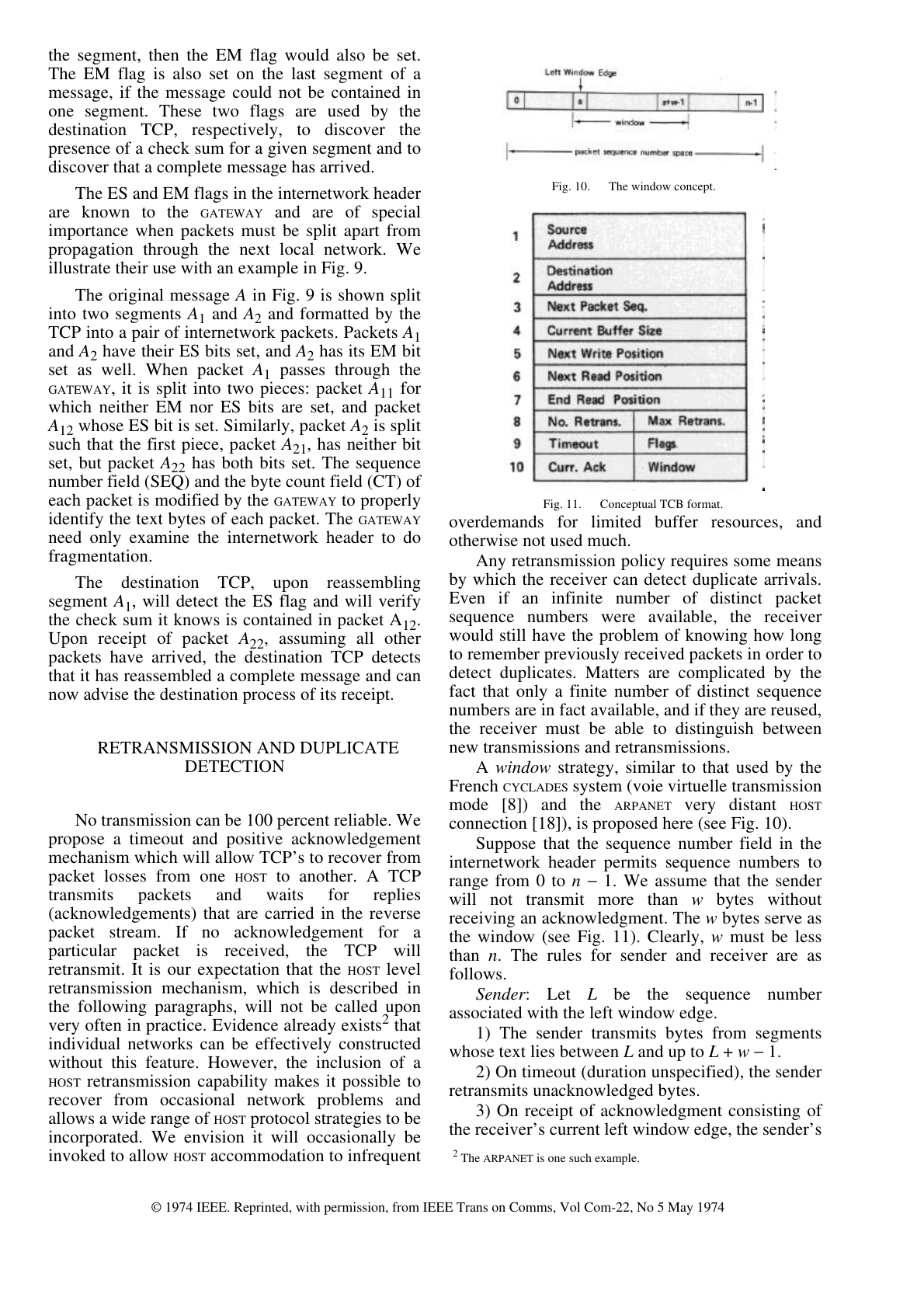
RETRANSMISSION AND DUPLICATE DETECTION
没有任何 transmission 能达到 100 percent reliability。本文提出一种 timeout 和 positive acknowledgement mechanism,使 TCPs 能够从一个 HOST 到另一个 HOST 的 packet loss 中 recovery。
TCP transmission packets,并等待由 reverse packet stream 携带的 replies(acknowledgements)。如果没有收到某个 packet 的 acknowledgement,TCP 就会 retransmit。
作者预期,下面将描述的 HOST-level retransmission mechanism 在实践中不会经常被调用。已经存在 evidence[^2] 表明,individual networks 可以在没有这个 feature 的情况下有效构建。
不过,加入 HOST retransmission capability,可以从 occasional network problems 中 recovery,并允许 incorporate a wide range of HOST protocol strategies。作者预计,它偶尔会被调用,以便 HOST 应对 limited buffer resources 的 infrequent over-demand;除此之外不会经常使用。
任何 retransmission policy 都需要一种让 receiver 检测 duplicate arrivals 的方法。即使有 infinite number of distinct packet sequence numbers,receiver 仍然必须知道应该记住 previously received packets 多久,才能检测 duplicates。
问题还因为实际上只有 finite number of distinct sequence numbers 而变得更复杂:一旦 sequence numbers 被 reuse,receiver 就必须区分 new transmissions 和 retransmissions。
本文提出一种 window strategy,类似于 French CYCLADES system 的 voie virtuelle transmission mode [8] 以及 ARPANET very distant HOST connection [18] 所使用的 strategy(见 Fig. 10)。
假设 internetwork header 中的 sequence-number field 允许 sequence numbers 取值范围为 0 到 n − 1。我们假设 sender 在收到 acknowledgement 之前,最多 transmission w bytes。这 w bytes 构成 window(见 Fig. 11),显然必须满足 w < n。
sender 和 receiver 的 rules 如下。
Sender
令 L 为 left window edge 关联的 sequence number。
- sender transmission text 位于
L到L + w − 1之间的 segments 中的 bytes。 - timeout 发生时(duration 未指定),sender retransmit 尚未 acknowledged 的 bytes。
- 当收到由 receiver 当前 left window edge 组成的 acknowledgement 时,sender 把 left window edge 向前推进,越过已经 acknowledged 的 bytes;right window edge 也会 implicit 地前移。
第 8 页:Receiver rules、flow control 与 TCP I/O
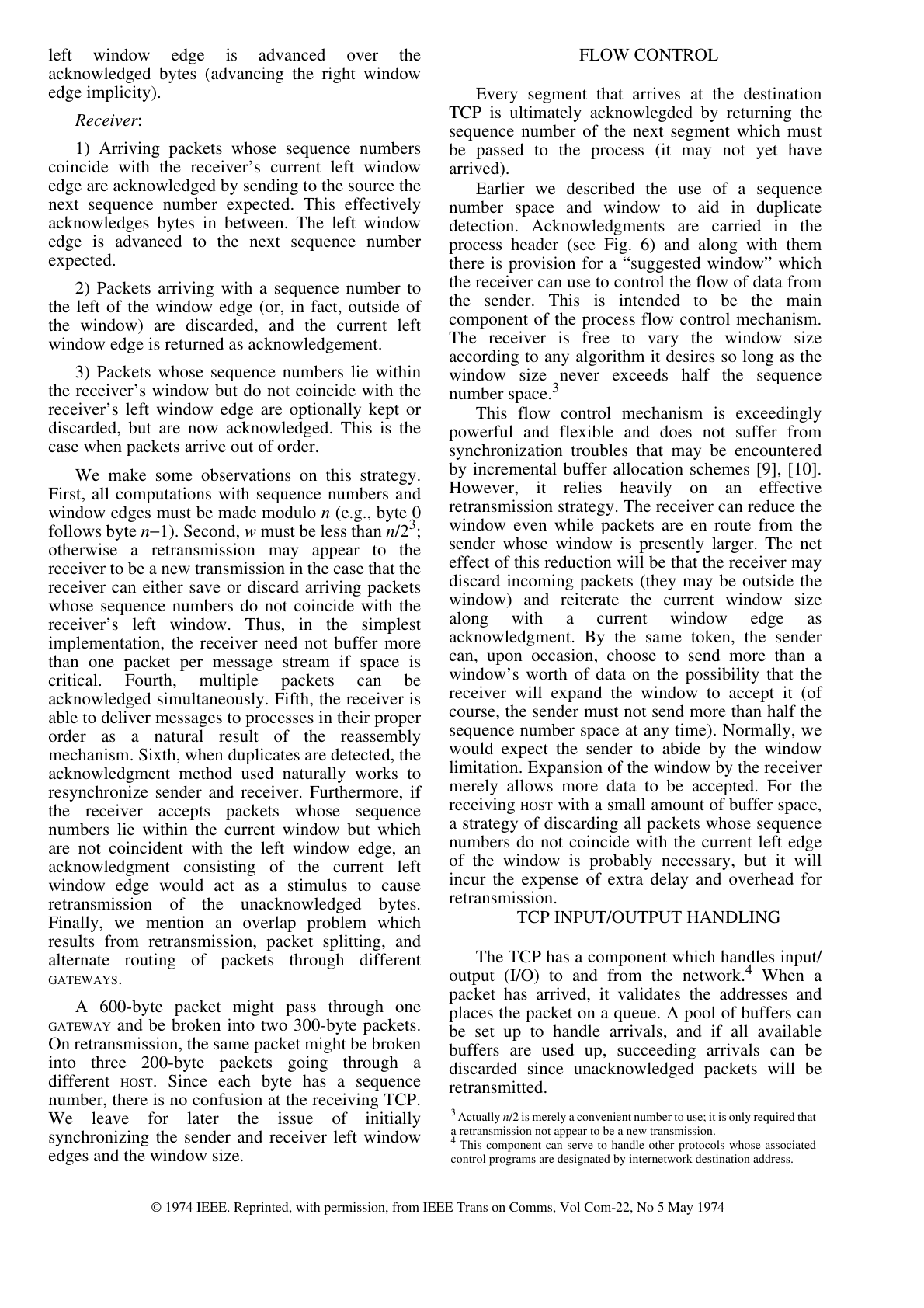
Receiver
- sequence numbers 与 receiver 当前 left window edge coincidence 的 arriving packets,会通过向 source 发送 next expected sequence number 得到 acknowledgement。这实际上 acknowledge 了中间的 bytes;left window edge 被推进到 next expected sequence number。
- sequence number 位于 window edge 左侧(或者事实上位于 window 之外)的 packets 会被 discard,同时返回当前 left window edge 作为 acknowledgement。
- sequence numbers 位于 receiver window 内、但不与 receiver left window edge coincidence 的 packets,可以被 optional 地保留或 discard,但现在会被 acknowledged。这就是 packets out of order arrival 的情况。
我们对这一 strategy 做如下 observations。
首先,所有关于 sequence numbers 和 window edges 的 computations 都必须 modulo n 进行。例如,byte 0 紧跟在 byte n − 1 后面。
其次,w 必须小于 n/2[^3];否则,当 receiver 可以选择保存或 discard sequence number 不与 receiver left window coincidence 的 arriving packets 时,某个 retransmission 可能被 receiver 误认为是 new transmission。
因此,在最简单的 implementation 中,如果 space 紧张,receiver 无需为每个 message stream buffer 多于一个 packet。
第四,多个 packets 可以被 simultaneously acknowledged。第五,receiver 能够作为 reassembly mechanism 的 natural result,按正确 order 向 processes delivery messages。第六,检测到 duplicates 时,所使用的 acknowledgement method 能够自然地 resynchronize sender 和 receiver。
此外,如果 receiver 接受 sequence numbers 位于 current window 内、但不与 left window edge coincidence 的 packets,那么由 current left window edge 构成的 acknowledgement 会作为 stimulus,促使 sender retransmit 尚未 acknowledged 的 bytes。
最后,作者提到一个由 retransmission、packet splitting 和 packets 经过不同 GATEWAYS alternate routing 导致的 overlap problem。
一个 600-byte packet 可能经过某个 GATEWAY,被拆成两个 300-byte packets。retransmission 时,同一个 packet 可能经过不同的 HOST,被拆成三个 200-byte packets。由于每个 byte 都有 sequence number,receiving TCP 不会产生 confusion。
至于如何 initially synchronize sender 与 receiver 的 left window edges 和 window size,本文留待后文讨论。
脚注 2:ARPANET 是具备这种能力的一个 example。
FLOW CONTROL
每个抵达 destination TCP 的 segment,最终都会通过返回“下一个必须 delivery 给 process 的 segment”的 sequence number 得到 acknowledgement;这个 segment 也许还没有到达。
前文描述了如何使用 sequence-number space 和 window 来帮助 duplicate detection。acknowledgements 携带在 process header 中(见 Fig. 6);process header 同时提供一个 “suggested window”,receiver 可以用它来控制 sender 的 data flow。
这 intended to be process flow-control mechanism 的 main component。receiver 可以按照它想要的任何 algorithm 改变 window size,只要 window size 永远不超过 sequence-number space 的一半即可[^4]。
这种 flow-control mechanism 非常 powerful 和 flexible,而且不会遭遇 incremental buffer allocation schemes [9]、[10] 可能产生的 synchronization troubles。
但它高度依赖 effective retransmission strategy。即使 packets 正在从当前 window 较大的 sender 途中,receiver 也可以 reduce window。
这种 reduction 的 net effect 是:receiver 可能 discard incoming packets(因为它们落在 window 之外),并把 current window size 连同 current window edge 作为 acknowledgement 再次发送。
同理,sender 有时可以选择发送超过一个 window 的 data,赌 receiver 会 expand window 来接受它;当然,sender 在任何时刻都不得发送超过 half of the sequence-number space 的 data。
通常我们期望 sender 遵守 window limitation。receiver 扩展 window,只是允许更多 data 被接受。
对于 buffer space 很少的 receiving HOST,discard 所有 sequence numbers 不与当前 left window edge coincidence 的 packets,可能是必要 strategy;但这会付出额外 retransmission 的 delay 和 overhead。
TCP INPUT/OUTPUT HANDLING
TCP 有一个 component,负责处理 network 的 input/output(I/O)[^5]。packet 到达时,这个 component 验证 addresses,并把 packet 放进 queue。
可以建立一个 buffer pool 来处理 arrivals。如果所有 available buffers 都已使用,后续 arrivals 可以直接 discard,因为尚未 acknowledged 的 packets 会被 retransmit。
第 9 页:Buffering、delivery conditions 与 TCB/RCB
在 output 方向,需要的 buffering 较少,因为 process buffers 可以容纳待 transmission 的 data。也许 double buffering 就足够了。
本文不规定 buffering 应如何实现,只要求它能够以尽可能小的 overhead service network。packet-sized buffers、一个或多个 ring buffers,或其他任意组合,都可以作为 candidates。
packet 到达 destination TCP 时,被放入一个 TCP 经常 service 的 queue。例如,当 packet 被放入 queue 时,可以 interrupt TCP。
然后 TCP 尝试把 packet text 放入适当 process receive buffer 的正确位置。如果 packet 终止一个 segment,那么 TCP 可以计算 checksum 并进行 acknowledgement。
placement 可能因以下原因失败:
- destination process 尚未准备好从 stated source receive,或者 destination port ID 不存在。
- 没有足够的 buffer space 容纳 text。
- text 的 beginning sequence number 不等于下一个应 delivery 给 process 的 sequence number,例如 packet out of order arrival。
在第一种情况下,TCP 应该简单地 discard packet(到目前为止,本文尚未为 error acknowledgements 做 provision)。
在第二和第三种情况下,可以检查 packet sequence number,判断 packet text 是否处于合法 reception window 内。如果是,TCP 可以 optional 地将 packet 保持在 queue 中,稍后处理;如果不是,TCP 可以 discard packet。
无论哪种情况,TCP 都可以 optional 地使用 current left window edge 做 acknowledgement。
process receive buffer 可能不在 HOST 的 active memory 中,而是存储在 secondary storage 上。如果是这样,TCP 可以 prompt scheduler 把相应 buffer 调入,然后把 packet queue 起来,稍后处理。
如果 TCP 没有更多 input buffers 用于临时 queue incoming packets,而且 TCP 不能快速使用 arriving data(例如 TCP-to-TCP message),那么 packet 会被 discard。
假设 system 运作 sensibly,这种 discard 不应影响 intended process 之外的其他 processes。如果 delayed-processing queue 过度增长,那么其中的 packets 都可以安全 discard,因为这些 packets 尚未被 acknowledged。
由于 robust retransmission 和 duplicate-detection strategy,TCP-level congestion 可以被 flexible 地处理。
TCP/PROCESS COMMUNICATION
为了发送 message,process 在自己的 address space 中的 buffer region 准备 text,把 requisite control information(下面列出)放入 transmit control block(TCB),然后把 control 交给 TCP。
TCB 的 exact form 没有被规定;它可以表现为传递的 pointer、pseudo-interrupt 或各种其他形式。
为了在自己的 address space 中接收 message,process 准备 receive buffer,把 requisite control information 放入 receive control block(RCB),再次把 control 交给 TCP。
在一些 simple systems 中,buffer space 事实上可以由 TCP 提供。为简单起见,本文假设每个 process 使用一个 ring buffer,但也不排除 buffer chaining 等其他 structures。
Fig. 11 展示了一种 possible TCB format。TCB 包含 TCP extract 并发送 process data 所需的信息。某些 information 可能已经被 implicit 地知道,但本文不讨论这一层 detail。
TCB fields 如下:
- Source Address:transmitter 的完整 net/HOST/TCP/port address。
- Destination Address:receiver 的完整 net/HOST/TCP/port address。
- Next Packet Sequence Number:TCP 将从该 port transmission 的下一个 packet 要使用的 sequence number。
- Current Buffer Size:process transmit buffer 的当前 size。
- Next Write Position:process 可以在 buffer 中放置新 transmission data 的下一个 position address。
- Next Read Position:TCP 应开始读取、以构造下一个 output segment 的 address。
- End Read Position:TCP 应停止 transmission 的 address。最初,6 和 7 共同 bound process 希望 transmission 的 message。
- Number of Retransmissions / Maximum Retransmissions:让 TCP 记录 data retransmitted 次数的 fields;如果 TCP 不应 give up,则这些 fields 可以省略。
- Timeout / Flags:timeout field 指定未 acknowledged data 应被 retransmit 前的 delay;flag field 用于 semaphores 以及其他 TCP/process synchronization status reporting 等。
- Current Acknowledgment / Window:current acknowledgment field 标识 destination TCP 尚未 acknowledge 的 first byte of data。
第 10 页:TCB buffer layout、connections 与 associations
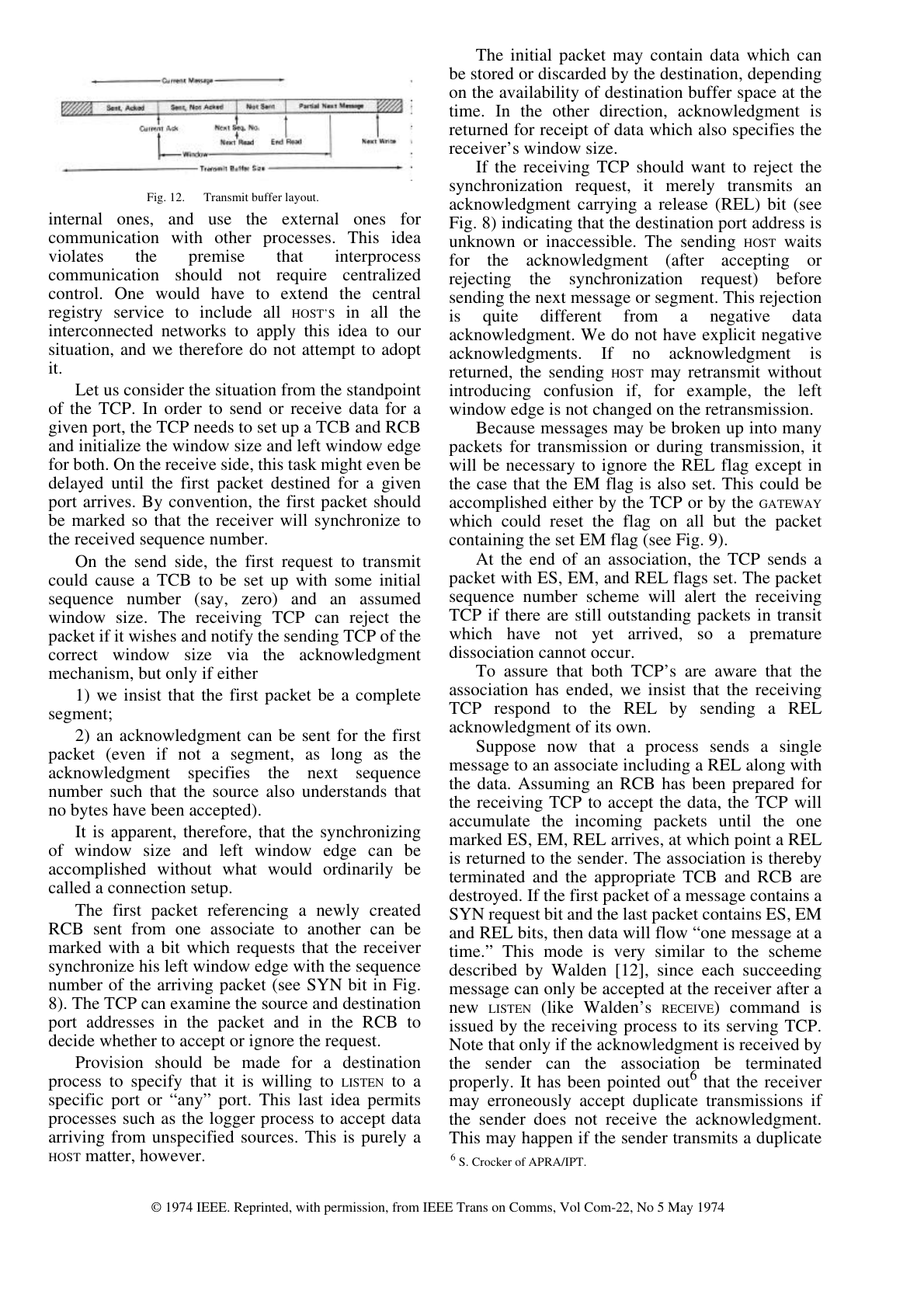
write position 和 read position 在 transmit buffer 中 circularly 移动;write position 总是位于 read position 的左侧(对 buffer size 取 modulo)。
next packet sequence number 应被约束为小于或等于 current acknowledgment 与 window fields 之和。
无论如何,为避免混淆 receiver 的 duplicate-detection algorithm,next sequence number 不应超过 current acknowledgment 加上 maximum possible sequence number 的一半。
Fig. 12 展示了一种 possible buffer layout。
RCB 与 TCB 基本相同,只是 end read field 被 partial segment checksum register 替换。这个 register 允许 receiving TCP 在一个 segment 分成多个 packets 到达时,计算并记住 partial checksums。
当 segment 的 final packet 到达时,TCP 可以 verify checksum;如果 verification 成功,就 acknowledge 这个 segment。
CONNECTIONS AND ASSOCIATIONS
在 packet-switched networks 中,人们对 process-to-process communication 的大量 thinking 受到 ubiquitous telephone system 的影响。
ARPANET 的 HOST-HOST protocol 明确处理 processes 之间 simplex connections 的 opening 和 closing [9]、[10]。
已有 evidence 表明,可以构造 message-based 的 “connection-free” protocols [12];因此,我们需要仔细考察 connection 这一 notion。
connection 这个 term 有许多 meanings。它可以指两个 entities 之间的 physical 或 logical path;可以指沿着该 path 的 flow;可以隐含指建立 path 的 action;也可以指两个或更多 entities 之间的 association,而不论它们之间是否存在 path。
本文并不明确 reject connection 这个 term,因为它已经被广泛使用,也确实表示一种有意义的 relation;但本文只把它理解为两个或更多 entities 之间、与 path 无关的 association。
更精确地说,我们把两个或更多正在 communication、或准备 communication 的 ports 之间的 relationship 定义为一个 association。彼此 associated 的 ports 称为 associates。
显然,要让两个 processes 进行任何 communication,其中一个必须能够 address 另一个。这里有两种重要 cases:destination port 可能具有 global 且 unchanging 的 address;也可能具有 globally unique、但会 dynamic reassigned 的 address。
在两种 cases 中,sender 都可能必须根据 destination name 学习 destination address;但只有第二种 case 要求每当希望建立 association 时,都从 destination(或其 representative)处学习 address。
只有当 source 学会如何 address destination 后,才可以说 association 已经发生。但这还不够。
如果还希望按顺序 delivery messages,那么两个 TCP 都必须维护足够的信息,以正确执行 sequencing。当两端都具备这些 information 时,才能说 association 已经发生。
注意,我们没有说 path,也没有说任一端必须知道另一端的 condition。只有当两个 partners 都准备好彼此 communication 时,association 才算发生;并且在 data 在它们之间 flow 之前,双方都可能无法 verify association 已存在。
CONNECTION-FREE PROTOCOLS WITH ASSOCIATIONS
在 ARPANET 中,interface message processors(IMP’s)不必从 source 到 destination opening 和 closing connections。原因是,connections 实际上始终 open:每个 source 和 destination 的 address 永远不会被 reassigned[^6]。
当 name 和 place static 且 unchanging 时,只需给 packet 标注 source 和 destination,就能通过 network transmission packet。用本文的 terminology,每个 source 和 destination 都形成一个 association。
但在 process case 中,我们发现 port addresses 会不断被使用和 reuse。一些始终存在的 processes 可能被分配 fixed addresses(例如 logger process)。
如果假设每个 TCP 都有无限 supply 的 port addresses,保证 old address 永远不会被 reuse,那么每个 newly created port 都可以获得下一个 unused address。
在这种 environment 中,source 和 destination TCP 永远不会对每条 message 的 intended recipient 或 implied source 产生 confusion;所有 ports 都是 associates。
遗憾的是,TCP(或者更准确地说,operating systems)通常没有无限的 internal port addresses。每个 port 消亡后,internal addresses 会被 reassign。
Walden [12] 建议,可以由 central registry 提供一组 unique、uniform 的 external port addresses。新创建的 port 可以向 central registry 申请一个 address,central registry 保证该 address 尚未被 network 中的任何 HOST system 使用。
每个 TCP 可以维护 external names 与 internal names 的 matching tables,并使用 external names 与其他 processes 通信。
但这个 idea 违反了 interprocess communication 不应要求 centralized control 的 premise。若要使这个 idea 适用于我们的 scenario,就必须把 central registry service 扩展到所有 interconnected networks 中的所有 HOSTS;因此我们不采用它。
第 11 页:Association synchronization、SYN 与 LISTEN
现在从 TCP 的 standpoint 考察这个 situation。
为了为给定 port send 或 receive data,TCP 需要 setup 一个 TCB 和一个 RCB,并初始化两端的 window size 和 left window edge。
在 receive side,这个 task 甚至可以延迟到第一个 destined for 给定 port 的 packet 到达之后。按照 convention,第一个 packet 应当被标记,使 receiver 能够与收到的 sequence number synchronize。
在 send side,第一个 transmission request 可能导致 TCP setup 一个 TCB,使用某个 initial sequence number(例如 zero)以及 assumed window size。
如果 receiver 愿意,receiving TCP 可以 reject packet,并通过 acknowledgement mechanism 通知 sending TCP 正确的 window size;但必须满足以下两种条件之一:
- 要求 first packet 是一个 complete segment;
- 允许针对 first packet 发送 acknowledgement,即使 first packet 还不是 complete segment,只要 acknowledgement 指定 next sequence number,使 source 也理解没有 bytes 被 accepted。
因此很明显,window size 和 left window edge 的 synchronization 可以在没有通常意义上的 connection setup 的情况下完成。
从一个 associate 发给另一个 associate、并 reference 新建 RCB 的 first packet,可以设置一个 bit,请求 receiver 将自己的 left window edge 与 arriving packet 的 sequence number synchronize(见 Fig. 8 中的 SYN bit)。
TCP 可以检查 packet 中的 source 和 destination port addresses,并与 RCB 中的 addresses 对比,以决定接受还是 ignore 这个 request。
应当允许 destination process 指定:它愿意 LISTEN 某个 specific port,或者 LISTEN “any” port。后一个 idea 允许 logger process 等 processes 接收来自 unspecified sources 的 data。不过,这完全是 HOST 的 matter。
initial packet 可能包含 data。destination 可以根据当时 destination buffer space 是否 available,选择存储或 discard 这些 data。
在另一方向,acknowledgment 会针对 data 的 receipt 返回,并且同时指定 receiver 的 window size。
如果 receiving TCP 希望 reject synchronization request,只需 transmission 一个携带 REL bit 的 acknowledgement(见 Fig. 8)。REL 表示 destination port address unknown 或 inaccessible。
第 12 页:REL、association lifetime 与 conclusions
sending HOST 在接受或 reject synchronization request 后等待 acknowledgement,然后才会发送下一个 message 或 segment。
这种 rejection 与 negative data acknowledgement 截然不同。本文没有 explicit negative acknowledgements。
如果没有 acknowledgement 返回,sending HOST 可以 retransmit;例如,只要 left window edge 在 retransmission 时没有改变,就不会引入 confusion。
由于 messages 可能在 transmission 过程中或 transmission 之前被拆成许多 packets,因此必须忽略 REL flag,除非 EM flag 也同时 set。
这可以由 TCP 完成,也可以由 GATEWAY 完成:GATEWAY 把除设置 EM flag 的 packet 之外的所有 packets 上的 REL flag reset(见 Fig. 9)。
在 association 结束时,TCP 发送一个同时设置 ES、EM 和 REL flags 的 packet。
packet sequence-number scheme 会在仍有 outstanding、尚未到达的 packets 时提醒 receiving TCP,因此不会发生 premature dissociation。
为了确保两个 TCP 都知道 association 已经 ended,我们要求 receiving TCP 对 REL 做出 response,发送它自己的 REL acknowledgement。
现在假设 process 向一个 associate 发送一条 single message,并在 data 中包含 REL。假设 receiving TCP 已经准备好 RCB 来接受 data,那么 TCP 会 accumulate incoming packets,直到带有 ES、EM、REL 的 packet 到达。
此时,TCP 向 sender 返回 REL。association 于是 terminated,适当的 TCB 和 RCB 被 destroyed。
如果 message 的 first packet 包含 SYN request bit,而 last packet 包含 ES、EM 和 REL bits,那么 data 就会以 “one message at a time” 的 mode flow。
这种 mode 与 Walden [12] 描述的 scheme 非常相似,因为 receiver process 必须向它所服务的 TCP 发出新的 LISTEN(类似 Walden 的 RECEIVE)command 后,receiver 才能接受下一条 message。
注意,只有 sender 收到 acknowledgement,association 才能正确 terminated。
有人已经指出[^7]:如果 sender 没有收到 acknowledgement,receiver 可能错误地接受 duplicate transmissions。
例如,sender 发送一条带有 SYN 和 REL bits 的 duplicate message,而 destination 已经 destroy 了上一次 transmission 的 record,此时就可能发生这个问题。
一种防止该问题的方法,是只有经过一个 known 且 suitably chosen timeout 后,才 destroy destination 中 association 的 record。不过,这意味着使用相同 source 和 destination port identifiers 的新 association,要等到这个 timeout expired 后才能 establish。
即使在 SYN 和 REL bits 被拆到不同 internetwork packets 中的 message sequences 里,也可能出现这个问题。作者承认必须解决它,但本文不再展开细节。
另一种方案是两个 processes 各自发送一条 message,促使两端 TCP 分别 allocate RCB/TCB pairs;这些 pairs 会与 exchanged data rendezvous,然后消失。
如果创建和销毁 RCBs 与 TCBs 的 overhead 很小,这种 protocol 可能足以支持大多数 low-bandwidth uses。
这个 idea 也可能成为一种相对 secure transmission system 的 basis。如果 communicating processes 同意以某种只有它们彼此知道的方式(例如 pseudorandom 方式)改变 external port addresses,那么每条 message 在外部看来都会像属于不同的 association message stream。
即使第三方 intercept data,他也无法知道这些 data 实际上应被视为一个 message sequence 的一部分。
本文描述了 processes 如何彼此建立 associations,从而成为可以交换 data 的 associates。
这些 associations 不一定要求在形成之前传输 data;事实上,两个 associates 甚至可能要等到尝试通信时,才能确定自己确实是 associates。
CONCLUSIONS
本文讨论了 interconnection of packet switching networks 的一些 fundamental issues。
具体来说,本文描述了一种 simple、powerful 且 flexible 的 protocol。它支持 individual networks 在 packet size 上的差异、transmission failures、sequencing、flow control,以及 process-to-process associations 的 creation 和 destruction。
本文还考察了由此产生的 implementation issues,并发现 proposed protocol 可以由 capacity 差异很大的 HOSTS 实现。
下一项重要工作,是产生 protocol 的 detailed specification,以便对它进行 initial experiments。
这些 experiments 需要确定 operational parameters,例如 packets 实际以多高 frequency、以多大的 out-of-order 程度到达;segment acknowledgements 之间存在什么样的 delay;以及 retransmission timeouts 应该设为多少。
ACKNOWLEDGMENT
作者感谢许多 colleagues 在 international network protocols 的早期 discussions 中提供 helpful comments,尤其感谢 R. Metcalfe、R. Scantlebury、D. Walden 和 H. Zimmerman;感谢 D. Davies 和 L. Pouzin 对 fragmentation 与 accounting issues 提供 constructive comments;并感谢 S. Crocker 对 associations creation 和 destruction 提供 comments。
本文页脚脚注:[^2] ARPANET 是 HOST-level retransmission capability 的 example;[^3] 实际上 n/2 只是一个 convenient number,真正的 requirement 是 retransmission 不能被 receiver 误认为 new transmission;[^4] 这个 I/O component 也可以处理其他 protocols,只要它们关联的 control programs 能由 internetwork destination address 指定;[^5] 除非 IMP 被 physically moved 到另一个 site,或 HOST 连接到另一个 IMP;[^6] 原文将该 comment 归给 S. Crocker of APRA/IPT。
第 13 页:References 与作者简介
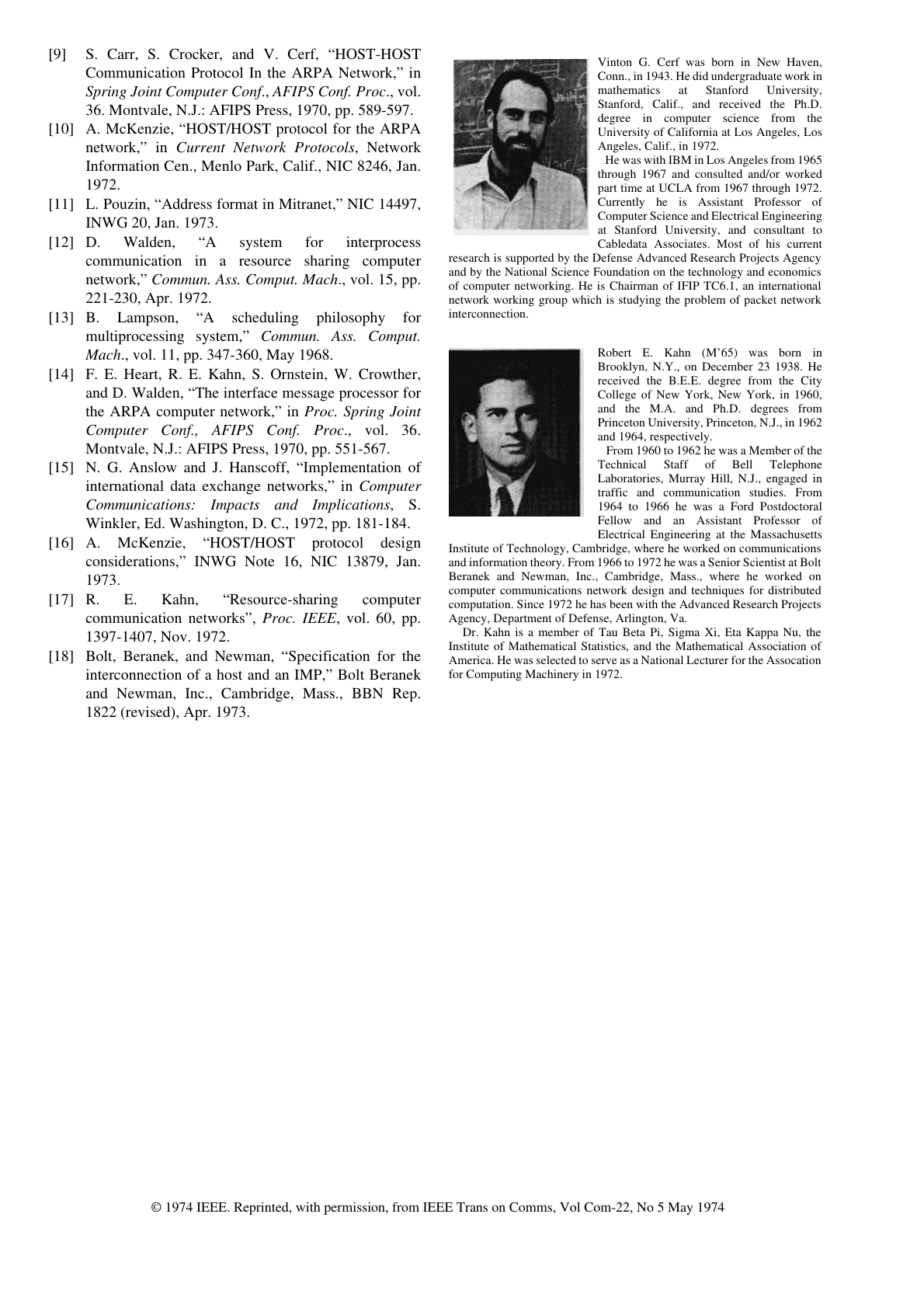
References
- L. Roberts;B. Wessler. “Computer network development to achieve resource sharing.” 1970 Spring Joint Computer Conference,AFIPS Conference Proceedings,Vol. 36,AFIPS Press,1970,pp. 543–549。
- L. Pouzin. “Presentation and major design aspects of the CYCLADES computer network.” Proceedings of the 3rd Data Communications Symposium,1973。
- F. R. E. Dell. “Features of a proposed synchronous data network.” Proceedings of the 2nd Symposium on Problems in the Optimization of Data Communications Systems,1971,pp. 50–57。
- R. A. Scantlebury;P. T. Wilkinson. “The design of a switching system to allow remote access to computer services by other computers and terminal devices.” Proceedings of the 2nd Symposium on Problems in the Optimization of Data Communications Systems,1971,pp. 160–167。
- D. L. A. Barber. “The European computer network project.” 收录于 Computer Communications: Impacts and Implications,S. Winkler 编,Washington, D.C.,1972,pp. 192–200。
- R. Despres. “A packet switching network with graceful saturated operation.” 收录于 Computer Communications: Impacts and Implications,S. Winkler 编,Washington, D.C.,1972,pp. 345–351。
- R. E. Kahn;W. R. Crowther. “Flow control in a resource-sharing computer network.” IEEE Transactions on Communications,Vol. COM-20,pp. 539–546,June 1972。
- J. F. Chambon、M. Elie、J. Le Bihan、G. Le Lann、H. Zimmerman. “Functional specification of transmission station in the CYCLADES network. ST-ST protocol.”(法文)I.R.I.A. Technical Report SCH502.3,May 1973。
- S. Carr、S. Crocker、V. Cerf. “HOST-HOST Communication Protocol in the ARPA Network.” Spring Joint Computer Conference,AFIPS Conference Proceedings,Vol. 36,1970,pp. 589–597。
- A. McKenzie. “HOST/HOST protocol for the ARPA network.” 收录于 Current Network Protocols,Network Information Center,Menlo Park,California,NIC 8246,January 1972。
- L. Pouzin. “Address format in Mitranet.” NIC 14497,INWG 20,January 1973。
- D. Walden. “A system for interprocess communication in a resource sharing computer network.” Communications of the ACM,Vol. 15,pp. 221–230,April 1972。
- B. Lampson. “A scheduling philosophy for multiprocessing system.” Communications of the ACM,Vol. 11,pp. 347–360,May 1968。
- F. E. Heart、R. E. Kahn、S. Ornstein、W. Crowther、D. Walden. “The interface message processor for the ARPA computer network.” Proceedings of the Spring Joint Computer Conference,AFIPS Conference Proceedings,Vol. 36,1970,pp. 551–567。
- N. G. Anslow;J. Hanscoff. “Implementation of international data exchange networks.” 收录于 Computer Communications: Impacts and Implications,S. Winkler 编,Washington, D.C.,1972,pp. 181–184。
- A. McKenzie. “HOST/HOST protocol design considerations.” INWG Note 16,NIC 13879,January 1973。
- R. E. Kahn. “Resource-sharing computer communication networks.” Proceedings of the IEEE,Vol. 60,pp. 1397–1407,November 1972。
- Bolt, Beranek, and Newman. Specification for the interconnection of a host and an IMP. Bolt Beranek and Newman, Inc.,Cambridge,Massachusetts,BBN Report 1822(revised),April 1973。
作者简介(按原文末页)
Vinton G. Cerf
Vinton G. Cerf 1943 年出生于 Connecticut 州 New Haven。他在 Stanford University 学习 mathematics,1972 年获得 University of California at Los Angeles 的 computer science Ph.D.。
1965–1967 年,他在 IBM 位于 Los Angeles 的机构工作;1967–1972 年,他在 UCLA 担任 consultant 和/或 part-time worker。
在本文发表时,他是 Stanford University Computer Science and Electrical Engineering 的 Assistant Professor,也是 Cabledata Associates 的 consultant。他当前的多数 research 由 Defense Advanced Research Projects Agency 和 National Science Foundation 支持,主题包括 computer networking 的 technology 和 economics。
他是 IFIP TC6.1 的 Chairman;该 international network working group 正在研究 packet network interconnection 问题。
Robert E. Kahn
Robert E. Kahn 1938 年 12 月 23 日出生于 New York 州 Brooklyn。1960 年,他在 City College of New York 获得 B.E.E. degree;1962 年和 1964 年,他分别在 Princeton University 获得 M.A. 和 Ph.D. degrees。
1960–1962 年,他是 Bell Telephone Laboratories 位于 Murray Hill 的 Technical Staff Member,从事 traffic 和 communication studies。1964–1966 年,他是 Ford Postdoctoral Fellow,并在 Massachusetts Institute of Technology 担任 Assistant Professor of Electrical Engineering,从事 communications 和 information theory 工作。
1966–1972 年,他是 Bolt Beranek and Newman, Inc. 位于 Cambridge 的 Senior Scientist,研究 computer communications network design 和 distributed computation techniques。
自 1972 年起,他任职于 Advanced Research Projects Agency,Department of Defense,Arlington。
Dr. Kahn 是 Tau Beta Pi、Sigma Xi、Eta Kappa Nu、Institute of Mathematical Statistics 和 Mathematical Association of America 的 member。1972 年,他被选为 Association for Computing Machinery 的 National Lecturer。
协议机制索引
| 机制 | 解决的问题 | 本文的责任边界 |
|---|---|---|
| GATEWAY | 把不同 packet switching strategies 的 networks 连接起来 | 负责 route、format conversion、accounting、必要时 fragmentation;不负责 end-to-end reassembly |
| Internetwork header | 让不同 networks 的 GATEWAYS 识别 packet 的 source、destination 和控制信息 | source HOST 加入;GATEWAY 转发并只按需要修改 sequence/byte-count 等字段 |
| Fragmentation | individual networks 的 maximum packet sizes 不同 | GATEWAY 在进入较小 packet-size network 时 split;destination HOST reassemble |
| Process header | 让 destination TCP 直接找到目标 process,避免共享 byte stream interference | 每个 packet 假设只携带一个 source process 到一个 destination process 的 text |
| Sequence number | 乱序 packet 的定位、message reassembly 和 duplicate detection | 在 destination port 的 message stream 内有意义;按 byte location 分配 |
| Window | 限制未 acknowledged data、控制 flow 并区分 retransmission | sender 遵守 window;receiver 返回 left edge 和 suggested window |
| Positive acknowledgement | 让 sender 发现 packet loss 并触发 retransmission | acknowledgement 携带在 reverse packet stream 或 process header 中 |
| SYN / REL | 初始化和结束 association | SYN synchronizes left window edge;REL 释放 association,需 REL acknowledgement |
| Association | 不依赖固定 path 地定义两个 ports 的通信关系 | 两端具备 addressing 和 sequencing state 后成立 |
设计判断与边界
- GATEWAY 的 interface 应保持 small and reliable:如果 GATEWAY 试图转换所有 HOST/process protocols,它就会被迫理解不断增长且彼此不兼容的 semantics;本文把共同的 process-level protocol 放到 HOST/TCP 侧。
- fragmentation 与 reassembly 分离:GATEWAY 只掌握进入下一个 network 所需的 packet-size information,而 destination HOST 才能承担跨多个 GATEWAYS、多个 paths 的完整 reassembly;把 reassembly 放到 GATEWAY 会增加 buffering、deadlock、same-path 和 delay 风险。
- packet-level checksum 不是 end-to-end correctness 的替代物:GATEWAY forward trailing checksum,不重算它;最终的 receiving TCP 根据 segment text 和 process header 验证 checksum。
- 每个 packet 携带 process header 的代价:相对于共享 TCP-to-TCP byte stream,Case 2 需要更多 header information,但避免了 gaps、out-of-order packet 和多个 processes 之间的 parsing interference。
- window 同时承担多个职责:它限制 sender 未确认的 bytes,帮助 receiver 判断 duplicate/retransmission,还允许 receiver 通过 suggested window 调整 flow。window space 必须与 sequence-number reuse 的 ambiguity 一起设计。
- association 不等于 path 或在线连接:两端可以形成与固定 path 无关的 addressing/sequencing relationship;甚至在 data flow 之前,双方都不一定能确认 association 已成立。
本篇验收
- [x] 已固定 1974 IEEE 论文版本:13 页,SHA-256 为
f7c614a116516e0efec906885fa3ffd9261c5101900d117b72d26d92de96d2f1。 - [x] 已按 PDF 页序保留第 1–13 页原始页面图;每页图与对应中文译文按页顺序排列。
- [x] 已保留原页面 copyright/reprint 声明、Fig. 1–12、脚注、Acknowledgment、18 条 References 和作者简介。
- [x] 已覆盖 Abstract、Introduction、GATEWAY notion、internetwork packet format、fragmentation/accounting、process-level communication、Case 1/Case 2、address formats、TCP/port addressing、segment/packet format、reassembly/sequencing、retransmission、duplicate detection、window、flow control、TCP I/O、TCB/RCB、connections/associations、connection-free protocol、SYN/REL、Conclusions。
- [x] 已补充术语表、协议机制索引、设计判断与历史版本边界分析。
参考资料
-
如果 packets 是 encrypted 的,可能需要先进行 preliminary reassembly,再执行 decryption。 ↩
评论 (0)