论文:Distributed Snapshots: Determining Global States of Distributed Systems
本篇整理 K. Mani Chandy 与 Leslie Lamport 的《Distributed Snapshots: Determining Global States of Distributed Systems》。每一页保留 Microsoft Research / ACM 官方 PDF 的原始页面图;页面图保留原文排版、Figure、state-transition diagram、公式、伪代码、脚注、版权声明和 References,下面严格按 PDF 页序给出中文译文。global state、channel state、marker、stable property、consistent cut、snapshot 等术语按语境保留 English 或中英并列。
论文:Distributed Snapshots: Determining Global States of Distributed Systems
相关文章:论文:Time, Clocks, and the Ordering of Events in a Distributed System · 6.5840:Lecture 04 Fault-Tolerant Agreement and Paxos · 6.5840:Lecture 06 RSM and Raft 1
TL;DR
- 问题:在没有 shared clock、shared memory、也不暂停 underlying computation 的情况下,记录 distributed system 的一个有意义的 global state。
- 模型:processes 通过可靠、FIFO、finite-delay 的 directed channels 通信;global state 由所有 process states 与 channel states 组成。
- 核心算法:process 记录自己的 state,然后沿 outgoing channels 发送 marker;第一次收到 marker 的 process 记录自己的 state,并把该 channel 记录为空;已经记录 state 的 process 则把 marker 之前收到的 messages 记为 channel state。
- 正确性:marker 诱导出的 recorded global state 不一定曾经作为实际瞬间出现,但它位于某个 computation 的可达状态序列中;因此可以用于检测 stable property。
- 用途:termination detection、deadlock detection、token disappearance、checkpoint/restart,以及任何可以表达为 stable property 的全局判断。
名词解释
| 名词 | 含义 | 本文译法 |
|---|---|---|
| global state | 所有 process states 与 channel states 的集合 | global state;全局状态 |
| channel state | 已发送但尚未被接收的 messages sequence | channel state;通道状态 |
| stable property | 一旦为 true,之后所有 reachable global states 中仍为 true 的 property | stable property;稳定性质 |
| snapshot | 记录各 process 与各 channel 的 global state | snapshot;快照 |
| marker | 不改变 underlying computation、用于划定 channel recording 边界的特殊 message | marker;标记消息 |
| consistent global state | 能够在某个合法 computation 中出现的 process/channel states 组合 | consistent global state;一致全局状态 |
| prerecording event | process 记录自己 state 之后发生的 event | prerecording event |
| postrecording event | process 记录自己 state 之前发生的 event | postrecording event |
y(S) | 在 global state S 上计算 stable property 的 Boolean predicate | property predicate |
目录
| 章节 | 内容 |
|---|---|
| 版本与来源 | 论文出版信息、官方 PDF 与固定边界 |
| 原文页面与逐页翻译 | 13 个 PDF 页面按原页保留并翻译 |
| 机制索引 | marker algorithm、consistent state 与 stable-property detection |
| 本篇验收 | 页数、图片、算法、定理与 References 覆盖范围 |
版本与来源
- 论文标题:Distributed Snapshots: Determining Global States of Distributed Systems。
- 作者与机构:K. Mani Chandy,University of Texas at Austin;Leslie Lamport,Stanford Research Institute。
- 发表信息:ACM Transactions on Computer Systems,Vol. 3,No. 1,February 1985,pp. 63–75。
- 官方来源:Microsoft Research publication page;Microsoft Research / ACM PDF。
- 本地固定文件:
source/distributed-snapshots.pdf。 - PDF 固定信息:13 页;SHA-256:
6d1a44f209fe073b34e7fc9c6d5a30871846bdc182e292184435224cf333bedf。 - 附件处理:每页按原始 page rectangle 以 2× 渲染为 PNG,存放于
assets/48 Distributed Snapshots/,正文按原图比例嵌入。Figure 1–8、state-transition diagrams、global-state diagrams 和伪代码均由原始页面图保留。 - 翻译边界:覆盖 Abstract、Introduction、stable property、system model、Examples 2.1/2.2、global-state-recording algorithm、termination、recorded global state properties、Theorem 1、proof、stability detection、Acknowledgments 和 11 条 References。
原文页面与逐页翻译
第 1 页:Abstract、Introduction 开始与系统问题
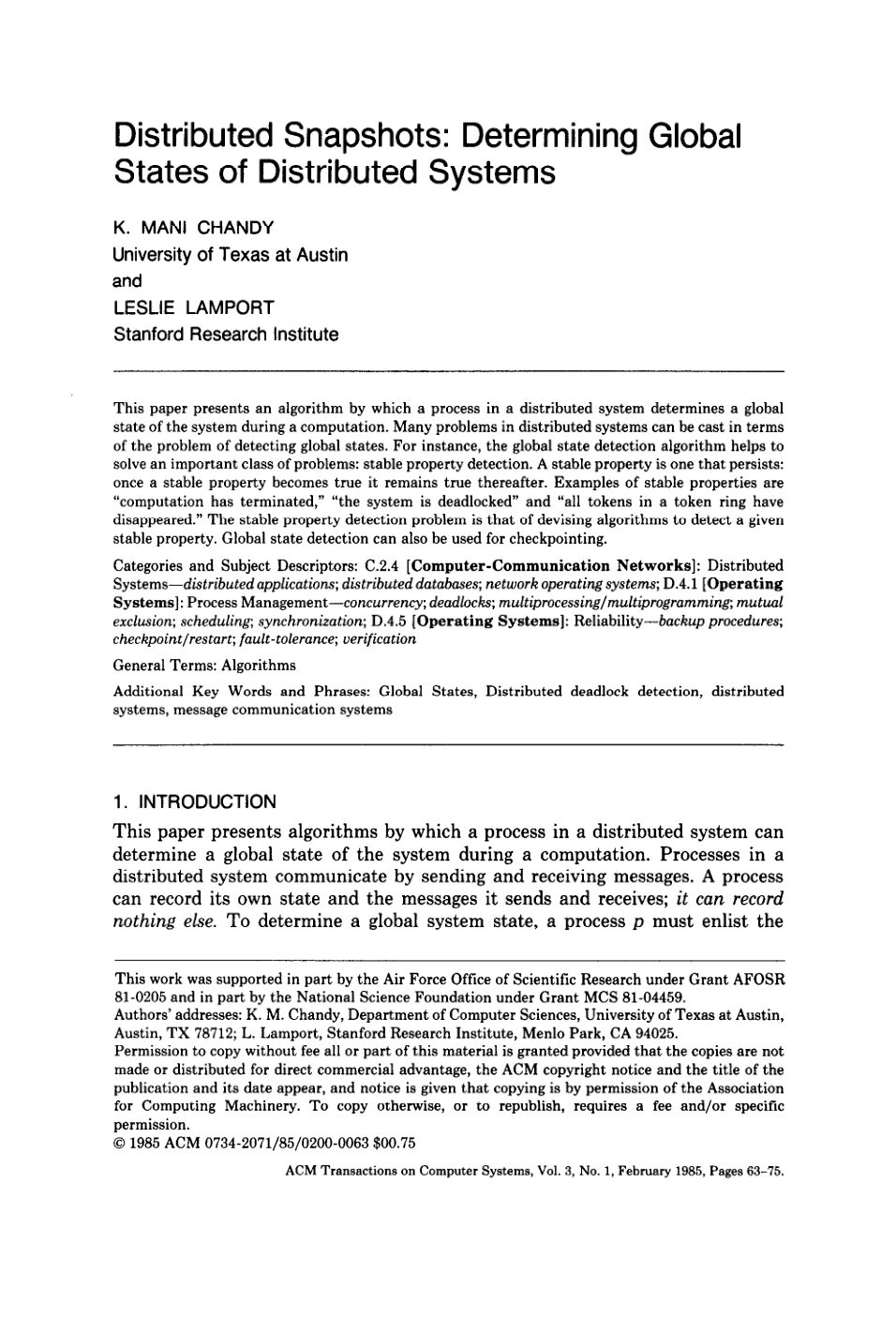
Distributed Snapshots: Determining Global States of Distributed Systems
作者:K. Mani Chandy,University of Texas at Austin;Leslie Lamport,Stanford Research Institute。
Abstract
本文给出一种 algorithm,使 distributed system 中的 process 能够在 computation 进行期间确定 system 的 global state。
distributed systems 中的许多问题都可以表述为 detecting global states 的问题。例如,global state detection algorithm 有助于解决一大类问题:stable property detection。stable property 是会持续存在的 property:一旦 stable property 变为 true,此后它就一直保持 true。stable property 的例子包括:“computation 已经终止”“system 处于 deadlock 中”以及“token ring 中所有 tokens 都消失了”。stable property detection problem,就是设计 algorithm 来检测给定的 stable property。
global state detection 也可以用于 checkpointing。
分类与主题词:C.2.4「Computer-Communication Networks:Distributed Systems——distributed applications、distributed databases、network operating systems」;D.4.1「Operating Systems:Process Management——concurrency、deadlocks、multiprocessing/multiprogramming、mutual exclusion、scheduling、synchronization」;D.4.5「Operating Systems:Reliability——backup procedures、checkpoint/restart、fault-tolerance、verification」。
General Terms:Algorithms。
Additional Key Words and Phrases:Global States、Distributed deadlock detection、distributed systems、message communication systems。
1. INTRODUCTION
本文给出一些 algorithms,使 distributed system 中的 process 能够在 computation 期间确定 system 的 global state。
distributed system 中的 processes 通过发送和接收 messages 进行通信。一个 process 可以记录自己的 state,以及它发送和接收的 messages;除此之外,它什么也记录不了。为了确定整个 system 的 state,process p 必须寻求其他 processes 的合作:其他 processes 记录自己的 local states,并把记录的 local states 发送给 p。
版权与使用声明(原文页内声明的译文):只要 copies 不用于 direct commercial advantage,并且 copies 上出现 ACM copyright notice、publication title 及其 date,同时注明 copying 是经 ACM 许可进行的,就允许免费复制本材料的全部或部分。其他复制方式或 republication,需要支付 fee 和/或取得 specific permission。
本研究部分得到 Air Force Office of Scientific Research Grant AFOSR 81-0205 以及 National Science Foundation Grant MCS 81-04459 支持。
作者地址:K. M. Chandy,Department of Computer Sciences,University of Texas at Austin,Austin, TX 78712;L. Lamport,Stanford Research Institute,Menlo Park, CA 94025。
第 2 页:Global-state detection、stable property 与 phase
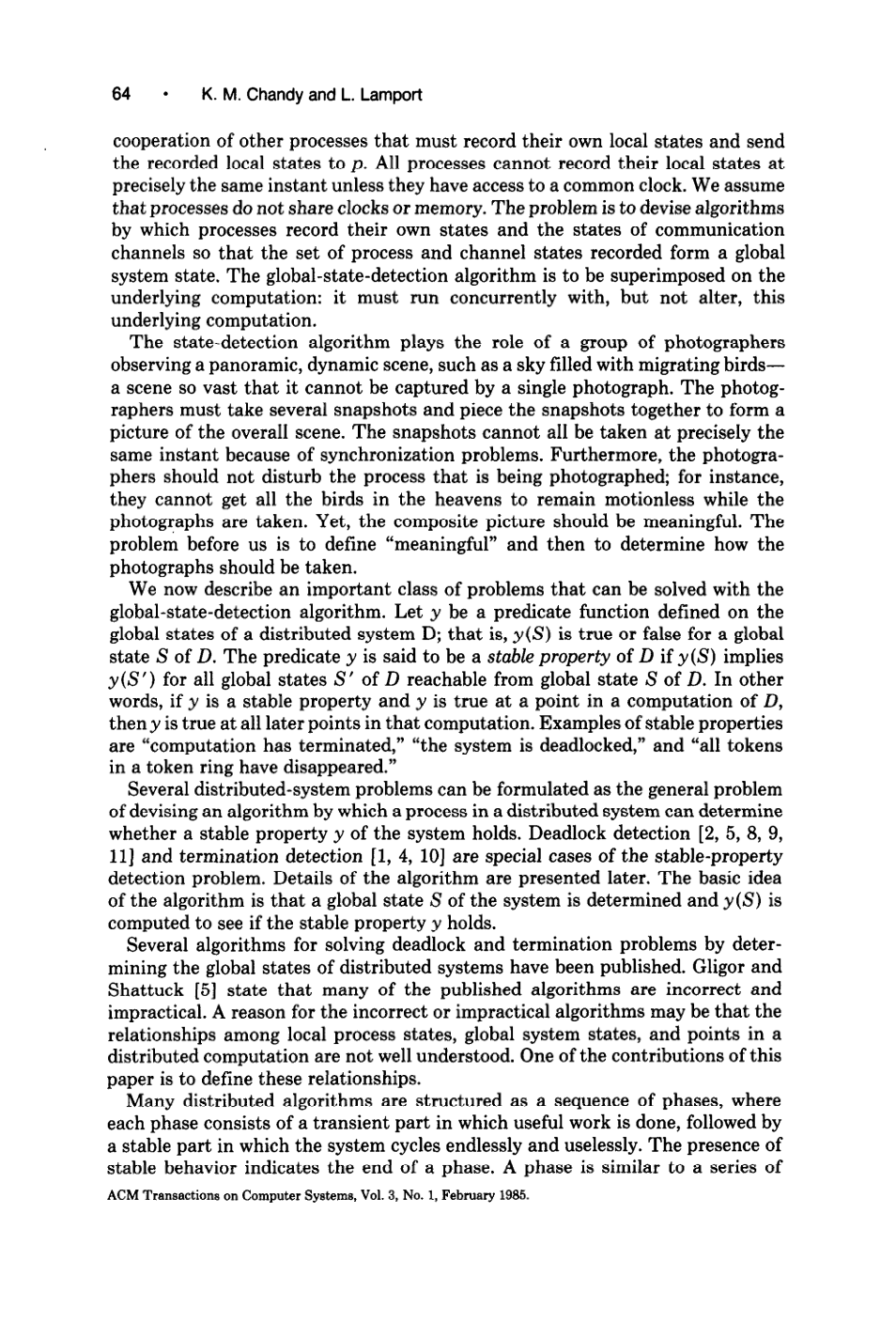
除非拥有 shared clock,否则所有 processes 不可能在精确相同的 instant 记录 local states。我们的任务是设计 algorithms,使 processes 记录自己的 states 和 communication channels 的 states,并且记录下来的 process states 与 channel states 的集合构成一个 global system state。
global-state-detection algorithm 必须叠加在 underlying computation 之上:它必须与 underlying computation concurrent 地运行,但不能改变 underlying computation。
state-detection algorithm 扮演一组 photographers 的角色:他们观察一个 panoramic、dynamic scene,例如充满迁徙 birds 的 sky;这个 scene 太大,无法用一张照片捕获。photographers 必须拍摄多张 snapshots,再把它们拼成整体场景的图像。这些 snapshots 不能因为 synchronization problem 而在精确相同的 instant 拍摄。此外,photographers 不应打扰被拍摄的过程:例如,他们不能让天空中所有 birds 在拍照时保持 motionless。然而,拼出的 composite picture 必须是 meaningful 的。我们面对的问题,就是定义 “meaningful”,然后确定应当怎样拍照。
现在描述一类可以用 global-state-detection algorithm 解决的重要问题。令 y 是定义在 distributed system D 的 global states 上的 predicate function;也就是说,对于 global state S,y(S) 为 true 或 false。
如果对于从 D 的 global state S 可达的所有 global states S′,y(S) 都蕴含 y(S′),那么称 predicate y 是 D 的 stable property。换句话说,如果 y 是 stable property,并且在 D 的一次 computation 中某个 point 上 y 为 true,那么在该 computation 的所有后续 points 上 y 都为 true。
stable property 的例子是:“computation 已终止”“system deadlocked”“token ring 中所有 tokens 都消失”。
若干 distributed-system problems 都可以表述为一个 general problem:设计 algorithm,让 distributed system 中的 process 确定 system 的 stable property y 是否成立。deadlock detection 和 termination detection 都是 stable-property detection problem 的 special cases。后文会给出 algorithm 的细节;基本思路是先确定 system 的 global state S,再计算 y(S),判断 stable property 是否成立。
已经有一些通过确定 distributed system global states 来解决 deadlock 和 termination problems 的 algorithms。Gligor 和 Shattuck 指出,许多已发表的 algorithms 是 incorrect 或 impractical 的。其原因可能是:local process states、global system states 与 distributed computation 中 points 之间的关系没有被充分理解。本文的贡献之一,就是定义这些关系。
许多 distributed algorithms 被组织成一系列 phases。每个 phase 由一个 transient part 和一个 stable part 组成:transient part 中完成有用工作,stable part 中 system endlessly、uselessly 地循环。stable behavior 的出现表示 phase 已经结束。一个 phase 类似 sequential program 中的一系列 iterations:反复执行,直到连续两次 iterations 不再产生变化,也就是达到 stability。必须检测 stability,才能终止一个 phase 并启动下一个 phase。
第 3 页:System model 开始
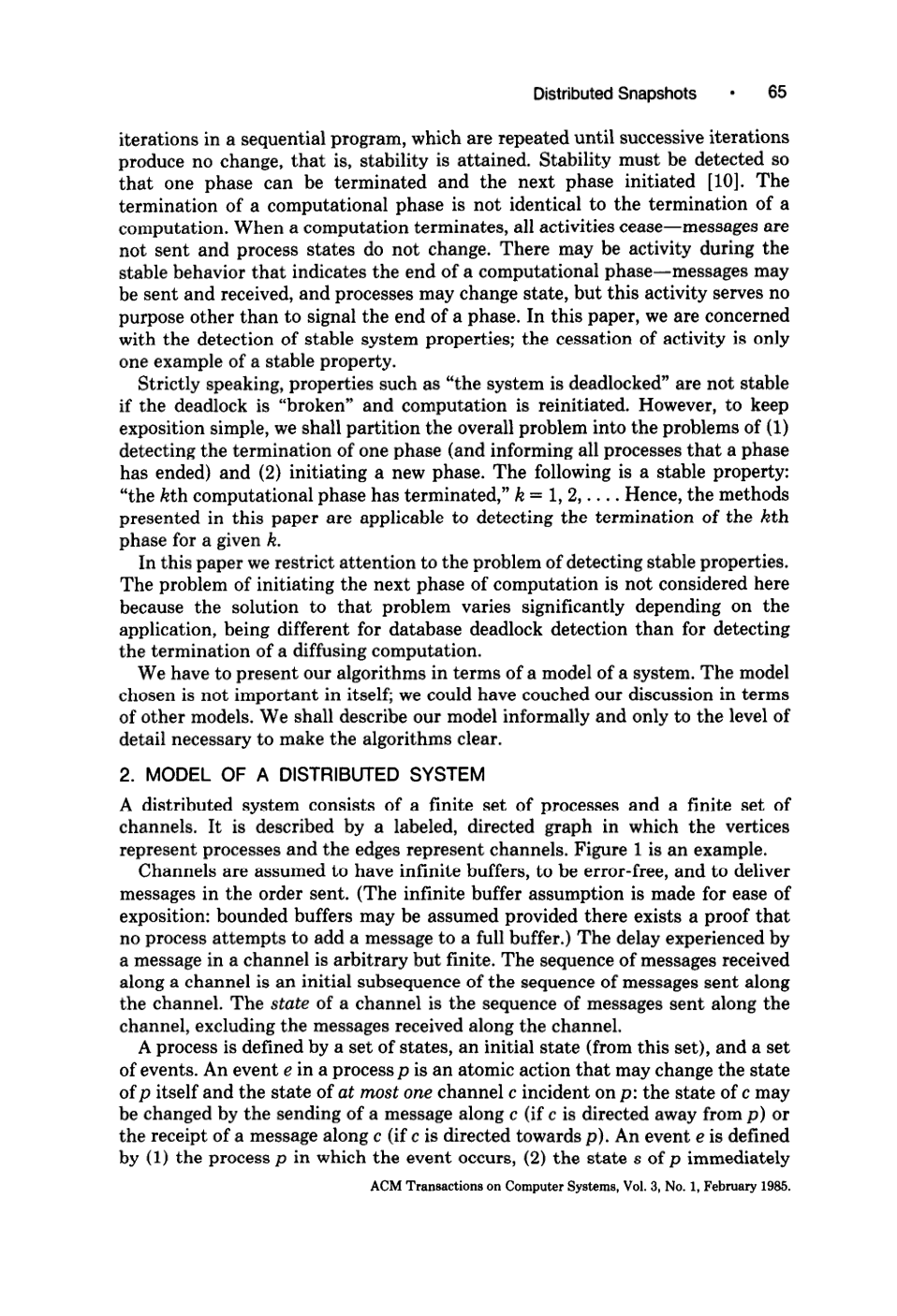
computational phase 的 termination 不等同于 computation 的 termination。当 computation 终止时,所有 activities 都停止:不再发送 messages,process states 也不再变化。stable behavior 期间仍可能存在 activity,用来表明 computational phase 的结束:messages 可能被发送和接收,processes 可能改变 states,但这些 activity 除了 signal phase end 之外没有其他用途。
本文关注 stable system properties 的 detection;activity 的 cessation 只是 stable property 的一个例子。
严格说,“system deadlocked” 这样的 properties 并不一定 stable,因为 deadlock 可能被 “broken”,computation 可能重新启动。不过,为了让 exposition 简单,我们把整体问题划分为两个问题:
- 检测一个 phase 的 termination,并通知所有 processes 该 phase 已结束;
- 启动一个新的 phase。
下面这个 property 是 stable 的:“第 k 个 computational phase 已经终止”,其中 k = 1, 2, …。因此,本文方法可用于检测给定 k 的第 k 个 phase 的 termination。
本文只讨论 detecting stable properties。没有讨论启动下一个 computation phase,因为这个问题的 solution 会因 application 而显著不同:database deadlock detection 与 diffusing computation termination detection 的 solution 就不同。
我们必须依据某个 system model 来描述 algorithms。所选 model 本身并不重要;也可以使用其他 models 来组织讨论。下面只非正式地描述 model,并且只描述使 algorithms 清楚所需的细节。
2. MODEL OF A DISTRIBUTED SYSTEM
distributed system 由有限集合的 processes 和有限集合的 channels 组成。它用一个 labeled、directed graph 描述:vertices 表示 processes,edges 表示 channels。Figure 1 是一个例子。
channels 假设具有 infinite buffers、没有 errors,并按发送顺序 delivery messages。(作 infinite-buffer 假设只是为了便于 exposition;如果能够证明没有 process 会尝试把 message 加入 full buffer,那么也可以假设 bounded buffers。)message 在 channel 中经历的 delay 可以 arbitrary,但必须 finite。
沿 channel 接收的 messages sequence,是沿该 channel 发送的 messages sequence 的一个 initial subsequence。channel 的 state,就是沿 channel 已发送、但尚未沿该 channel 接收的 messages sequence。
一个 process 由一组 states、该集合中的一个 initial state,以及一组 events 定义。process p 中的 event e 是一个 atomic action,它可以改变 p 自身的 state,以及与 p incident 的至多一个 channel c 的 state:如果 c 从 p directed away,c 的 state 可以被沿 c 发送 message 改变;如果 c directed towards p,则可以被沿 c 接收 message 改变。
event e 用下面五元组定义:
- event 发生的 process
p; - event 发生前 process
p的 states; - event 发生后 process
p的 states′; - state 被改变的 channel
c(如果有); - 沿
c发送或接收的 messageM(如果有)。
如果 event 的发生没有改变任何 channel 的 state,那么 M 和 c 都使用特殊符号 null。
第 4 页:Global state、computation 与 Example 2.1 开始
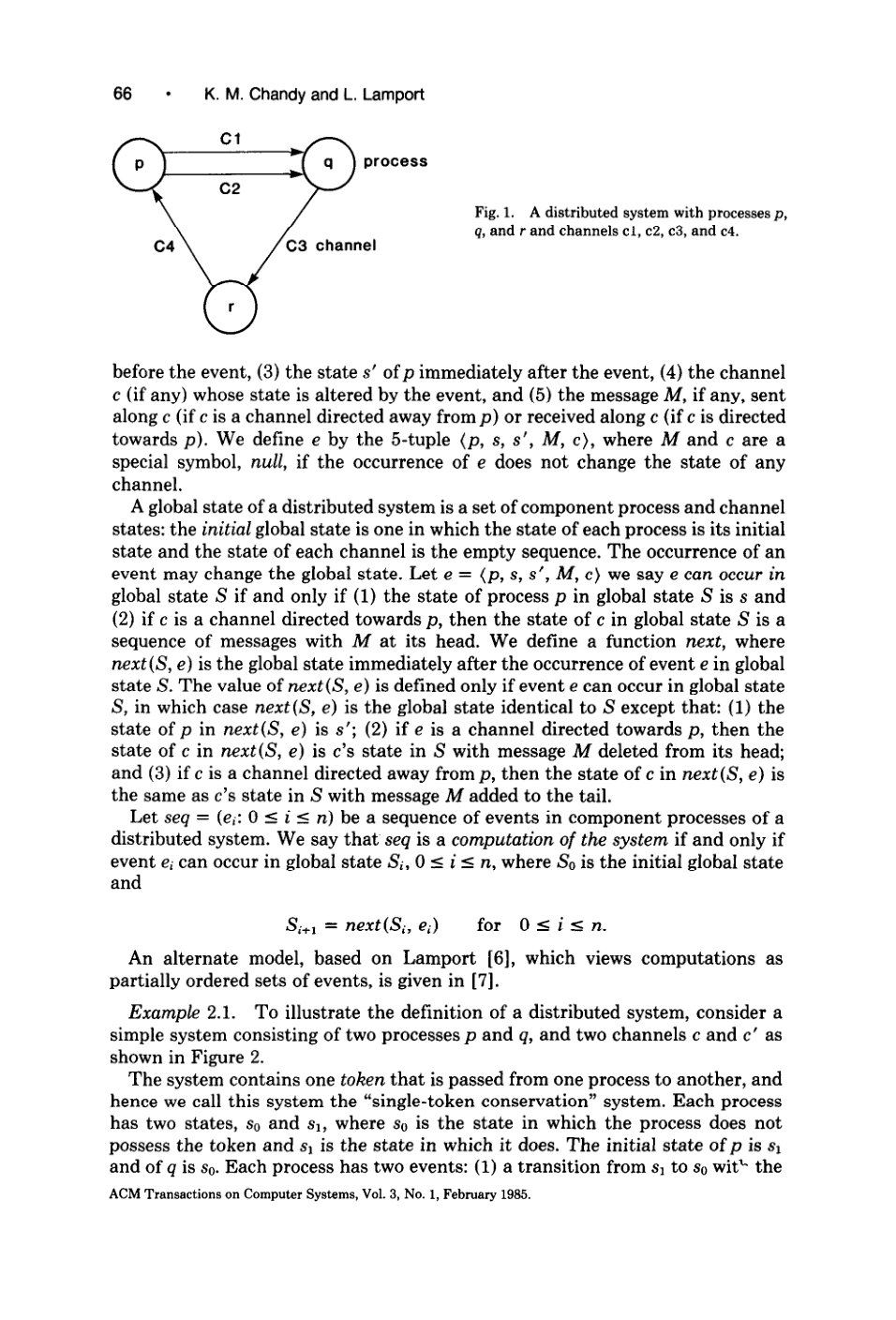
distributed system 的 global state 是各 component process states 和 channel states 的集合。initial global state 中,每个 process 都处于自己的 initial state,每个 channel 都是 empty sequence。
event 的发生可能改变 global state。令 e = (p, s, s′, M, c)。当且仅当以下条件成立时,说 event e 可以在 global state S 中发生:
- global state
S中 processp的 state 是s; - 如果
c是 directed towardsp的 channel,那么S中c的 state 是一个以M为 head 的 messages sequence。
定义 function next:next(S, e) 是 event e 在 global state S 发生后紧接着的 global state。只有当 event e 能在 S 中发生时,next(S, e) 才有定义;此时 next(S, e) 与 S 相同,除了:
next(S, e)中 processp的 state 是s′;- 如果
e是 processp从 directed-towards channelc接收 message,那么next(S, e)中c的 state 是从S的cstate 的 head 删除M后的 sequence; - 如果
c是 directed-away channel,那么next(S, e)中c的 state 是在S的cstate tail 添加M后的 sequence。
令 seq = (eᵢ : 0 ≤ i ≤ n) 是 distributed system 的 component processes 中的一串 events。当且仅当对 0 ≤ i ≤ n,event eᵢ 能在 global state Sᵢ 中发生,且 S₀ 是 initial global state、Sᵢ₊₁ = next(Sᵢ, eᵢ) 时,称 seq 是 system 的一个 computation。
另有一种基于 Lamport [6] 的 model,把 computations 看作 events 的 partially ordered sets,见文献 [7]。
Example 2.1
为了说明 distributed system 的定义,考虑 Figure 2 所示的简单 system:它包含两个 processes p 和 q,以及两个 channels c 和 c′。
system 中有一个在两个 processes 之间传递的 token,因此称它为 single-token conservation system。每个 process 有两个 states:s₀ 和 s₁;s₀ 表示 process 不持有 token,s₁ 表示 process 持有 token。p 的 initial state 是 s₁,q 的 initial state 是 s₀。
每个 process 有两个 events:
- 从
s₁转换到s₀,同时发送 token; - 从
s₀转换到s₁,同时接收 token。
Figure 3 给出了 process 的 state-transition diagram。Figure 4 给出了 global states 和 transitions。
system computation 对应于 Figure 4 global-state-transition diagram 中从 initial global state 出发的一条 path。
system computations 的例子包括:
- empty sequence;
(p sends token, q receives token, q sends token)。
下面这串 sequence 不是 system computation:(p sends token, q sends token)。因为当 q 处于 s₀ 时,event “q sends token” 不能发生。
为简洁起见,按照 transition 顺序,将四个 global states 分别称为:(1) in-p、(2) in-c、(3) in-q 和 (4) in-c′,表示 token 所在的位置。后文会用这个 example 来推动 algorithm 的设计。
第 5 页:Example 2.1 的 diagrams 与 computation
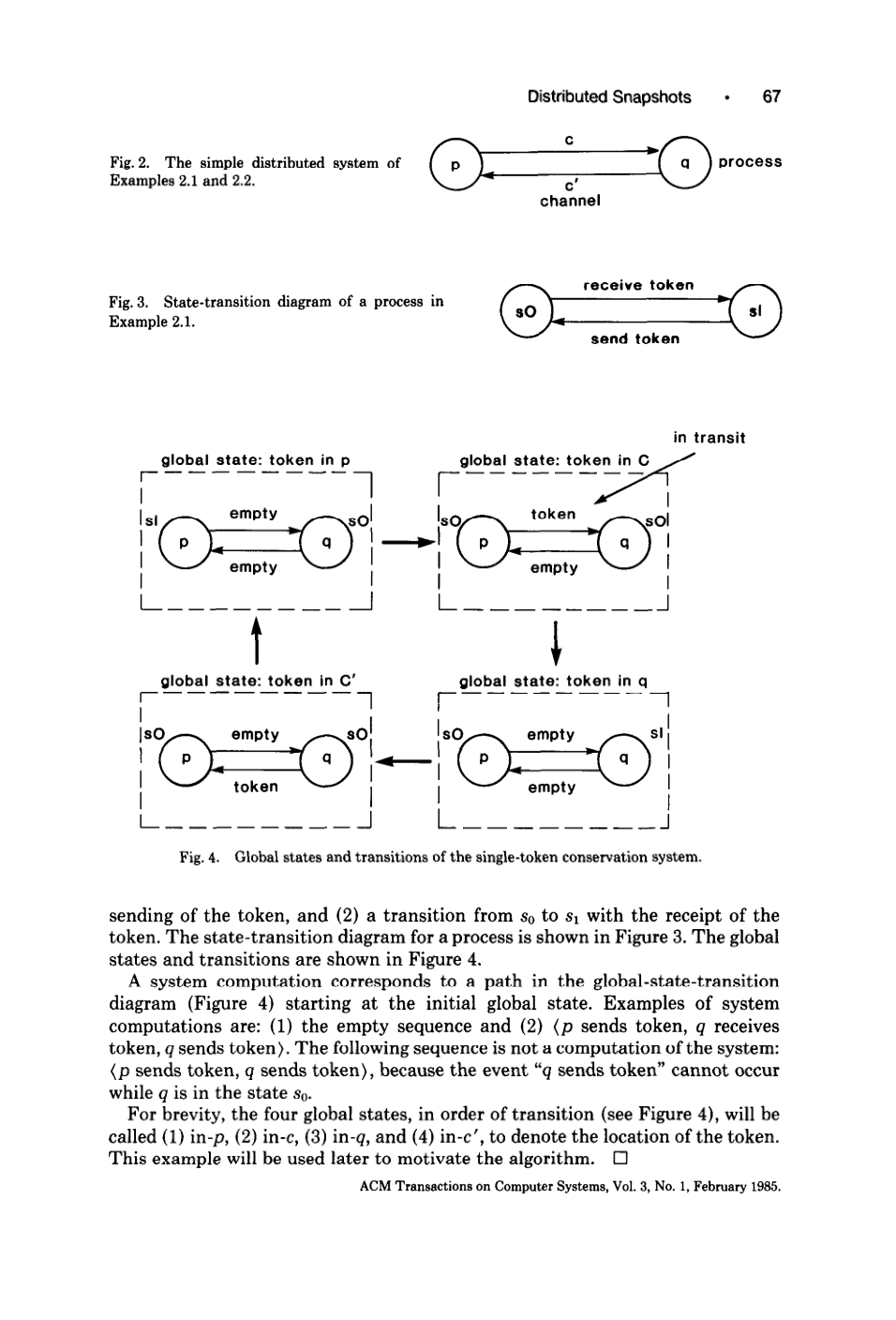
Figure 2 是 Example 2.1 和 Example 2.2 中 simple distributed system 的图。图中标出了 channel 与 process。
Figure 3 是 Example 2.1 中 process 的 state-transition diagram:process 收到 token 后进入持有 token 的 state,发送 token 后进入 token 不在本地的 state。
Figure 4 是 single-token conservation system 的 global states 和 transitions。四个 global states 分别是 token 在 p 中、token 在 channel c 中、token 在 q 中,以及 token 在 channel c′ 中。
一个 system computation 就是 global-state-transition diagram 中从 initial global state 出发的一条 path。
“empty sequence” 是一个 computation;(p sends token, q receives token, q sends token) 也是一个 computation。相反,(p sends token, q sends token) 不是 computation,因为 q sends token 发生时,q 仍处于没有 token 的 s₀。
第 6 页:Example 2.2 与 nondeterministic computations
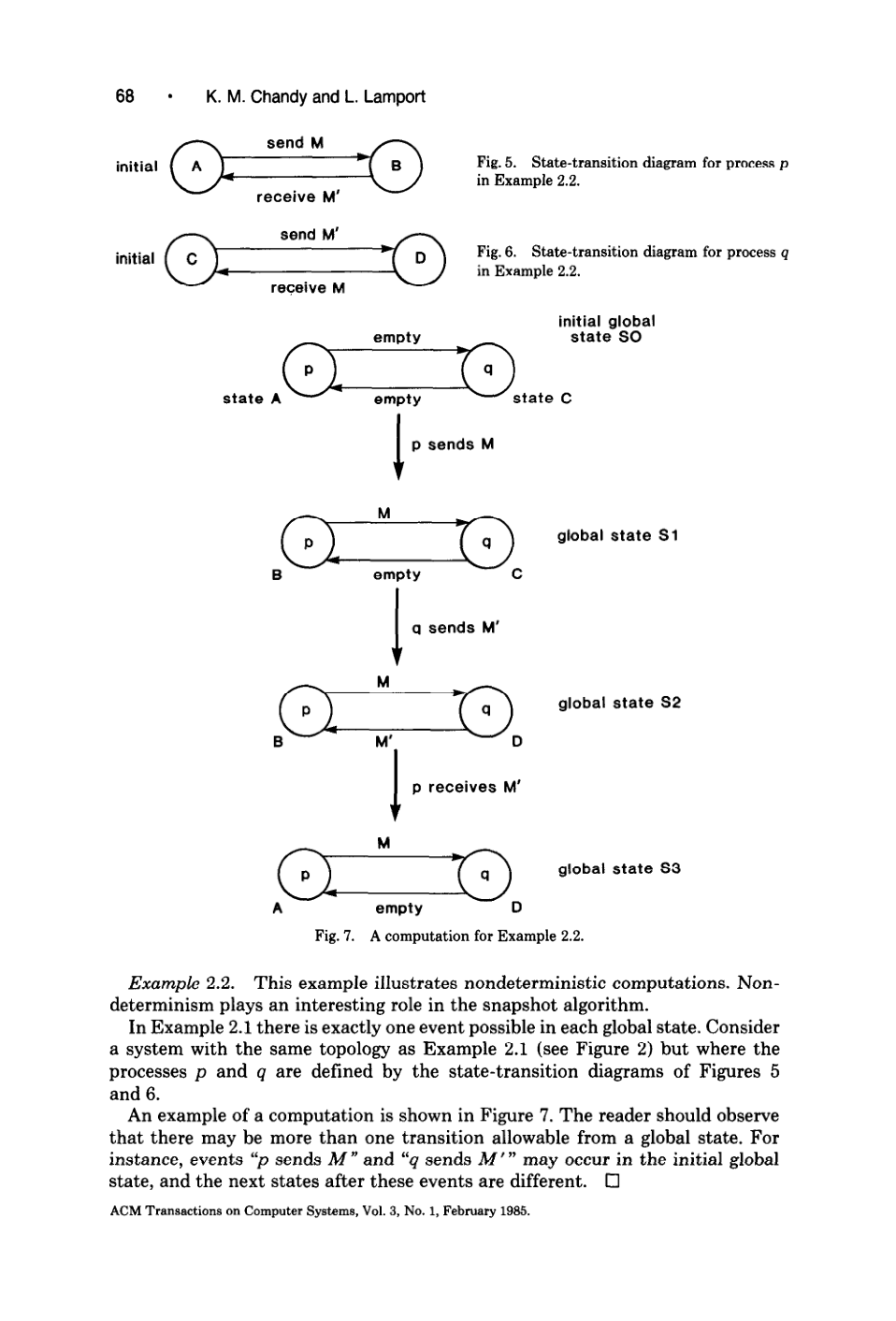
Example 2.2
这个 example 说明 nondeterministic computations。nondeterminism 在 snapshot algorithm 中扮演有趣的角色。
在 Example 2.1 中,每个 global state 恰好只有一个可能发生的 event。现在考虑 topology 与 Example 2.1 相同的 system(见 Figure 2),但两个 processes 的定义分别由 Figures 5 和 6 的 state-transition diagrams 给出。
Figure 7 展示了一次 computation。注意,一个 global state 可能允许多个 transitions。例如,在 initial global state 中,events “p sends M” 和 “q sends M′” 都可以发生;这两个 events 之后的 states 不同。
Figure 5 描述 process p 的 transitions:它从 initial state 出发,发送 M 后进入另一个 state,并在随后收到 M′ 时发生下一次转换。Figure 6 描述 process q 的相应 transitions。Figure 7 展示了一个可能的执行顺序:先由 p 发送 M,再由 q 发送 M′,然后 p 接收 M′。
Figure 5–7:Example 2.2 的 process state-transition diagrams 与一条 computation。原始 diagrams 保留在本页图片中。
3. THE ALGORITHM
3.1 Motivation for the Steps of the Algorithm
global-state recording algorithm 的工作方式如下:每个 process 记录自己的 state;对于每个 channel,由该 channel 两端的两个 processes 合作记录 channel state。
因为没有 global clock,无法保证所有 processes 和 channels 的 states 在同一个 instant 被记录。不过,我们要求被记录的 process states 和 channel states 构成一个 “meaningful” global system state。
global-state recording algorithm 必须叠加在 underlying computation 之上:它必须与 underlying computation concurrent 地运行,但不能改变 underlying computation。algorithm 可以发送 messages,也可以要求 processes 执行 computations;但是,record global state 所需的 messages 和 computations 不得 interfere with underlying computation。
下面用一个 example 推导 algorithm 的 steps。先假设 channel state 可以被 instantaneously record;channel state 应如何记录,会在后文讨论。
令 c 是从 p 指向 q 的 channel。这个 example 的目的是形成直觉:channel c 的 state 应在什么 instant 记录,以及这与 process p、q 的 states 被记录的 instants 有什么关系。
Example 3.1
考虑 single-token conservation system。假设 process p 的 state 在 global state in-p 被记录,于是记录的 p state 显示 token 在 p 中。现在假设 system 转换到 in-c(因为 p 发送 token)。再假设 channel c、channel c′ 和 process q 的 states 都在 global state in-c 被记录:记录的 channel c state 显示 token 在其中,而记录的 channel c′ 和 process q states 显示它们不持有 token。
用这种方式拼出的 composite global state 会显示 system 中有两个 tokens:一个在 p 中,一个在 c 中。但在 single-token conservation system 中,从 initial global state 出发,一次 computation 不可能到达含有两个 tokens 的 global state!
不一致产生的原因是:p 的 state 在 p 沿 c 发送 message 之前被记录,而 c 的 state 在该 message 发送之后被记录。令 n 为 p 的 state 被记录之前沿 c 发送的 messages 数量,令 n′ 为 c 的 state 被记录之前沿 c 发送的 messages 数量。这个 example 暗示:当 n < n′ 时,记录的 global state 可能 inconsistent。
再考虑另一种情况。假设 c 的 state 在 global state in-p 被记录,随后 system 转换到 in-c,然后在 in-c 记录 c′、p 和 q 的 states。记录出的 global state 显示 system 中没有 token。
这个 example 暗示:如果 channel c 的 state 在 p 沿 c 发送 message 之前被记录,而 p 的 state 在发送之后被记录,也就是 n > n′,那么 recorded global state 可能 inconsistent。
由这些 examples 可以得到:通常,一个 consistent global state 要求
n = n′。 (1)
第 7 页:Marker 的动机
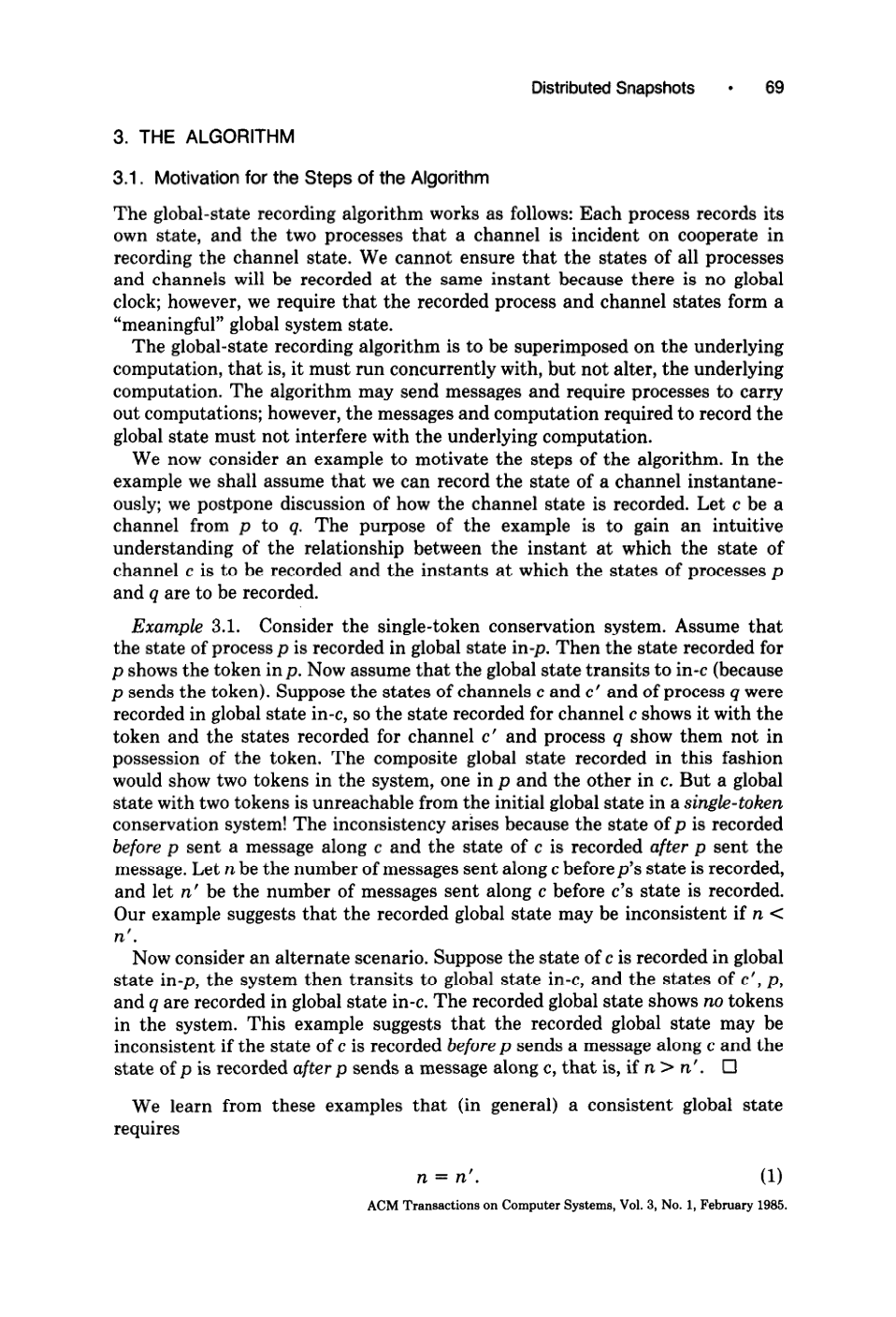
global-state recording algorithm 先让每个 process 记录自己的 state,再由每条 channel 两端的 processes 合作记录 channel state。由于没有 global clock,无法保证所有 process states 和 channel states 在同一个 instant 被记录,但要求组合出的结果构成一个 “meaningful” global system state。
algorithm 必须叠加在 underlying computation 上,与它 concurrent 地运行,却不能改变它。algorithm 可以发送 messages,也可以要求 processes 执行 computations;但这些额外 messages 和 computations 不得 interfere with underlying computation。
令 c 是从 p 到 q 的 channel。先假设 channel state 可以 instantaneously record,后文再讨论如何真正记录 channel state。
Example 3.1
考虑 single-token conservation system。假设 process p 的 state 在 global state in-p 中被记录,所以记录的 p state 显示 token 在 p 中。然后 system 转换到 in-c(因为 p 发送 token)。如果 channel c、channel c′ 和 process q 的 states 都在 in-c 中被记录,那么记录的 c state 显示 token 在 c 中,而记录的 c′ 和 q states 显示它们不持有 token。
这样拼出的 composite global state 会显示 system 中有两个 tokens:一个在 p,另一个在 c。但这个 single-token conservation system 从 initial global state 出发不可能到达含有两个 tokens 的 global state。
不一致的原因是:p 的 state 在 p 沿 c 发送 message 之前被记录,而 c 的 state 在 message 发送之后被记录。令 n 为 p 的 state 被记录之前沿 c 发送的 messages 数量,令 n′ 为 c 的 state 被记录之前沿 c 发送的 messages 数量。这个 example 暗示,当 n < n′ 时,记录出的 global state 可能 inconsistent。
再考虑另一种情况:c 的 state 在 in-p 中被记录,system 随后转到 in-c,然后在 in-c 中记录 c′、p 和 q 的 states。记录出的 global state 显示 system 中没有 token。
这说明,当 channel c 的 state 在 p 沿 c 发送 message 之前被记录,而 p 的 state 在发送之后被记录,也就是 n > n′ 时,recorded global state 也可能 inconsistent。
因此,通常要得到 consistent global state,必须有:
n = n′。 (1)
第 8 页:Marker 与 Global-State-Detection Algorithm Outline
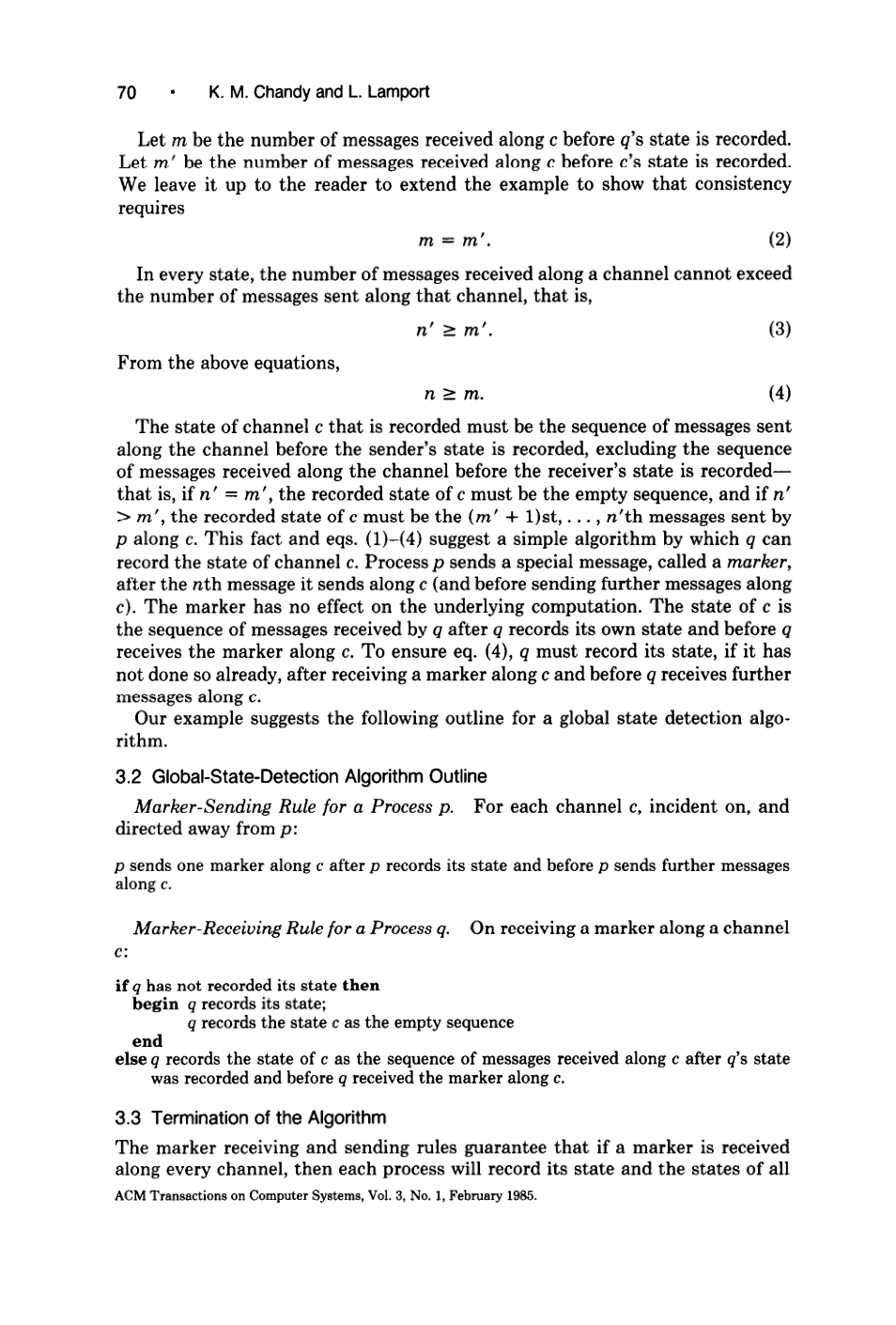
令 m 为在 q 的 state 被记录之前沿 c 接收的 messages 数量,令 m′ 为在 c 的 state 被记录之前沿 c 接收的 messages 数量。类似地,consistency 要求:
m = m′。 (2)
在任何 state 中,沿 channel 接收的 messages 数量不能超过沿该 channel 发送的 messages 数量,因此:
n′ ≥ m′。 (3)
结合前面的关系,还能得到:
n ≥ m。 (4)
记录的 channel c state 必须是:sender state 被记录之前沿 channel 发送的 messages sequence,减去 receiver state 被记录之前沿 channel 接收的 messages sequence。也就是说,如果 n′ = m′,记录的 c state 是 empty sequence;如果 n′ > m′,记录的 c state 是 p 沿 c 发送的第 m′ + 1 到第 n′ 个 messages。
因此,process p 可以在沿 c 发送第 n 个 message 之后、继续沿 c 发送其他 messages 之前,发送一个特殊 message,称为 marker。marker 不影响 underlying computation。
channel c 的 state,就是 q 记录自己的 state 之后、q 沿 c 收到 marker 之前收到的 messages sequence。为了保证 equation (4),q 必须在沿 c 收到 marker 之后、收到沿 c 的其他 messages 之前记录自己的 state(如果尚未记录)。
3.2 Global-State-Detection Algorithm Outline
Marker-Sending Rule for a Process
p
对于每个与pincident、且 directed away fromp的 channelc:p在记录自己的 state 之后、沿c发送更多 messages 之前,沿c发送一个 marker。
Marker-Receiving Rule for a Process
q
当沿 channelc收到 marker 时:
- 如果
q还没有记录自己的 state:
q记录自己的 state;q将 channelc的 state 记录为空 sequence。- 否则,
q将 channelc的 state 记录为:q记录自己 state 之后、沿c收到 marker 之前收到的 messages sequence。
第 9 页:Termination 与 recorded global state 的例子
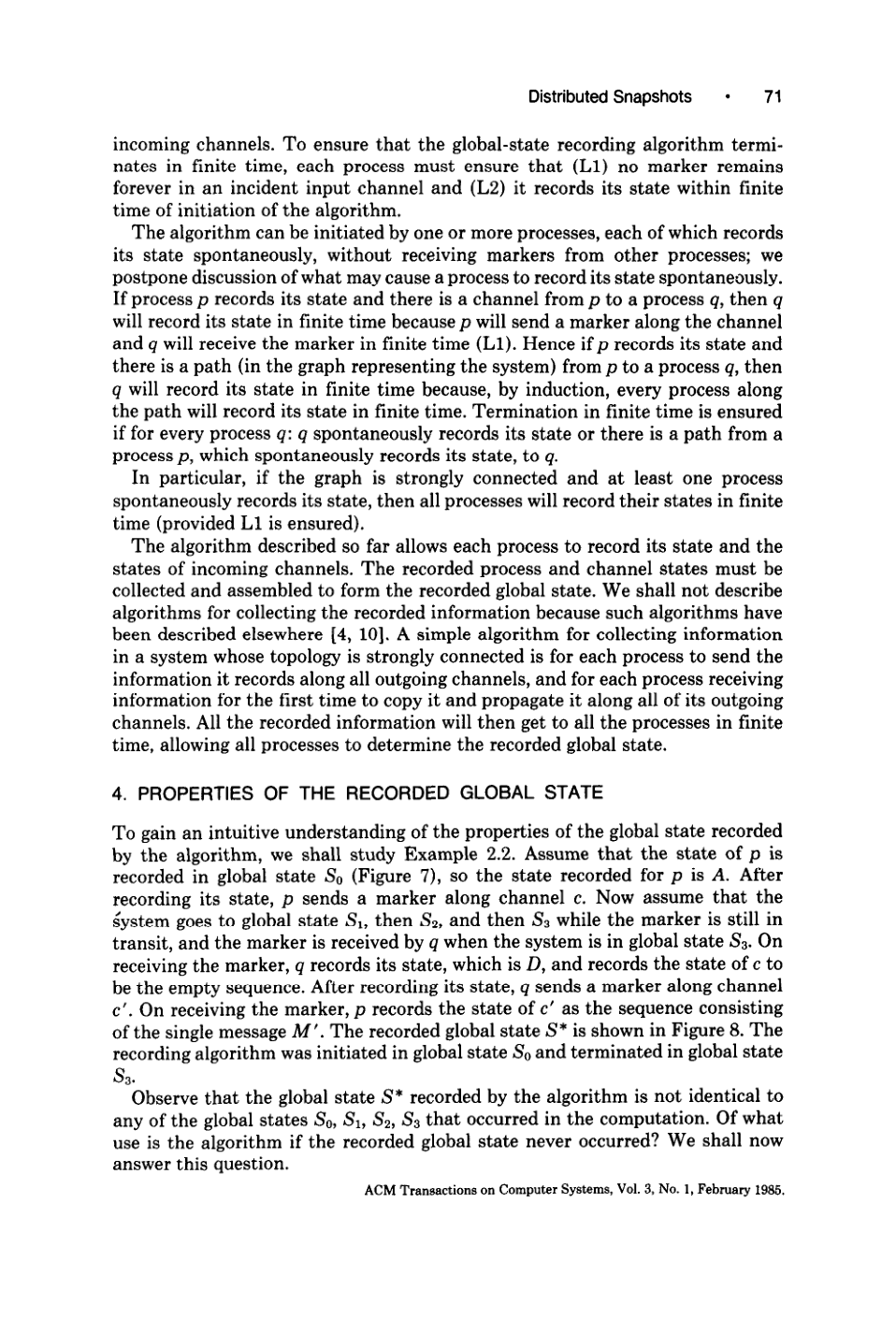
3.3 Termination of the Algorithm
marker receiving rule 和 marker sending rule 保证:如果每条 channel 都收到 marker,那么每个 process 都会记录自己的 state 以及所有 incoming channels 的 states。
为了保证 global-state recording algorithm 在 finite time 内终止,每个 process 必须保证:
- L1:任何 marker 都不会永远停留在 incident input channel 中;
- L2:从 algorithm initiation 开始,process 会在 finite time 内记录自己的 state。
algorithm 可以由一个或多个 processes 启动;每个启动它的 process 都会 spontaneously record 自己的 state,而不必等待从其他 processes 收到 markers。什么原因会让 process spontaneously record state,稍后再讨论。
如果 process p 记录自己的 state,并且存在从 p 到 process q 的 channel,那么 q 会在 finite time 内记录自己的 state:p 会沿该 channel 发送 marker,而 q 会在 finite time 内收到 marker(由 L1 保证)。
因此,如果 p 记录 state,且 system graph 中存在从 p 到 q 的 path,那么 q 也会在 finite time 内记录 state;证明方式是对 path 上的 processes 做 induction:path 上的每个 process 都会在 finite time 内记录 state。
若对于每个 process q,要么 q spontaneously record state,要么存在一条从 spontaneously record state 的 process p 到 q 的 path,则 algorithm 在 finite time 内终止。
特别地,如果 graph 是 strongly connected,且至少有一个 process spontaneously record 自己的 state,那么在保证 L1 的前提下,所有 processes 都会在 finite time 内记录各自的 states。
到这里,algorithm 允许每个 process 记录自己的 state 和 incoming channels 的 states。还必须把记录的 process states 与 channel states 收集、组装成 recorded global state。本文不描述收集这些 recorded information 的 algorithms,因为这类 algorithms 已在其他文献中给出。
在 topology strongly connected 的 system 中,一个简单的 information-collection algorithm 是:每个 process 将自己记录的信息沿所有 outgoing channels 发送;第一次收到某份 information 的 process 复制它,并沿自己的所有 outgoing channels 继续传播。这样,所有 recorded information 都会在 finite time 内到达所有 processes,所有 processes 都能确定 recorded global state。
4. PROPERTIES OF THE RECORDED GLOBAL STATE
为了直观理解 algorithm 记录出的 global state 的 properties,研究 Example 2.2。假设 process p 的 state 在 Figure 7 的 global state S₀ 中被记录,因此记录的 p state 是 A。记录 state 后,p 沿 channel c 发送 marker。
现在假设 system 依次进入 global states S₁、S₂、S₃,而 marker 仍在 transit;当 system 处于 global state S₃ 时,q 收到 marker。q 收到 marker 后记录自己的 state D,并把 c 的 state 记录为空 sequence。记录完自己的 state 后,q 沿 channel c′ 发送 marker。
p 收到这个 marker 后,将 c′ 的 state 记录为只包含一个 message M′ 的 sequence。algorithm 记录的 global state S* 如 Figure 8 所示。recording algorithm 在 global state S₀ 启动,并在 global state S₃ 终止。
注意,algorithm 记录的 global state S* 与 computation 中实际出现的 global states S₀、S₁、S₂、S₃ 都不相同。如果 recorded global state 从未出现过,这个 algorithm 有什么用?下一节回答这个问题。
第 10 页:Theorem 1 的目标与 recorded state
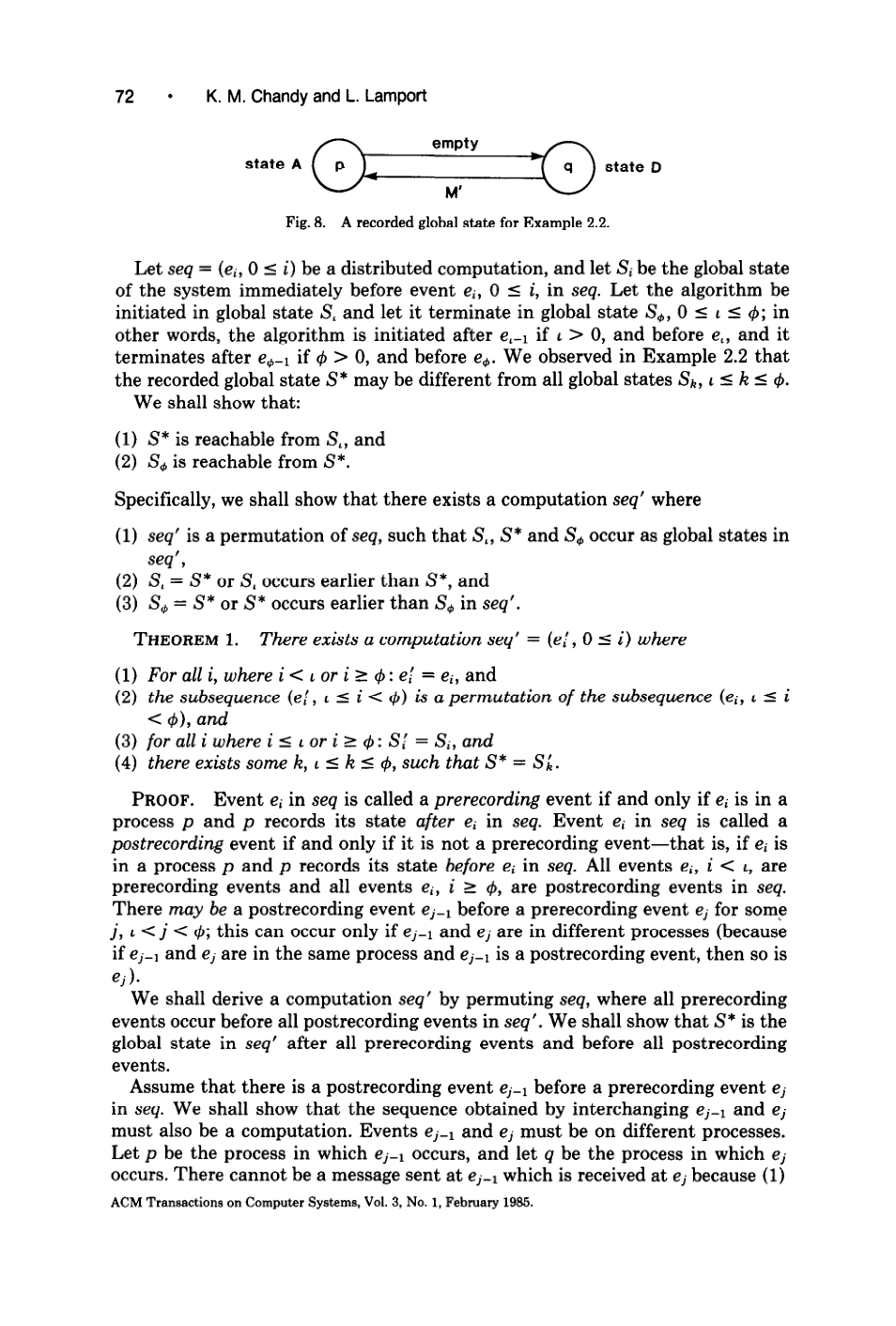
令 seq = (eᵢ, 0 ≤ i) 是一次 distributed computation;令 Sᵢ 是 seq 中 event eᵢ 之前 system 紧接着所处的 global state。
假设 algorithm 在 global state Sₗ 启动,并在 global state Sᵣ 终止,其中 0 ≤ l ≤ r。换句话说,如果 l > 0,algorithm 在 eₗ₋₁ 之后、eₗ 之前启动;如果 r > 0,algorithm 在 eᵣ₋₁ 之后、eᵣ 之前终止。
Example 2.2 已经说明,recorded global state S* 可能与实际出现的任意 global state Sₖ 都不同。接下来证明:
S*可以从Sₗreach;Sᵣ可以从S*reach。
具体地,要证明存在一次 computation seq′,满足:
seq′是seq的一个 permutation,因此Sₗ、S*、Sᵣ都作为 global states 出现在seq′中;Sₗ = S*,或Sₗ在seq′中早于S*;Sᵣ = S*,或S*在seq′中早于Sᵣ。
THEOREM 1. 存在一个 computation
seq′ = (eᵢ′, 0 ≤ i),使得:
- 对于所有
i < l或i ≥ r,eᵢ′ = eᵢ;- 子序列
(eᵢ′, l ≤ i < r)是原子序列(eᵢ, l ≤ i < r)的一个 permutation;- 对于所有
i ≤ l或i ≥ r,Sᵢ′ = Sᵢ;- 存在某个
k,l ≤ k ≤ r,使得S* = Sₖ′。
第 11 页:Theorem 1 proof 与 permutation
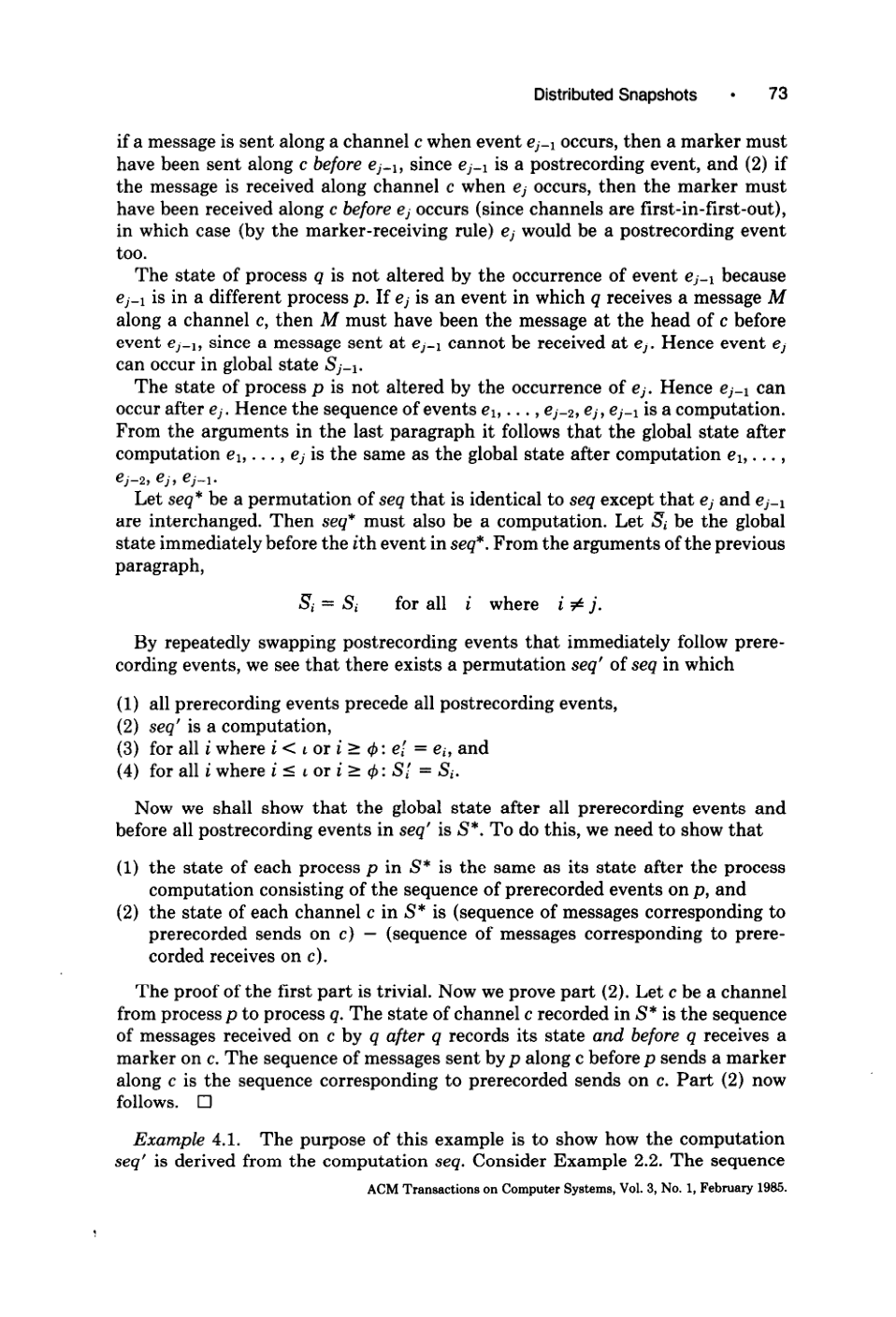
Proof. 在 seq 中,如果 event eᵢ 位于 process p,且 p 在 seq 中位于 eᵢ 之后记录自己的 state,那么称 eᵢ 是 prerecording event。如果 event eᵢ 位于 process p,且 p 在 seq 中位于 eᵢ 之前记录自己的 state,则称 eᵢ 是 postrecording event。
i < l 的所有 events 都是 prerecording events,i > r 的所有 events 都是 postrecording events。对于某个 l < j < r,可能出现一个 postrecording event eⱼ₋₁ 在一个 prerecording event eⱼ 之前;这只能发生在两个 events 位于不同 processes 的情况下。因为,如果 eⱼ₋₁ 和 eⱼ 位于同一个 process,且 eⱼ₋₁ 是 postrecording event,那么 eⱼ 也会是 postrecording event。
我们通过 permutation seq 构造 computation seq′,使所有 prerecording events 都出现在所有 postrecording events 之前。将证明:在 seq′ 中,所有 prerecording events 之后、所有 postrecording events 之前的 global state 就是 S*。
假设 seq 中有一个 postrecording event eⱼ₋₁ 紧接着位于一个 prerecording event eⱼ 之前。下面证明,交换 eⱼ₋₁ 和 eⱼ 后得到的 sequence 仍然是一次 computation。
这两个 events 位于不同 processes。令 p 为 eⱼ₋₁ 所在的 process,令 q 为 eⱼ 所在的 process。
eⱼ₋₁ 发生时不可能发送一条 message、而该 message 在 eⱼ 被接收。原因是:
- 如果
eⱼ₋₁沿 channelc发送 message,那么因为eⱼ₋₁是 postrecording event,marker 必须在eⱼ₋₁之前已经沿c发送; - 如果
eⱼ沿 channelc接收 message,那么由于 channels 是 FIFO,marker 必须在eⱼ之前已经沿c被接收; - 根据 marker-receiving rule,在这种情况下
eⱼ也会是 postrecording event,矛盾。
eⱼ₋₁ 发生不会改变 process q 的 state,因为 eⱼ₋₁ 位于不同的 process p。
如果 eⱼ 是 q 沿 channel c 接收 message M 的 event,那么在 eⱼ₋₁ 发生之前,M 必须已经位于 c 的 head:因为 eⱼ₋₁ 发送的 message 不可能恰好在 eⱼ 被接收。因此,event eⱼ 可以在 global state Sⱼ₋₁ 中发生。
eⱼ 的发生不会改变 process p 的 state,所以 eⱼ₋₁ 可以在 eⱼ 之后发生。因此,sequence
e₀, …, eⱼ₋₂, eⱼ, eⱼ₋₁
也是一次 computation。
令 seq* 为 seq 的 permutation,只把 eⱼ 与 eⱼ₋₁ 交换。于是 seq* 也是一次 computation。令 Sᵢ* 为 seq* 中第 i 个 event 之前的 global state。由上面的论证,对于除 i = j 外的所有 i,都有 Sᵢ* = Sᵢ。
反复交换那些紧跟在 prerecording events 后面的 postrecording events,就能得到 seq′ 的 permutation,使得:
- 所有 prerecording events 都先于所有 postrecording events;
seq′是一次 computation;- 对于
i < l或i ≥ r,eᵢ′ = eᵢ; - 对于
i ≤ l或i ≥ r,Sᵢ′ = Sᵢ。
现在证明:在 seq′ 中,所有 prerecording events 之后、所有 postrecording events 之前的 global state 是 S*。
需要证明两点:
S*中每个 process 的 state,等于该 process 执行属于它的 prerecorded events sequence 后得到的 state;S*中每个 channelc的 state,等于“沿c的 prerecorded sends 对应的 messages sequence”减去“沿c的 prerecorded receives 对应的 messages sequence”。
第一点是 trivial 的。下面证明第二点。令 c 是从 process p 到 process q 的 channel。S* 中记录的 channel c state,是 q 记录自己的 state 之后、q 沿 c 收到 marker 之前收到的 messages sequence。p 沿 c 发送 marker 之前发送的 messages sequence,正是沿 c 的 prerecorded sends 对应的 sequence。因此第二点成立。
第 12 页:Example 4.1 与 Stability Detection
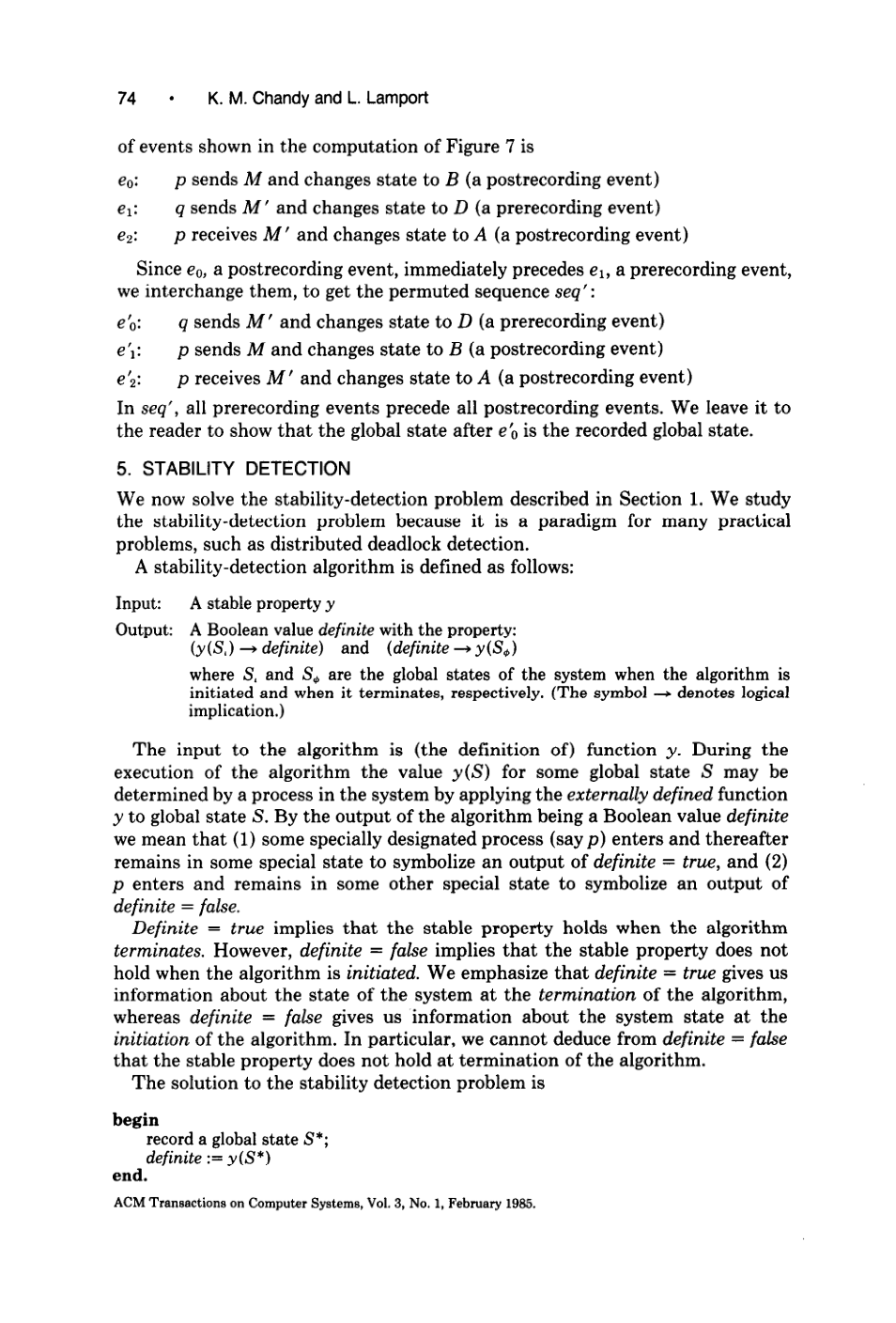
Example 4.1
这个 example 说明 computation seq′ 如何从 computation seq 得到。考虑 Example 2.2。Figure 7 中 computation 的 events sequence 是:
e₀: p sends M and changes state to B       (postrecording event)
e₁: q sends M′ and changes state to D      (prerecording event)
e₂: p receives M′ and changes state to A    (postrecording event)
因为 postrecording event e₀ 紧接着位于 prerecording event e₁ 之前,所以交换它们,得到 permutation seq′:
e₀′: q sends M′ and changes state to D     (prerecording event)
e₁′: p sends M and changes state to B      (postrecording event)
e₂′: p receives M′ and changes state to A   (postrecording event)
在 seq′ 中,所有 prerecording events 都先于所有 postrecording events。读者可以自行证明,e₀′ 之后的 global state 就是 recorded global state。
5. STABILITY DETECTION
现在解决 Section 1 描述的 stability-detection problem。研究它,是因为它代表许多 practical problems,例如 distributed deadlock detection。
stability-detection algorithm 定义如下:
Input:一个 stable property y。
Output:一个 Boolean value definite,满足:
y(Sₗ) ⇒ definite,并且 definite ⇒ y(Sᵣ),
其中 Sₗ 与 Sᵣ 分别是 algorithm 被启动和终止时 system 的 global states。
algorithm 的 input 是 function y 的定义。在 algorithm 执行期间,system 中的某个 process 可以把外部定义的 function y 应用于某个 global state S,从而得到 y(S)。
称 algorithm 的 output 是 Boolean value definite,是指:
- 某个 specially designated process(例如
p)进入一个 special state,并从此保持在该 state,以表示 outputdefinite = true; p进入另一个 special state,并从此保持在该 state,以表示 outputdefinite = false。
definite = true 意味着:当 algorithm 终止时,stable property 已经成立。但 definite = false 意味着:当 algorithm 启动时,stable property 尚未成立。
要特别强调:definite = true 为我们提供的是 algorithm termination 时 system state 的信息;而 definite = false 提供的是 algorithm initiation 时 system state 的信息。特别地,不能从 algorithm 输出 definite = false 推断 stable property 在 algorithm termination 时仍不成立。
stability-detection problem 的 solution 是:
begin
    record a global state S*
    definite := y(S*)
end
第 13 页:Stability Detection 正确性、Acknowledgments 与 References
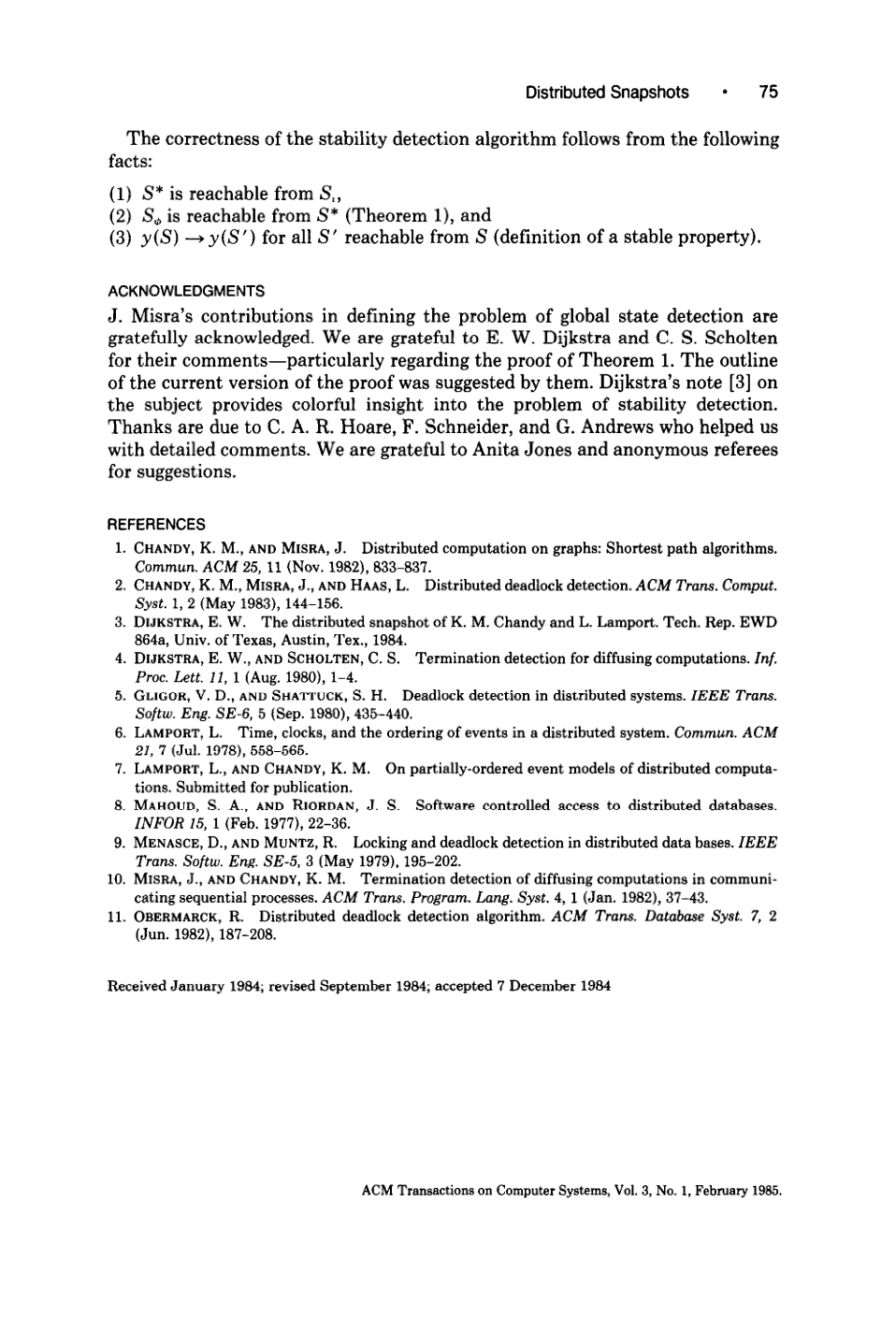
stability-detection algorithm 的 correctness 来自以下 facts:
S*可以从Sₗreach;Sᵣ可以从S*reach(Theorem 1);- 根据 stable property 的 definition,对于所有从
Sreachable 的S′,都有y(S) ⇒ y(S′)。
因此,如果 y(Sₗ) 为 true,那么 S* 中 y 为 true,algorithm 输出 definite = true;如果 algorithm 输出 definite = false,则 y(S*) 为 false,从而 y(Sₗ) 必为 false。这个 output 语义正好满足 stability-detection problem 的要求。
ACKNOWLEDGMENTS
感谢 J. Misra 在定义 global state detection problem 方面作出的 contributions。感谢 E. W. Dijkstra 和 C. S. Scholten 的 comments,尤其是他们对 Theorem 1 proof 的 comments。当前 proof version 的 outline 是他们提出的。Dijkstra 关于该主题的 note [3] 为 stability-detection problem 提供了富有启发性的 insight。
感谢 C. A. R. Hoare、F. Schneider 和 G. Andrews 对本文提供 detailed comments。感谢 Anita Jones 和 anonymous referees 提出的 suggestions。
REFERENCES
- Chandy, K. M., and Misra, J. “Distributed Computation on Graphs: Shortest Path Algorithms.” Communications of the ACM 25(11), Nov. 1982, 833–837。
- Chandy, K. M., Misra, J., and Haas, L. “Distributed Deadlock Detection.” ACM Transactions on Computer Systems 1(2), May 1983, 144–156。
- Dijkstra, E. W. “The Distributed Snapshot of K. M. Chandy and L. Lamport.” Technical Report EWD 864a, University of Texas, Austin, 1984。
- Dijkstra, E. W., and Scholten, C. S. “Termination Detection for Diffusing Computations.” Information Processing Letters 12(1), Aug. 1980, 1–4。
- Gligor, V. D., and Shattuck, S. H. “Deadlock Detection in Distributed Systems.” IEEE Transactions on Software Engineering SE-6(5), Sep. 1980, 435–440。
- Lamport, L. “Time, Clocks, and the Ordering of Events in a Distributed System.” Communications of the ACM 21(7), Jul. 1978, 558–565。
- Lamport, L., and Chandy, K. M. “On Partially-Ordered Event Models of Distributed Computations.” Submitted for publication。
- Mahoud, S. A., and Riordan, J. S. “Software Controlled Access to Distributed Databases.” INFOR 15(1), Feb. 1977, 22–36。
- Menasce, D., and Muntz, R. “Locking and Deadlock Detection in Distributed Data Bases.” IEEE Transactions on Software Engineering SE-5(3), May 1979, 195–202。
- Misra, J., and Chandy, K. M. “Termination Detection of Diffusing Computations in Communicating Sequential Processes.” ACM Transactions on Programming Languages and Systems 4(1), Jan. 1982, 37–43。
- Obermarck, R. “Distributed Deadlock Detection Algorithm.” ACM Transactions on Database Systems 7(2), Jun. 1982, 187–208。
Received January 1984; revised September 1984; accepted 7 December 1984。
机制索引
| 机制 | 本文位置 | 核心含义 |
|---|---|---|
| Global state | Model | 所有 process states 与 channel states 的组合 |
| Stable property | Introduction | 一旦为 true,之后 reachable states 中一直为 true |
| Channel state | Model / Example 3.1 | 已发送但尚未接收的 messages sequence |
| Marker | Section 3 | 划定 channel state recording 边界的特殊 message |
| Marker-sending rule | Section 3.2 | process 记录 state 后、继续发送 computation messages 前发送 marker |
| Marker-receiving rule | Section 3.2 | 第一次 marker 触发 local state recording,后续 marker 结束该 channel recording |
| L1 / L2 | Section 3.3 | marker 最终到达;process 在 finite time 内记录 state |
| Theorem 1 | Section 4 | recorded state 等价于某个 permutation computation 中实际可达的 state |
| Stability detection | Section 5 | record S* 后计算 y(S*),得到有界语义的 Boolean output |
与本专栏其他内容的关系
- 与 Time and Clocks 的关系:Time/Clocks 用 logical ordering 描述 causality;Distributed Snapshots 则不依赖 shared clock,而用 marker 构造 meaningful global state。
- 与 checkpoint/restart 的关系:snapshot 给出 process states 与 in-flight messages 的一致组合,可作为 checkpoint 的逻辑基础;实际 durable checkpoint 还需要 storage、failure recovery 与 versioning。
- 与 deadlock / termination detection 的关系:这些问题可以先转化为 stable property
y,再由 snapshot algorithm 记录S*并计算y(S*)。 - 与 Raft snapshot 的关系:Raft snapshot 是 replicated state machine 的日志压缩与持久化 checkpoint;本文 snapshot 是 asynchronous distributed computation 的 global-state recording,两者都叫 snapshot,但 state boundary、正确性目标和 failure model 不同。
本篇验收
- [x] Microsoft Research / ACM 官方 PDF 已固定到
source/distributed-snapshots.pdf。 - [x] 13 个 PDF 页面均已按原始 page rectangle 渲染为 PNG,并保存到
assets/48 Distributed Snapshots/。 - [x] 13 个页面图片均在对应译文前按原页顺序嵌入,并保留原始 page image 的宽高比例。
- [x] Abstract、Introduction、stable property、system model、Figure 1–8、Examples 2.1/2.2/3.1/4.1、marker rules、termination、Theorem 1、proof、stability detection、Acknowledgments 和 11 条 References 均已覆盖。
- [x] global state、channel state、marker、stable property、consistent global state、prerecording/postrecording event 等术语按本系列约定保留 English 或中英并列。
- [x] 本地源文件 SHA-256:
6d1a44f209fe073b34e7fc9c6d5a30871846bdc182e292184435224cf333bedf。
参考资料
评论 (0)