论文:Consensus in the Presence of Partial Synchrony
本篇整理 Cynthia Dwork、Nancy Lynch 与 Larry Stockmeyer 的《Consensus in the Presence of Partial Synchrony》。正文按 1988 年 JACM 版本逐页翻译;每一页保留原始 PDF 页面图,原文中的模型定义、算法、lemma、theorem、表格、公式和 References 均按原页顺序保留。partial synchrony、GST、fail-stop、omission、authenticated Byzantine、distributed clock 等术语按分布式系统领域惯例保留 English 或中英并列。
论文:Consensus in the Presence of Partial Synchrony
相关文章:论文:Impossibility of Distributed Consensus with One Faulty Process · 论文:Paxos Made Simple · 论文:The Part-Time Parliament · 论文:Practical Byzantine Fault Tolerance(PBFT) · 论文:Time, Clocks, and the Ordering of Events in a Distributed System
TL;DR
- 核心问题:FLP 说明完全 asynchronous system 中,即使只有一个 fail-stop fault,也无法保证 deterministic consensus;完全 synchronous system 又往往需要预先知道 message delay 和 processor speed bounds。
- partial synchrony:在同步与异步之间,可能存在固定上界但事先不知道,也可能上界已知但只从未知的 Global Stabilization Time(GST)之后才成立。
- 主要结果:对 fail-stop、omission、authenticated Byzantine 和 unauthenticated Byzantine 四类 faults,给出 consensus protocols 及相应 resiliency lower bounds。
- 方法:先在具有 round/GST 的 basic round model 中构造协议,再把实际 partial-synchrony models 模拟为该模型;当 processor speed 也未知时,再用 fault-tolerant distributed clocks 提供近似共同时间。
- 边界:在 partial communication synchrony 下,authentication 不提高 resiliency;在很多模型中,安全性可以始终成立,而 termination 只要求在系统最终进入同步区间后成立。
名词解释
| 名词 | 含义 | 本文对应物 |
|---|---|---|
| partial synchrony | 介于 synchronous 与 asynchronous 的 timing model | 未知 bound 或 GST 之后成立的 bound |
| Δ | message transmission time 的上界 | communication bound |
| Φ | relative processor speed 的上界 | processor bound |
| GST | Global Stabilization Time | 从此以后 Δ/Φ bound 开始保证的时间 |
| fail-stop | processor 按协议运行,但可能停止且不能重启 | 最弱的 processor fault |
| omission fault | 发送或接收时可能遗漏 messages | processor 不任意伪造 state,但丢 message |
| authenticated Byzantine | 任意行为,但 sender signature 不可伪造 | 可验证消息来源 |
| Byzantine | 任意行为,且没有 signature mechanism | receiver 仍知道 sender identity |
| t-resilient | 最多容忍 t 个 faulty processors | 协议在至少 N−t 个 correct processors 上满足条件 |
| strong/weak unanimity | 对相同 initial values 的 validity 强弱 | strong 不要求所有 processors 都 correct |
| distributed clock | 各 processor 模拟的近似共同时间 | 连接 processor partial synchrony 与 round protocol |
目录
| 章节 | 内容 |
|---|---|
| 版本与来源 | JACM 1988 版本和固定 PDF |
| 原文页面与逐页翻译 | 36 个 PDF 页面按原页保留并翻译 |
| 结果与模型索引 | partial synchrony、resiliency 和协议层次 |
| 设计判断与边界 | safety/termination、GST 与 fault model |
| 本篇验收 | 页数、图片、算法与证明覆盖 |
版本与来源
- 论文标题:Consensus in the Presence of Partial Synchrony。
- 作者:Cynthia Dwork、Nancy Lynch、Larry Stockmeyer。
- 版本:Journal of the ACM,Vol. 35,No. 2,April 1988,pp. 288–323;该版本获得 2007 Dijkstra Prize。
- 本地固定来源:MIT Theory of Distributed Systems PDF;作者页面和出版信息见 Dwork publication page。
- 本地固定文件:
source/consensus-in-the-presence-of-partial-synchrony.pdf。 - PDF 固定信息:36 页;SHA-256:
d307503b15594d2cbd6c1ca6be1bd13666e03e90c097096d9cd35aedc19777cb。 - 附件处理:每页按原始 PDF 页面矩形以 2× 渲染为 PNG,存放于
assets/55 Consensus in the Presence of Partial Synchrony/,正文按600宽度嵌入;原始页面尺寸略有差异,因此保留每页原始比例。 - 笔记类型:深度分析;理由是本文同时给出 timing model、consensus algorithms、resiliency upper/lower bounds、distributed-clock construction 和 impossibility arguments。
原文页面与逐页翻译
第 1 页:Abstract、分类与版本说明
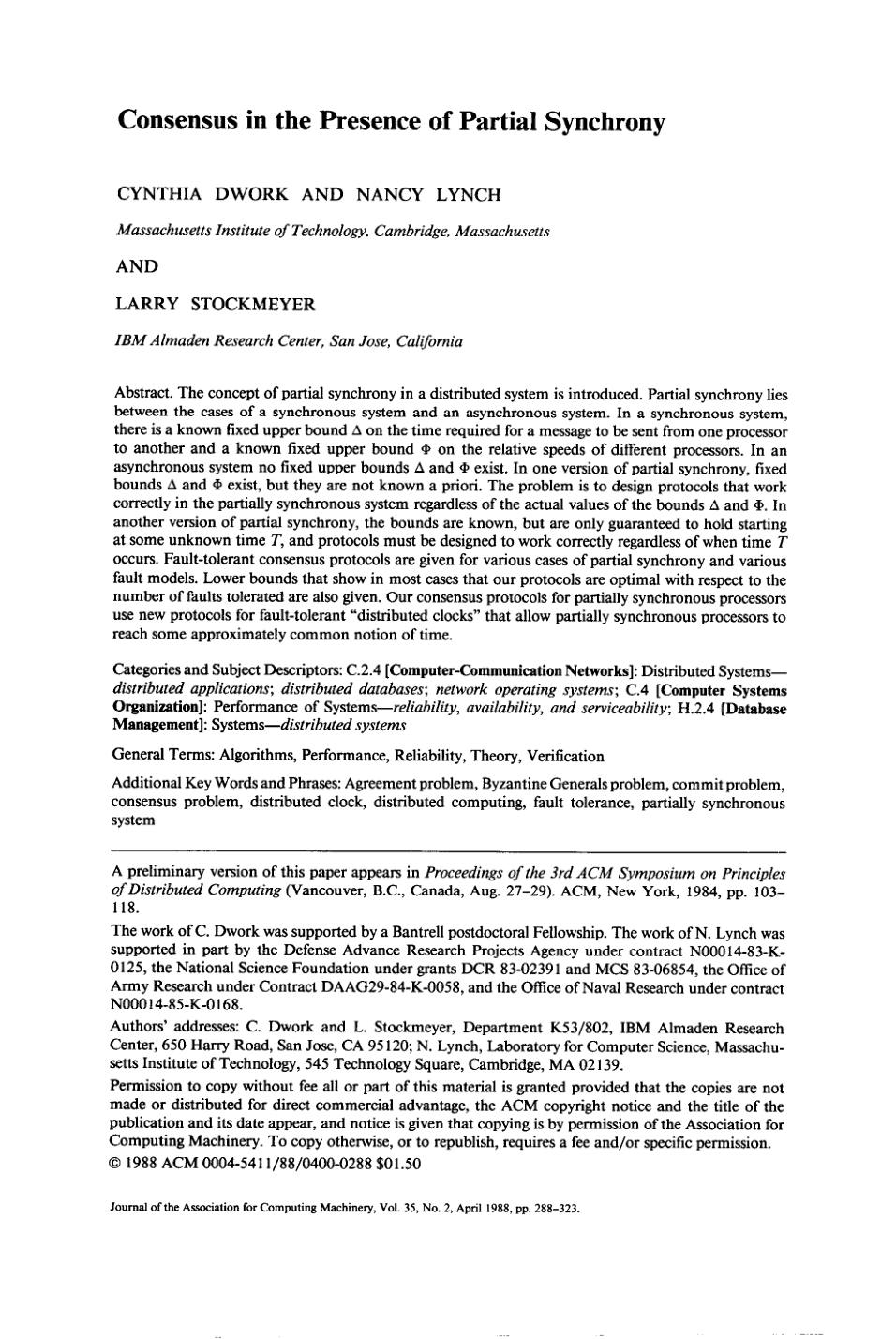
Consensus in the Presence of Partial Synchrony
作者:Cynthia Dwork、Nancy Lynch,Massachusetts Institute of Technology,Cambridge, Massachusetts;Larry Stockmeyer,IBM Almaden Research Center,San Jose, California。
Abstract
本文引入 distributed system 中 partial synchrony 的概念。Partial synchrony 位于 synchronous system 与 asynchronous system 两种情况之间。
在 synchronous system 中,存在一个已知的固定上界 Δ,表示 message 从一个 processor 发送到另一个 processor 所需的时间;还存在一个已知的固定上界 Φ,表示不同 processors 的相对速度差异。在 asynchronous system 中,不存在固定的 Δ 和 Φ 上界。
在一种 partial synchrony 中,固定 bounds Δ 和 Φ 存在,但事先并不知道它们的值。问题是:设计 protocols,使其无论实际 bounds Δ 和 Φ 是什么,都能在 partially synchronous system 中正确工作。
在另一种 partial synchrony 中,bounds 是已知的,但只保证从某个未知时间 T 开始成立;protocols 必须无论 T 何时发生都能正确工作。
本文针对多种 partial-synchrony 情况和多种 fault models 给出 fault-tolerant consensus protocols。本文还给出 lower bounds,说明在多数情况下,从可容忍 faults 数量来看,这些 protocols 是 optimal 的。
本文的 partially synchronous processors consensus protocols 使用了新的 fault-tolerant distributed clocks protocols,使 partially synchronous processors 能够达到某种近似共同的时间概念。
Categories and Subject Descriptors:C.2.4 Distributed Systems、distributed applications、distributed databases、network operating systems;C.4 reliability、availability、serviceability;H.2.4 distributed database systems。
General Terms:Algorithms、Performance、Reliability、Theory、Verification。
Additional Key Words and Phrases:Agreement problem、Byzantine Generals problem、commit problem、consensus problem、distributed clock、distributed computing、fault tolerance、partially synchronous system。
本文的 preliminary version 见 Proceedings of the 3rd ACM Symposium on Principles of Distributed Computing(Vancouver, B.C., Canada,August 27–29,1984,pp. 103–118)。
原文同时列出作者的 fellowship、DARPA、NSF、Office of Army Research 和 Office of Naval Research 资助信息,以及作者地址。
版权与复制说明:原刊页说明,复制全部或部分材料而不收取 direct commercial advantage 的费用时,必须保留 ACM copyright notice、publication title 与 date,并说明复制得到 Association for Computing Machinery 的许可;其他复制或再发表需要付费和/或取得具体许可。本笔记保留原始 PDF 页面图和书目信息。
第 2 页:Background 与两种 partial communication synchrony
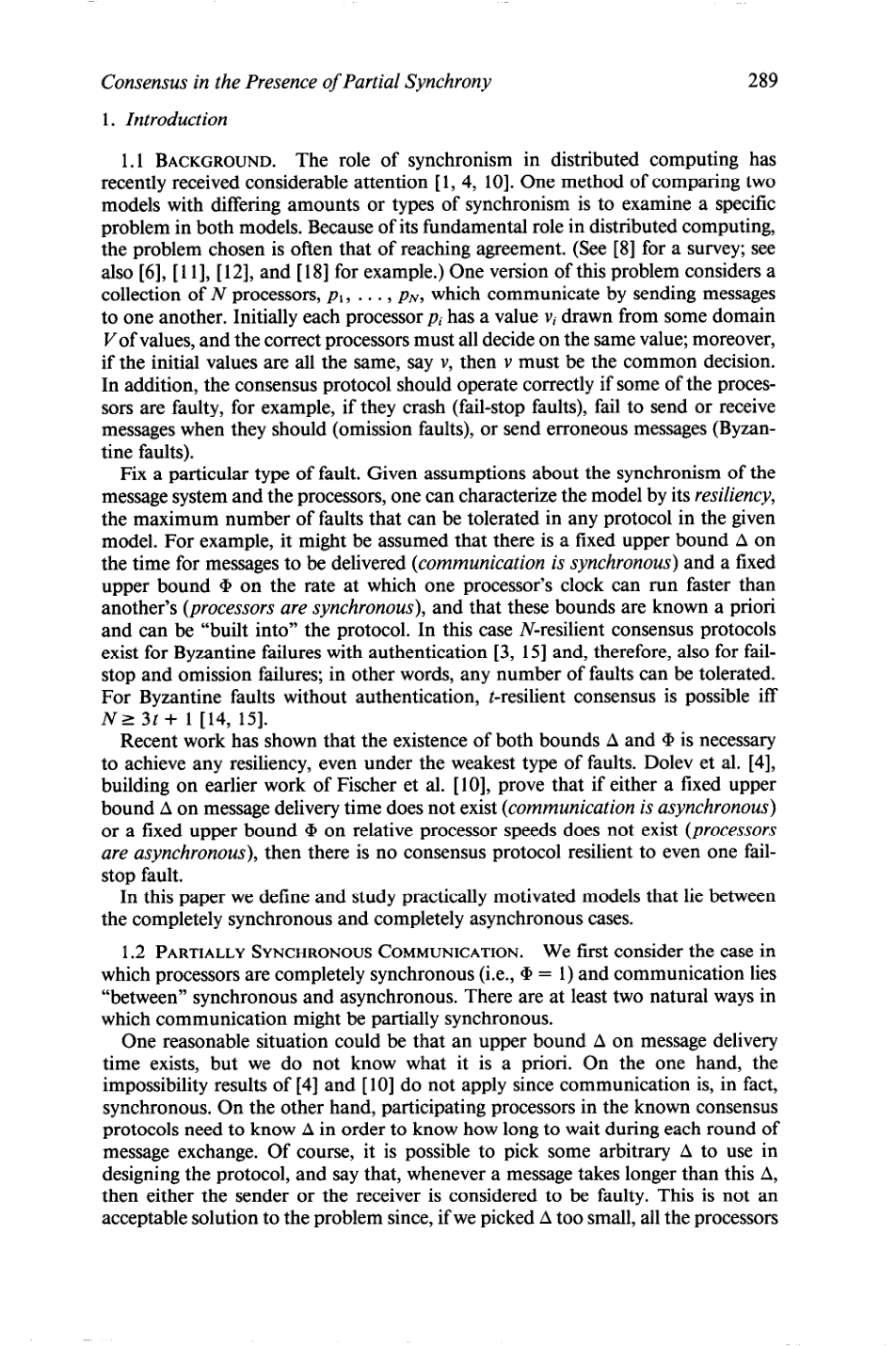
1. Introduction
1.1 BACKGROUND
最近,synchronism 在 distributed computing 中的作用受到相当多关注。比较具有不同数量或不同类型 synchronism 的两个 models 的一种方法,是在两个 models 中研究同一个具体 problem。
由于 agreement 在 distributed computing 中具有 fundamental role,被选择的问题通常是达成 agreement。(参见相关 survey 和文献。)
该 problem 的一个版本考虑一组 N 个 processors p1, ..., pN,它们通过互相发送 messages 进行通信。最初,每个 processor pi 都有一个从 value domain V 中取出的 value vi。Correct processors 必须全部决定同一个 value;此外,如果所有 initial values 都相同,例如都是 v,那么共同 decision 必须是 v。
Consensus protocol 还应当在部分 processors faulty 时正确运行,例如 processors 发生 crash(fail-stop faults)、在应发送或接收 messages 时没有发送或接收(omission faults),或者发送错误 messages(Byzantine faults)。
固定一种 fault type。给定关于 message system 和 processors synchronism 的 assumptions,可以用 model 的 resiliency 来刻画它:即在该 model 中,任何 protocol 能够容忍的最大 fault 数量。
例如,可以假设 message delivery time 存在固定上界 Δ(communication synchronous),processor clock 的运行速度相对于另一个 processor 存在固定上界 Φ(processors synchronous),并且这两个 bounds 事先已知,可以 “built into” protocol。
在这种情况下,带 authentication 的 Byzantine failures 存在 N-resilient consensus protocols,因此也存在 fail-stop 和 omission failures 的 N-resilient protocols;换句话说,可以容忍任意数量的 faults。
没有 authentication 的 Byzantine faults,则只有当 N ≥ 3t + 1 时才可能实现 t-resilient consensus。
近期工作说明,要获得任何 resiliency,同时存在 Δ 和 Φ 两个 bounds 是必要的。Dolev 等人基于 Fischer 等人的早期工作证明:如果 message delivery time 不存在固定上界 Δ(communication asynchronous),或者 relative processor speeds 不存在固定上界 Φ(processors asynchronous),那么即使只要求容忍一个 fail-stop fault,也不存在 consensus protocol。
本文定义并研究一组处于完全 synchronous 与完全 asynchronous 之间、且具有实际动机的 models。
1.2 PARTIALLY SYNCHRONOUS COMMUNICATION
我们首先考虑 processors 完全 synchronous(即 Φ = 1),而 communication 位于 synchronous 和 asynchronous 之间的情况。
communication 可能 partial synchronous,至少有两种自然方式。
一种合理情形是:message delivery time 存在上界 Δ,但我们事先不知道它是多少。一方面,Dolev 和 Fischer 等人的 impossibility results 不适用,因为 communication 实际上是 synchronous;另一方面,已有 consensus protocols 中的 participating processors 需要知道 Δ,才能知道每个 message-exchange round 应等待多长时间。
当然,可以在 protocol design 时任意选择一个 Δ;当 message 花费时间超过该 Δ 时,就把 sender 或 receiver 视为 faulty。但这不是可接受的 solution:如果选择的 Δ 太小,所有 processors 很快都可能被视为 faulty;按照定义,faulty processors 的 decisions 不必与任何其他 processor 的 decision 一致。
第 3 页:GST model、safety/termination 与初步 resiliency 结果
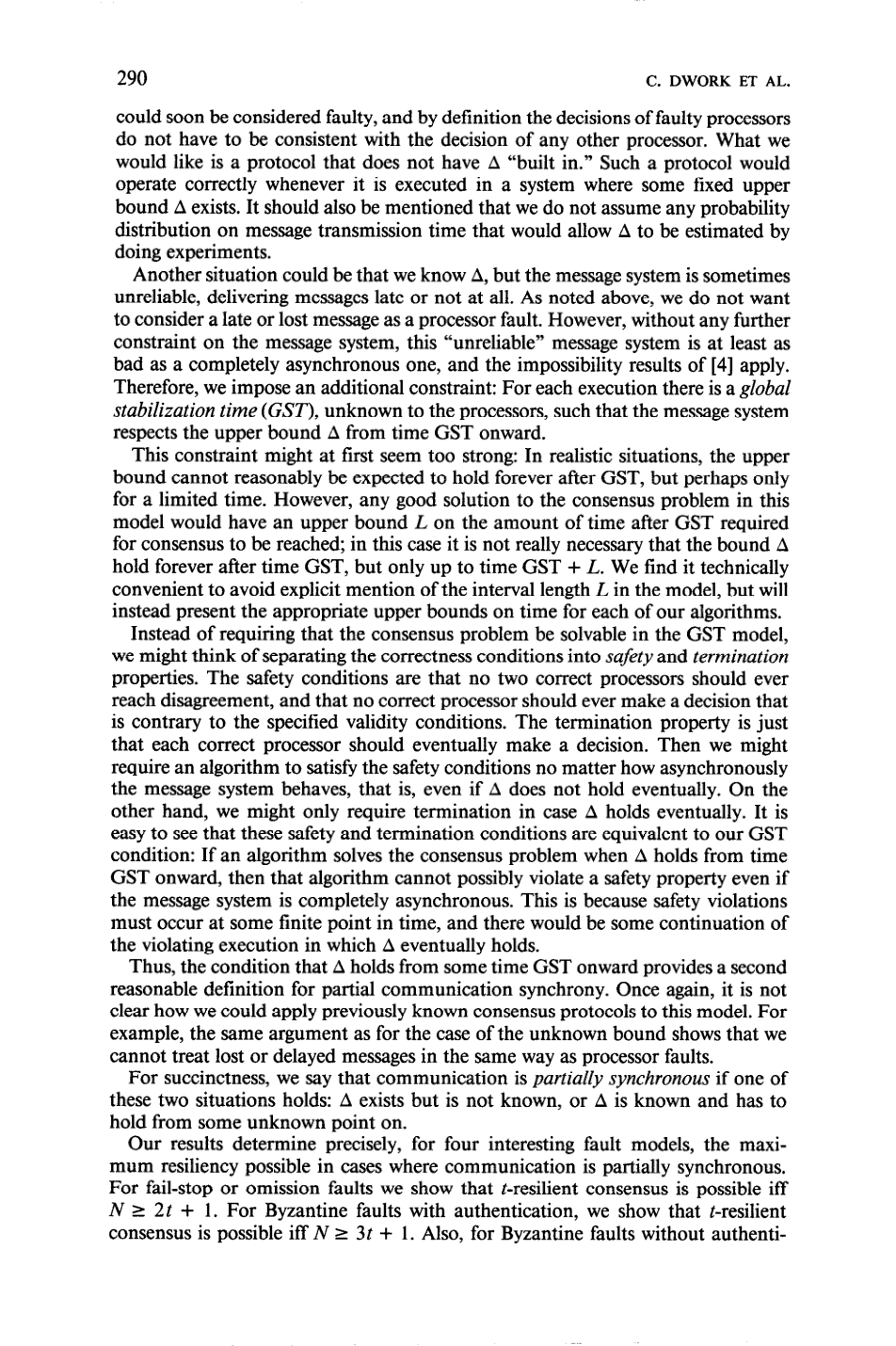
我们希望得到一种不把 Δ “built in” 的 protocol。这种 protocol 应当在任何存在某个固定 message-delivery upper bound Δ 的 system 中正确运行。
还要说明的是,我们不假设 message transmission time 存在某种 probability distribution,使得可以通过 experiments 估计 Δ。
另一种情形是:我们知道 Δ,但 message system 有时不可靠,messages 可能迟到或根本不到达。正如前面所述,我们不希望把 late 或 lost message 当作 processor fault。
然而,如果不对 message system 施加进一步约束,这种 “unreliable” message system 至少和 completely asynchronous system 一样糟糕,Dolev 等人的 impossibility result 仍然适用。
因此,我们增加一个 constraint:对每次 execution,都存在一个 processor 不知道的 Global Stabilization Time(GST);从 GST 开始,message system 遵守上界 Δ。
这个 constraint 初看可能太强。在 realistic situations 中,很难合理地期望上界在 GST 之后永久成立,也许只能维持一个有限 interval。但任何好的 consensus solution 都应当存在一个上界 L,表示 GST 之后达到 consensus 所需的时间;此时,并不需要 Δ 在 GST 之后永久成立,只需要成立到 GST + L。
本文为了 technical convenience,不在 model 中显式描述 interval length L,而是在每个 algorithm 中给出相应的 time upper bounds。
也可以不要求 consensus problem 在 GST model 中整体 solvable,而把 correctness conditions 分为 safety 和 termination:
- safety:任何两个 correct processors 都不应发生 disagreement;任何 correct processor 都不应作出违反 validity conditions 的 decision。
- termination:每个 correct processor 最终都应作出 decision。
于是,可以要求 algorithm 无论 message system 多么 asynchronous,都满足 safety,即使 Δ 最终不成立;另一方面,只在 Δ 最终成立时要求 termination。
容易看出,这些 safety/termination conditions 与 GST condition 等价。若 algorithm 在 Δ 从 GST 起成立时能够解决 consensus,那么即使 message system 完全 asynchronous,它也不可能违反 safety property。
原因是 safety violation 必须在某个 finite point 发生;而对于 violating execution,总能构造一个 continuation,使 Δ 最终成立。因此该 continuation 应满足 consensus correctness,而这与已经发生的 safety violation 矛盾。
所以,“从某个 GST 开始 Δ 成立”提供了 partial communication synchrony 的第二种合理定义。我们仍然不清楚如何把已知 consensus protocols 直接应用到这个 model。
简洁起见,如果以下两种情况之一成立,我们就称 communication 是 partially synchronous:
- Δ 存在但未知;或者
- Δ 已知,但必须从某个未知点开始成立。
本文的 results 精确确定了四种 interesting fault models 在 partially synchronous communication 下的 maximum resiliency:
- fail-stop 或 omission faults:t-resilient consensus 可实现,当且仅当
N ≥ 2t + 1; - authenticated Byzantine faults:t-resilient consensus 可实现,当且仅当
N ≥ 3t + 1; - unauthenticated Byzantine faults:t-resilient consensus 可实现,当且仅当
N ≥ 3t + 1。
对于四种 faults,所有 correct processors 达成 consensus 所需的时间为:Δ 未知的 model 中,N 和 Δ 的 polynomial;GST model 中,GST 加上 N 和 Δ 的 polynomial。
本文所有在 N、Δ、GST 等 parameters 上具有 polynomial time bound 的 consensus protocols,也具有 total message bits 数量 polynomially bounded 的性质。
第 4 页:Resiliency 表与共同协议方法
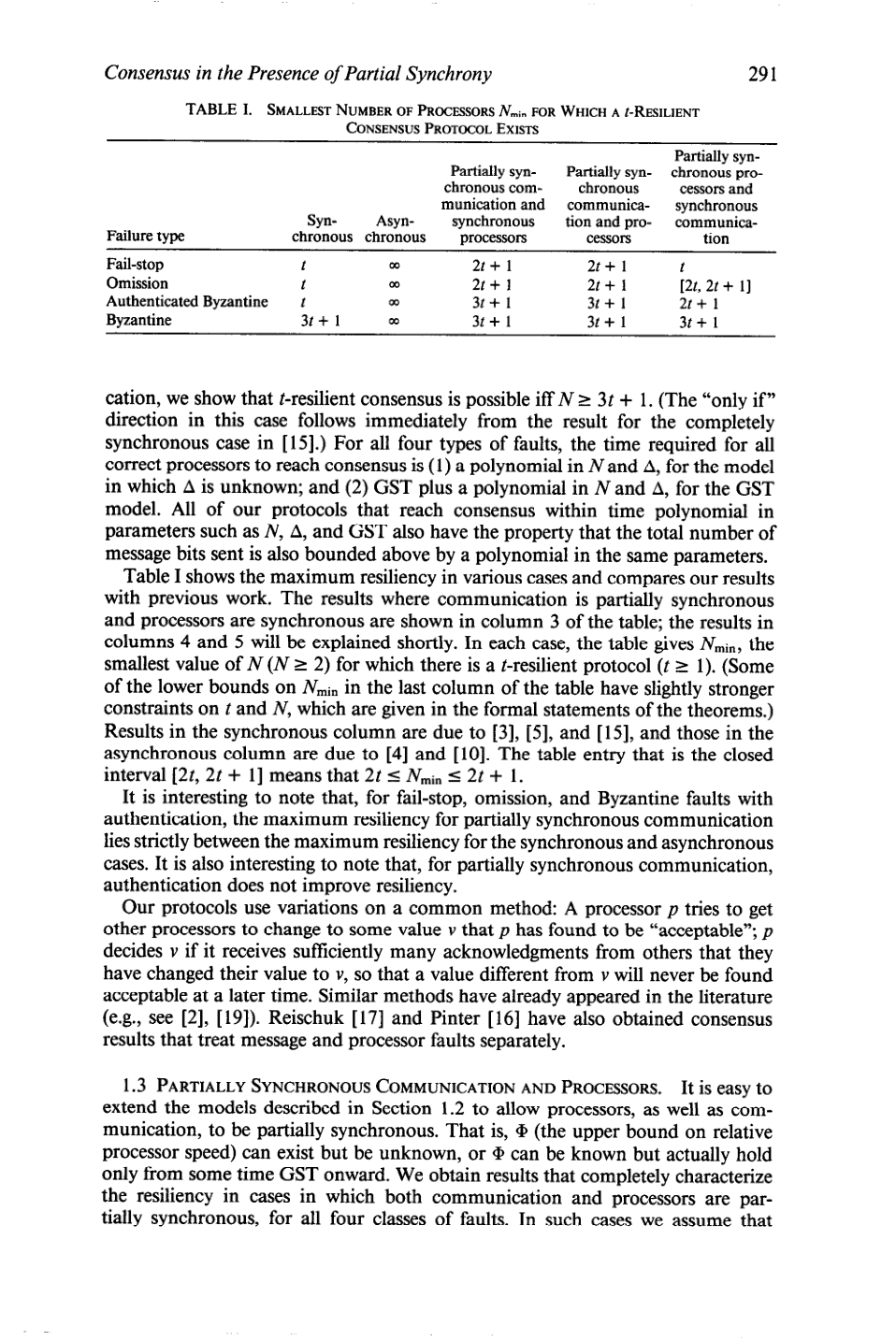
表 1:存在 t-resilient consensus protocol 所需的最小 processor 数量
Nmin。 原表按以下列比较:synchronous、asynchronous、partially synchronous processors + synchronous communication、partially synchronous communication + synchronous processors、partially synchronous communication + processors。原表中的结果为:
| Failure type | Synchronous | Asynchronous | Partial processors + sync communication | Partial communication + sync processors | Both partial |
|---|---|---|---|---|---|
| Fail-stop | t + 1 | ∞ | 2t + 1 | t + 1 | 2t + 1 |
| Omission | t + 1 | ∞ | 2t + 1 | 2t + 1 | [2t, 2t + 1] |
| Authenticated Byzantine | t + 1 | ∞ | 3t + 1 | 3t + 1 | 2t + 1 |
| Byzantine | 3t + 1 | ∞ | 3t + 1 | 3t + 1 | 3t + 1 |
这里的表格转录保留原文的比较含义;[2t, 2t + 1] 表示 2t ≤ Nmin ≤ 2t + 1。每个 case 中,Nmin 是存在 t-resilient protocol 的最小 N(N ≥ 2,t > 1)。原文指出,最后一列的一些 lower bounds 对 t 和 N 还有更强约束,正式 theorem 中会说明。
synchronous column 的 results 来自相关早期工作;asynchronous column 的 results 来自 FLP 方向的 impossibility results。
有趣的是,对于 fail-stop、omission 和 authenticated Byzantine faults,partially synchronous communication 的 maximum resiliency 严格位于 synchronous 与 asynchronous cases 的 maximum resiliency 之间。
另一个有趣现象是:在 partially synchronous communication 中,authentication 并不能提高 resiliency。
本文 protocols 使用一种共同方法的变体:processor p 试图让其他 processors 把自己的 value 改成 p 认为 “acceptable” 的 value v;如果 p 从足够多的其他 processors 收到 acknowledgment,确认它们已经把 value 改成 v,使得之后不可能再有不同于 v 的 value 被认为 acceptable,那么 p 就决定 v。
类似方法已经出现在文献中。Reischuk 和 Pinter 也得到了分别处理 message faults 与 processor faults 的 consensus results。
1.3 PARTIALLY SYNCHRONOUS COMMUNICATION AND PROCESSORS
把 Section 1.2 的 models 扩展为 processors 也 partial synchronous 很容易:也就是 relative processor speed upper bound Φ 可以存在但未知,或者 Φ 已知但只从某个 GST 之后成立。
对于四类 faults,本文完全刻画 communication 和 processors 都 partial synchronous 时的 resiliency。这种情况下,我们假设 communication 和 processors 具有同一种 partial synchrony:要么 Φ 和 Δ 都未知,要么二者都从某个 GST 开始成立。
第 5 页:两者都 partial synchrony 与 distributed clocks
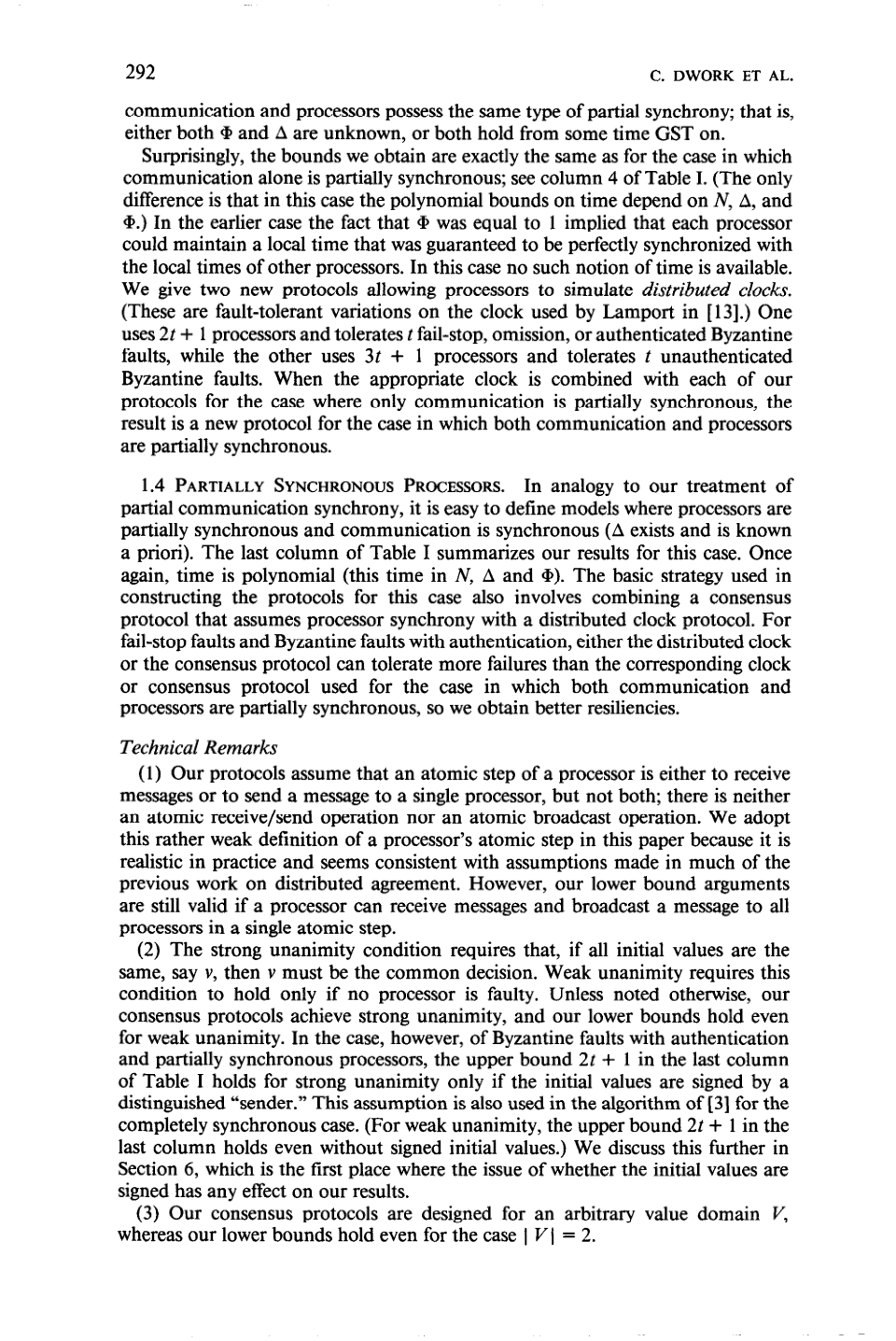
令人意外的是,这里得到的 bounds 与“只有 communication partial synchronous”时完全相同(见表 1 第四列)。差别仅在于:此时 time polynomial bounds 依赖 N、Δ 和 Φ。
在前一种情形中,Φ 等于 1,意味着每个 processor 都能维护一个 local time,并保证它与其他 processors 的 local times 完全同步。本节讨论的情形没有这种 time notion。
我们给出两个新的 protocols,让 processors 模拟 distributed clocks。这些是 Lamport clock 的 fault-tolerant variations:一种使用 2t + 1 个 processors,容忍 t 个 fail-stop、omission 或 authenticated Byzantine faults;另一种使用 3t + 1 个 processors,容忍 t 个 unauthenticated Byzantine faults。
把适当的 clock 与“只有 communication partial synchronous”时的 protocols 结合,就得到 communication 和 processors 同时 partial synchronous 时的新 protocol。
1.4 PARTIALLY SYNCHRONOUS PROCESSORS
类似对 partial communication synchrony 的处理,可以定义 processors partial synchronous、communication synchronous(Δ 存在且事先已知)的 models。
表 1 最后一列总结了这种情形的 results。此时 time bound 是 N、Δ 和 Φ 的 polynomial。
构造 protocols 的基本 strategy,仍然是把假设 processor synchrony 的 consensus protocol 与 distributed clock protocol 结合起来。
对于 fail-stop faults 和 authenticated Byzantine faults,distributed clock 或 consensus protocol 中有一个可以容忍比“communication 和 processors 都 partial synchronous”时对应组件更多的 faults,因此可以得到更好的 resiliency。
Technical Remarks
-
本文假设 processor 的一个 atomic step 要么是接收 messages,要么是向单个 processor 发送一个 message,但不能二者同时进行;不存在 atomic receive/send operation,也不存在 atomic broadcast operation。
本文采用这种较弱的 atomic-step 定义,是因为它在实践中 realistic,也与此前 distributed agreement 工作中的假设一致。但即使 processor 能在一个 atomic step 中接收 messages 并向所有 processors broadcast,一个 lower-bound argument 仍然成立。
-
Strong unanimity 要求:如果所有 initial values 都相同(例如都是
v),那么共同 decision 必须是v。Weak unanimity 只在没有 processor faulty 时要求该条件。除非另有说明,本文 consensus protocols 都达到 strong unanimity,lower bounds 即使对 weak unanimity 也成立。
但在 authenticated Byzantine faults 且 processors partial synchronous 的 case 中,表 1 最后一列的
2t + 1upper bound 只有在 initial values 由一个 distinguished “sender” 签名时,才对 strong unanimity 成立。完全 synchronous case 的 algorithm 也使用这一假设。对于 weak unanimity,即使没有 signed initial values,最后一列的2t + 1upper bound 仍成立。Section 6 会进一步讨论这个问题。 -
Consensus protocols 面向 arbitrary value domain
V;而 lower bounds 即使在|V| = 2的情形下也成立。
第 6 页:论文结构与 formal computation model
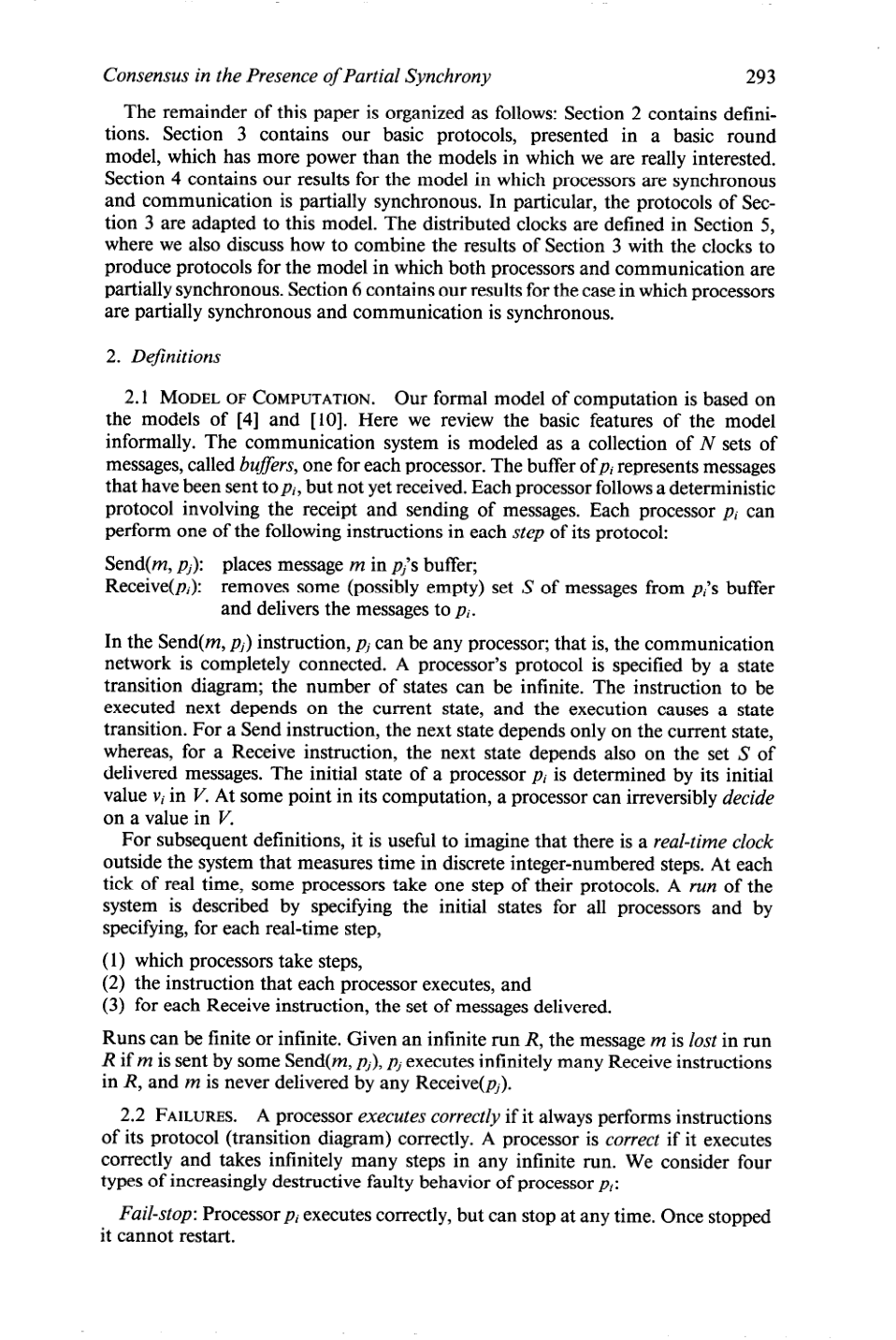
本文其余部分组织如下:Section 2 给出 definitions;Section 3 在一个比目标 model 更强的 basic round model 中给出 basic protocols;Section 4 讨论 processors synchronous、communication partial synchronous 的 model,并把 Section 3 protocols 适配到该 model;Section 5 定义 distributed clocks,并把 Section 3 results 与 clocks 结合,得到 processors 和 communication 同时 partial synchronous 的 protocols;Section 6 讨论 processors partial synchronous、communication synchronous 的情形。
2. Definitions
2.1 MODEL OF COMPUTATION
本文的 formal computation model 建立在相关早期 models 之上。下面非正式回顾其 basic features。
communication system 被建模为 N 个 message sets,称为 buffers;每个 processor 有一个 buffer。pi 的 buffer 表示已经发送给 pi、但尚未被接收的 messages。
每个 processor 遵循一个涉及接收和发送 messages 的 deterministic protocol。每一步中,processor pi 可以执行以下 instructions 之一:
Send(m, pj):
    把 message m 放入 pj 的 buffer。

Receive(pi):
    从 pi 的 buffer 中移除某个(可能为空的)message set S,
    并把这些 messages 交给 pi。
在 Send(m, pj) instruction 中,pj 可以是任意 processor,即 communication network completely connected。
processor protocol 由 state-transition diagram 指定,state 数量可以是 infinite。下一条 instruction 取决于 current state,执行 instruction 会产生 state transition。
对于 Send instruction,next state 只依赖 current state;对于 Receive instruction,next state 还依赖 delivered message set S。
processor pi 的 initial state 由它在 V 中的 initial value vi 决定。在 computation 的某个时刻,processor 可以 irreversibly decide 一个 V 中的 value。
为便于后续定义,可以设想 system 外部存在一个 real-time clock,以离散、编号递增的 steps 测量时间。每个 real-time tick,某些 processors 执行一次 protocol step。
system 的一次 run,由以下信息描述:所有 processors 的 initial states;以及每个 real-time step 中,
- 哪些 processors 执行 steps;
- 每个 processor 执行哪条 instruction;
- 对于每个 Receive instruction,交付哪些 messages。
Runs 可以是 finite 或 infinite。
给定 infinite run R,如果 message m 由某个 Send(m, pj) 发送,pj 在 R 中执行 infinitely many Receive instructions,而 m 从未由任何 Receive(pj) delivered,则称 message m 在 run R 中 lost。
2.2 FAILURES
如果 processor 总是正确执行其 protocol(transition diagram)中的 instructions,则称它执行正确。如果 processor 执行正确,并且在任意 infinite run 中都执行 infinitely many steps,则称它是 correct。
本文考虑 processor pi 的四种破坏性逐渐增强的 faulty behaviors:
-
Fail-stop:
pi正确执行 protocol,但可以在任意时刻停止;一旦停止就不能 restart。 -
Omission:
pi正确遵循 protocol,但执行Send(m, pj)时可能不把m放入pj的 buffer;执行Receive(pi)时,可能只真正接收 delivered messages 的某个 subset。换句话说,如果某个 message set
S被交给pi,且所有S中 messages 都从pi的 buffer 移除,但pi的 state transition 却像只 delivered 了S'(S'可以为空,也可以是S的 subset),则这是 reception 上的 omission fault。
第 7 页:Fault models、partial synchrony 的 formal 定义
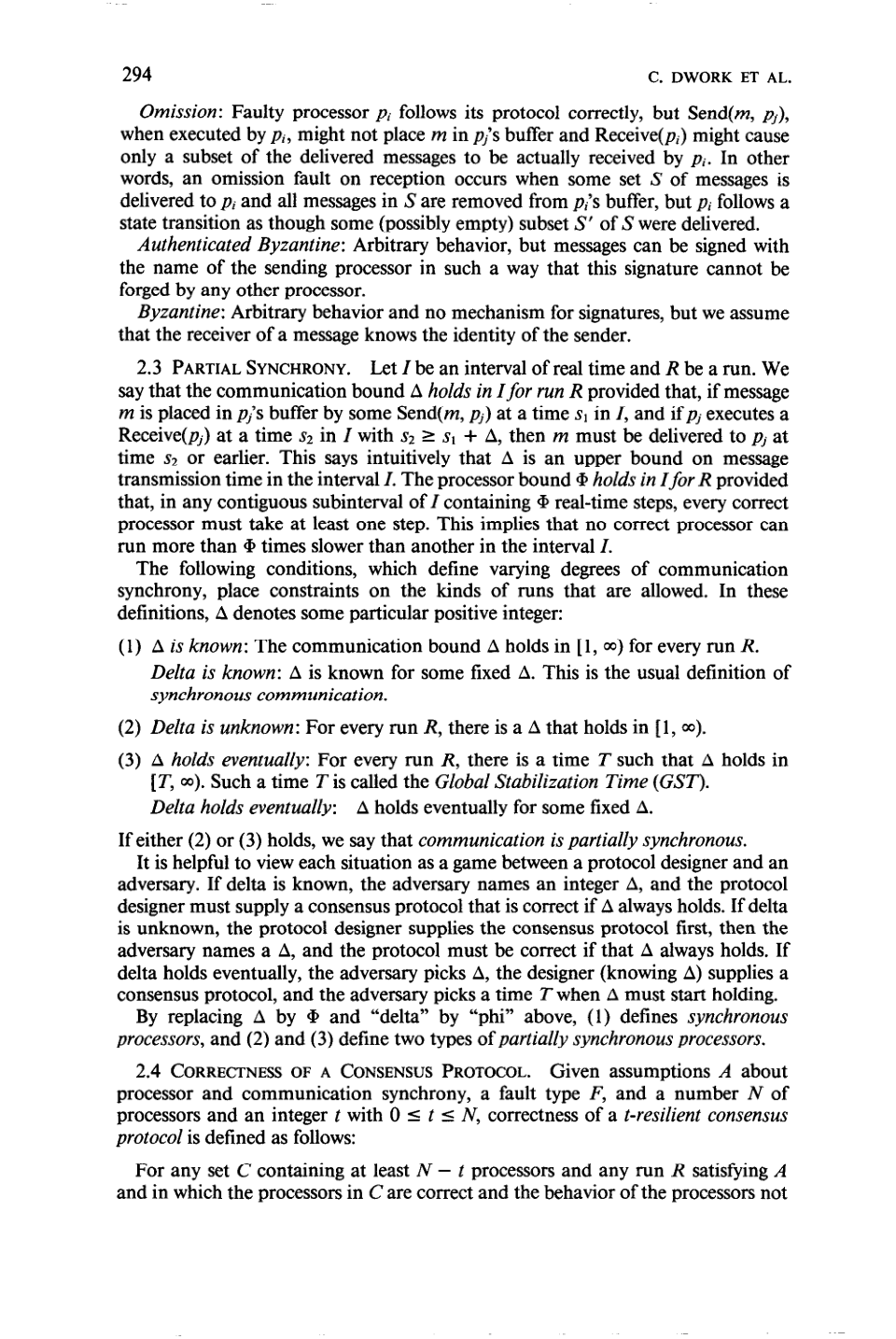
-
Authenticated Byzantine:processor 可以任意行为,但 messages 可以用发送 processor 的 name 签名,并且任何其他 processor 都不能伪造该 signature。
-
Byzantine:processor 可以任意行为,没有 signature mechanism,但 receiver 知道 message sender 的 identity。
2.3 PARTIAL SYNCHRONY
设 I 是 real-time interval,R 是一次 run。如果在 run R 中,某次 Send(m, pj) 在时间 s1 ∈ I 把 message m 放入 pj 的 buffer,并且 pj 在时间 s2 ∈ I 执行 Receive(pj),其中 s2 ≥ s1 + Δ,那么 message m 必须在 s2 或更早的时间被 delivered 给 pj;此时称 communication bound Δ 在 I 中对 R 成立。
直观上,这表示 Δ 是该 interval 中 message transmission time 的 upper bound。
如果在 I 的任意 contiguous subinterval 中,只要该 subinterval 包含 Φ 个 real-time steps,每个 correct processor 至少执行一个 step,那么称 processor bound Φ 在 I 中对 R 成立。
这意味着,在该 interval 中,任何 correct processor 都不会比另一个 processor 慢超过 Φ 倍。
下面的 conditions 定义不同程度的 communication synchrony,并限制允许的 runs。这里 Δ 表示某个特定的 positive integer:
- Δ is known:对每个 run
R,communication bound Δ 在[1,∞)中成立;也就是固定的 Δ 已知。这是 synchronous communication 的通常定义。 - Δ is unknown:对每个 run
R,存在某个 Δ,使得 Δ 在[1,∞)中成立。 - Δ holds eventually:对每个 run
R,存在一个时间T,使得 Δ 在[T,∞)中成立。这个T称为 Global Stabilization Time(GST)。
如果某个固定 Δ eventually holds,就称 “Δ holds eventually”。如果 (2) 或 (3) 成立,就称 communication partially synchronous。
可以把每种 situation 看成 protocol designer 与 adversary 之间的 game:
- 若 Δ 已知,adversary 指定整数 Δ,protocol designer 必须提供一个在 Δ 始终成立时正确的 consensus protocol。
- 若 Δ 未知,protocol designer 先提供 consensus protocol,之后 adversary 指定 Δ;protocol 必须在该 Δ 始终成立时正确。
- 若 Δ eventually holds,adversary 先选择 Δ,designer(知道 Δ)提供 consensus protocol;然后 adversary 选择 Δ 开始成立的时间
T。
把上面的 Δ 替换成 Φ,就得到 synchronous processors 的定义,以及两种 partially synchronous processors 的定义。
2.4 CORRECTNESS OF A CONSENSUS PROTOCOL
给定 processor/communication synchrony assumptions A、fault type F、N 个 processors,以及 0 ≤ t ≤ N 的整数 t,t-resilient consensus protocol 的 correctness 定义如下:
对任何包含至少 N − t 个 processors 的 set C,以及满足 A、且 C 中 processors correct、C 外 processors 的 behavior 属于 fault type F 所允许范围的任何 run R,protocol 都达到:
- Consistency:
C中没有两个不同 processors 作出不同 decisions。 - Termination:如果
R是 infinite,则C中每个 processor 都作出 decision。 - Unanimity:有两种形式:
- Strong unanimity:如果所有 initial values 都是
v,且C中任意 processor 作出 decision,则该 decision 是v。 - Weak unanimity:如果所有 initial values 都是
v,C包含所有 processors,且任意 processor 作出 decision,则该 decision 是v。
- Strong unanimity:如果所有 initial values 都是
在 messages 不会 lost 的 models(例如 Δ unknown 的 models)中,可以很容易修改 protocols,使所有 correct processors 在足够多 correct processors 已经 decided 后不久 halt。
但本文不在 termination condition 中显式要求 halting,因为可以证明:在 Δ eventually holds 的 model 中,如果 protocol 对 fail-stop faults 是 t-resilient,且 GST 之前 messages 可能 lost,那么存在某次 execution,使某个 correct processor 不 halt。
Section 4.2 的 Remark 2 会在 protocols 描述之后进一步讨论 halting 问题。
第 8 页:Basic round model 与 proper values
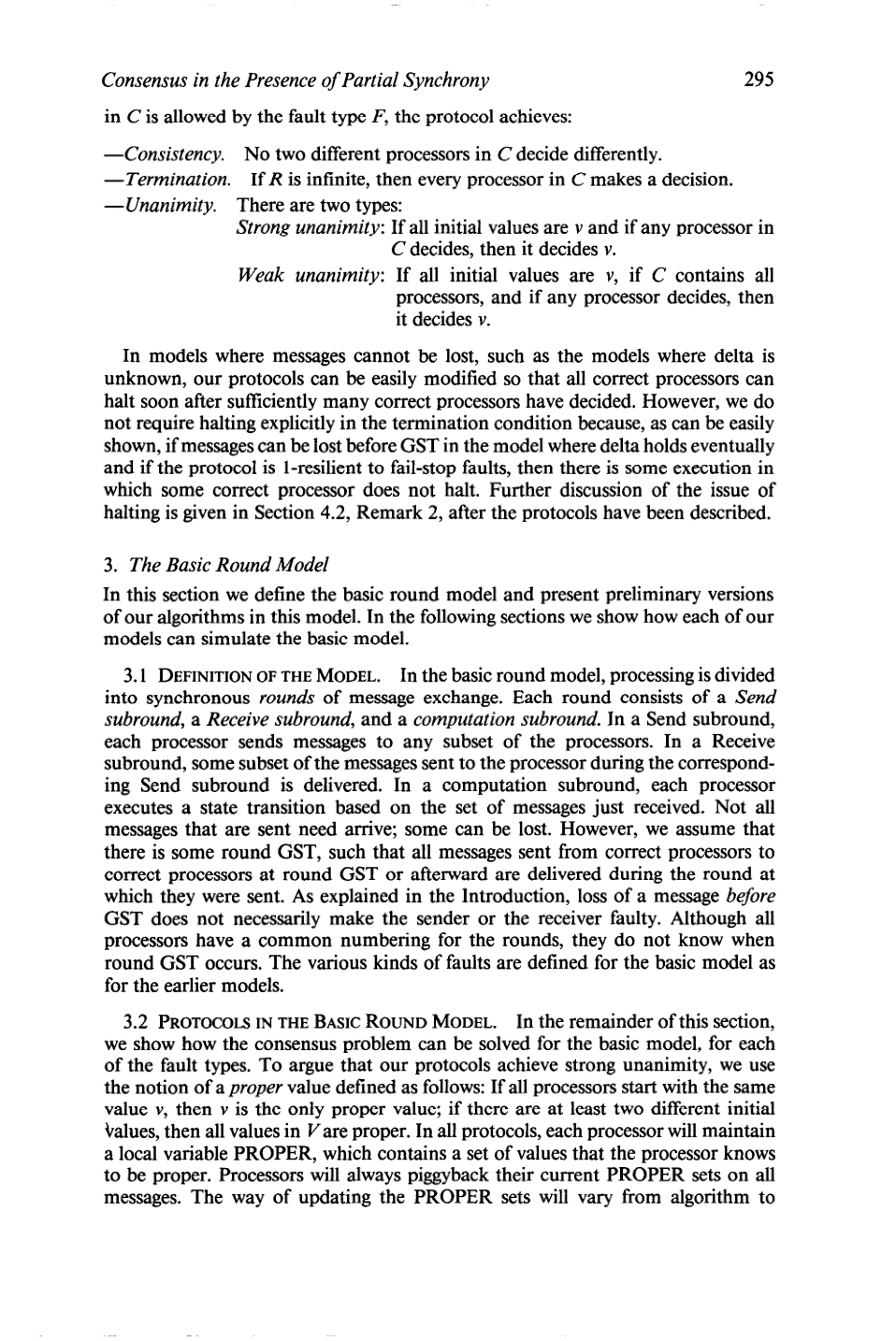
3. The Basic Round Model
本节定义 basic round model,并在该 model 中给出 algorithms 的 preliminary versions。后续 sections 将展示各目标 models 如何模拟 basic model。
3.1 DEFINITION OF THE MODEL
在 basic round model 中,processing 被划分为同步的 message-exchange rounds。每个 round 包含:Send subround、Receive subround 和 computation subround。
- 在 Send subround 中,每个 processor 向任意 subset 的 processors 发送 messages。
- 在 Receive subround 中,Send subround 中发给该 processor 的 messages 的某个 subset 被 delivered。
- 在 computation subround 中,每个 processor 根据刚刚收到的 messages 执行 state transition。
并非所有发送的 messages 都必须到达;一些 messages 可以 lost。但是,存在某个 round GST,使得从该 round GST 或之后开始,correct processors 发给 correct processors 的所有 messages,都会在发送它们的那个 round 内 delivered。
正如 Introduction 中解释的,GST 之前 message loss 不一定使 sender 或 receiver faulty。
所有 processors 对 rounds 使用共同编号,但它们不知道 round GST 何时发生。各种 faults 的定义与前面的 models 相同。
3.2 PROTOCOLS IN THE BASIC ROUND MODEL
本节剩余部分展示:对每种 fault type,如何在 basic model 中解决 consensus problem。
为了论证 protocols 达到 strong unanimity,我们使用 proper value 概念:
- 如果所有 processors 都从相同的 value
v开始,那么v是唯一 proper value; - 如果至少存在两个不同 initial values,那么
V中的所有 values 都是 proper。
在所有 protocols 中,每个 processor 都维护一个 local variable PROPER,其中包含该 processor 知道是 proper 的 values。
Processors 会把当前 PROPER sets piggyback 到所有 messages 上。不同 algorithms 更新 PROPER sets 的方式不同;下一页开始给出相应协议。
第 9 页:Fail-stop/omission 的 Algorithm 1
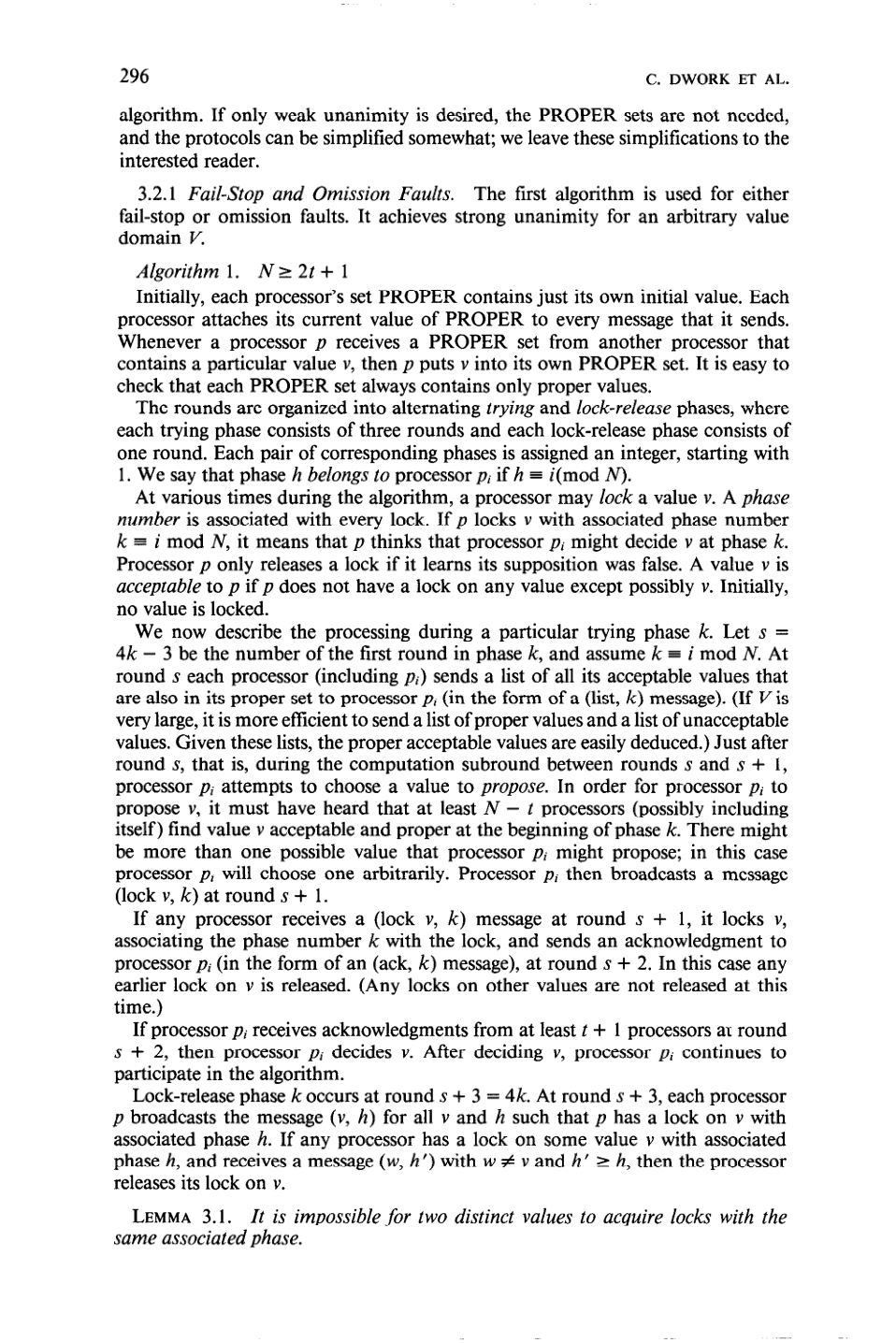
如果只要求 weak unanimity,则不需要 PROPER sets,protocols 也可以相应简化;本文把这些简化留给感兴趣的读者。
3.2.1 Fail-Stop and Omission Faults
第一个 algorithm 同时用于 fail-stop 和 omission faults。它对 arbitrary value domain V 达到 strong unanimity。
Algorithm 1:N ≥ 2t + 1
- 初始时,每个 processor 的
PROPERset 只包含自己的 initial value。 - 每个 processor 把当前
PROPERvalue 附加到它发送的每个 message 上。 - 当 processor
p从另一个 processor 收到一个PROPERset,且其中包含 valuev时,p把v加入自己的PROPERset。
容易检查:每个 PROPER set 始终只包含 proper values。
Rounds 被组织为交替的 trying phases 和 lock-release phases。每个 trying phase 包含 3 个 rounds,每个 lock-release phase 包含 1 个 round。每一对对应 phases 被赋予一个 integer,从 1 开始。
如果 h = i (mod N),就说 phase h 属于 processor pi。
在 algorithm 的不同时间,processor 可能 lock 某个 value v。每个 lock 都关联一个 phase number。如果 p 以 phase number k = i (mod N) lock v,意思是:p 认为 processor pi 可能在 phase k 决定 v。
Processor p 只有在得知这个 supposition 错误时才释放 lock。对于 p,如果它没有 lock 除了 v 之外的任何 value,就说 v 对 p 是 acceptable。初始时没有任何 value 被 locked。
现在描述某个 trying phase k 的 processing。令 s = 4k − 3,表示 phase k 的 first round,并假定 k = i (mod N)。
在 round s,每个 processor(包括 pi)把所有同时满足以下条件的 acceptable values 发送给 pi:它们也在自己的 proper set 中。消息形式为 (list, k)。
如果 V 很大,更高效的方式是发送 proper values list 和 unacceptable values list;从这两个 lists 可以很容易推导出 proper acceptable values。
刚过 round s,即在 s 与 s + 1 之间的 computation subround 中,pi 尝试选择要 propose 的 value。为了 propose v,pi 必须听到至少 N − t 个 processors(可以包括自己)在 phase k 开始时认为 v acceptable 且 proper。
如果可能 propose 的 values 不止一个,pi 任意选择一个。随后,pi 在 round s + 1 broadcast (lock v, k) message。
如果任意 processor 在 round s + 1 收到 (lock v, k),它就 lock v,把 phase number k 与该 lock 关联起来,并在 round s + 2 向 pi 发送 acknowledgment (ack, k)。此时,它会释放之前对 v 的 lock;但不会在这一时刻释放对其他 values 的 locks。
如果 pi 在 round s + 2 收到至少 t + 1 个 processors 的 acknowledgments,就决定 v。决定 v 之后,pi 仍然继续参与 algorithm。
Phase k 的 lock-release phase 位于 round s + 3 = 4k。在该 round,每个 processor p 对所有自己持有 lock 的 (v, h) broadcast (v, h) message。
如果 processor 对某个 value v 持有 associated phase h 的 lock,并收到 (w, h'),其中 w ≠ v 且 h' ≥ h,则它释放 v 的 lock。
Lemma 3.1
两个不同 values 不可能在同一个 associated phase 获得 locks。
证明:为了让两个 values v 和 w 在 trying phase k 获得 locks,拥有 phase k 的 processor 必须发送互相冲突的 (lock v, k) 和 (lock w, k) messages;在这种 fault model 中,该 processor 不会这样做。
Lemma 3.2
假设某 processor 在 phase k 决定 v,且 k 是发生任何 decision 的最小 phase number。那么至少 t + 1 个 processors 在 phase k lock v。
此外,从那一刻起,所有在 phase k lock v 的 processors 始终持有 v 的 lock,且 associated phase number 至少为 k。
证明要点:至少 t + 1 个 processors lock v 是直接的。若第二个结论不成立,令 l 是某个 phase:其中一个 phase k 设置的 locks 在不被更高 phase 的 v lock 立即替代的情况下首次释放。
该 lock 只能在 lock-release phase l 释放,因为某 processor 得知另一个 value w ≠ v 在 phase h 获得了 lock,其中 k ≤ h ≤ l。由 Lemma 3.1,不可能有任何 value w ≠ v 在 phase k 获得 lock,因此必有 k < h ≤ l。
于是,在 phase h 的 first round,w 必须被至少 N − t 个 processors 认为 acceptable;这意味着在该 phase 开始时,至少 N − t 个 processors 没有 lock v。但到 l 的 first round,已有 t + 1 processors 至少一直持有 v lock,矛盾。
Lemma 3.3
在 GST 或之后发生的任意 lock-release phase 之后,correct processors 所持有 locks 中的 values 至多有一个。
证明:直接由 lock-release rule 得出。
Theorem 3.1
假设 basic model 中存在 fail-stop 或 omission faults,并且 N ≥ 2t + 1。那么 Algorithm 1 对 arbitrary value domain 达到 consistency、strong unanimity 和 termination。
证明:
首先证明 consistency。假设某 correct processor pi 在 phase k 决定 v,并且 k 是最小 decision phase。由 Lemma 3.2,在 phase k 之后的任何时刻,至少有 t + 1 个 processors lock v。
因此,在任何更晚的 phase 中,不可能有不同于 v 的 value 被至少 N − t 个 processors 认为 acceptable;所以没有 processor 会决定 v 以外的 value。
strong unanimity:如果所有 initial values 都是 v,那么任何 processor 的 PROPER set 中出现的唯一 value 就是 v,所以唯一可能的 decision value 是 v。
termination:考虑某个属于 correct processor pi 的 trying phase k;它和此前的 lock-release phase 都发生在 GST 或之后。如果 pi 尚未决定,就会在 trying phase k 达到 decision。
由 Lemma 3.3,在 trying phase k 开始时,correct processors 至多 lock 一个 value。如果存在这样的 locked value v,则到 phase k 开始时已经发生了足够 communication,使每个 correct processor 的 PROPER set 都包含 v。
此外,每个 correct processor 的 initial value 也都在 phase k 开始时进入所有 correct processors 的 PROPER sets。因为至少有 N − t ≥ t + 1 个 correct processors,所以 pi 一定能找到 proper、acceptable value 来 propose,并在该 trying phase 决定 proposed value。
所有 correct processors 最迟在 GST + 4(N + 1) 个 rounds 前作出 decisions。
第 10 页:Algorithm 1 的 proof 与 authenticated Byzantine 的 Algorithm 2
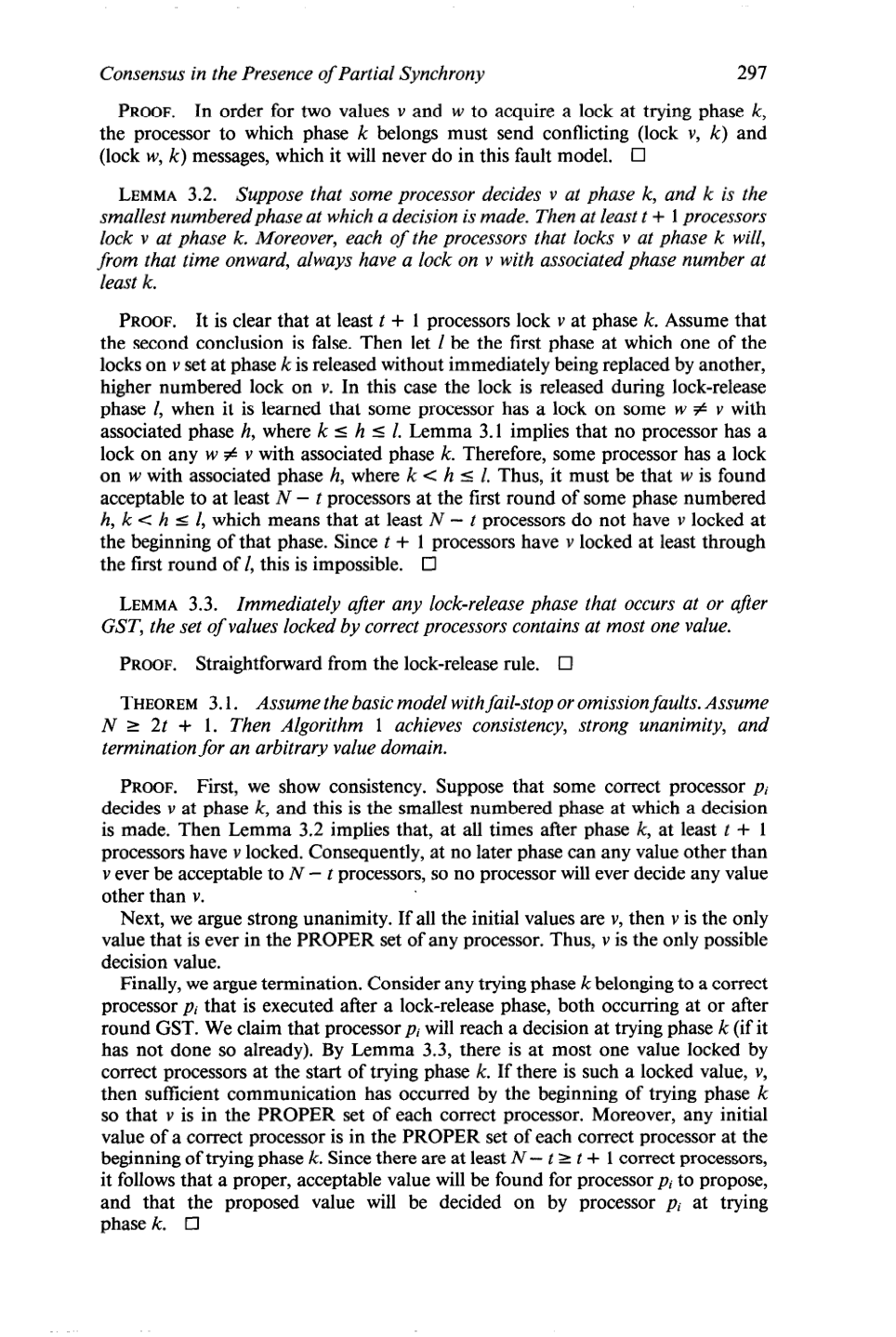
3.2.2 Byzantine Faults with Authentication
第二个 algorithm 用于带 authentication 的 Byzantine faults,并对 arbitrary value set V 达到 strong unanimity。
Algorithm 2:N ≥ 3t + 1
初始时,每个 processor 的 PROPER set 只包含自己的 initial value。每个 processor 把自己的 PROPER set 和 initial value 附加到每条发送的 message 上。
如果 processor p 收到来自不同 processors 的 2t + 1 个 initial values,且其中没有 t + 1 个具有相同 value,那么 p 把整个 V 放入自己的 PROPER set。(实际实现中只需要设置一个 bit,表示 PROPER 包含整个 V。)
如果 processor p 从至少 t + 1 个其他 processors 收到 claims,声称某个 value v 在它们的 PROPER sets 中,则 p 把 v 放入自己的 PROPER set。
不难检查,correct processor 的 PROPER set 始终只包含 proper values。
Processing 同样分为交替的 trying 和 lock-release phases,phase 编号和长度与 Algorithm 1 相同。
Algorithm 2 中,每个 lock 除了关联 phase number,还关联一份证明 value 可接受:这是一组由 N − t 个 processors 发送的 signed messages,声明在给定 phase 开始时,locked value 是 acceptable 且位于它们的 PROPER sets 中。
某 value v 对 p acceptable,当且仅当 p 没有 lock 除 v 之外的其他 value。
在 phase k 中,令 s = 4k − 3。round s,每个 processor pj(包括 pi)以 Ej(list, k) 形式把自己的 proper acceptable values list 发送给 pi,其中 Ej 是 authentication function。
刚过 round s,pi 尝试选择 propose value。它必须听到至少 N − t 个 processors 在 phase k 认为 v acceptable 且 proper。若有多个 possible values,任意选择一个。
随后,pi broadcast Ei(lock v, k, proof);proof 是从上述 N − t 个 processors 收到的 signed Ej(list, k) messages 集合。
如果某 processor 在 round s + 1 收到该 message,就 decode proof,检查至少 N − t 个 processors 是否确实认为 v 在 phase k acceptable 且 proper。若 proof valid,则 lock v,把 k 和 Ei(lock v, k, proof) 关联到 lock,并向 pi 发送 acknowledgment;它会释放此前对 v 的 lock,但不释放其他 values 的 locks。
如果 processor 收到多个 values 的这类 messages,就对每个 value 分别处理。完整的 Ei(lock v, k, proof) message 称为 phase k 上 v 的 valid lock。
如果 pi 收到至少 2t + 1 个 processors 的 acknowledgments,就决定 v;之后仍继续参与 algorithm。
Lock-release phase k 发生在 s + 3 = 4k。Processors broadcast Ei(lock v, h, proof),表示 sender 在 phase h 持有 v lock,带有相应 proof,且 pi 在 phase h 发送了导致该 lock 被放置的 message。
如果 processor 对 v 有 associated phase h 的 lock,并收到 proper signed Ei(lock w, h', proof'),其中 w ≠ v 且 h' ≥ h,则释放 v 的 lock。
Lemma 3.4
如果 phase k 属于 correct processor,则两个不同 values 不可能在同一个 trying phase k 获得 valid locks。
证明:要让不同 values v、w 在 phase k 获得 valid locks,拥有 phase k 的 processor pi 必须发送冲突的 signed lock messages;correct processor 不会这样做。
Lemma 3.5
假设某 correct processor 在 phase k 决定 v,且 k 是 correct processor 作出任何 decision 的最小 phase。则至少 t + 1 个 correct processors 在 phase k lock v;并且这些 processors 从此始终持有 v 的 lock,associated phase number 至少为 k。
证明要点:至少 2t + 1 个 processors 发送 acknowledgment,确认它们 lock v,所以至少 t + 1 个 correct processors lock v。其余 contradiction argument 与 Lemma 3.2 相同。
Lemma 3.6
在 GST 或之后发生的任意 lock-release phase 之后,correct processors 所持有 locks 的 values 至多有一个。证明直接来自 lock-release rule。
Theorem 3.2
假设 basic model 中存在 authenticated Byzantine faults,且 N ≥ 3t + 1。则 Algorithm 2 对 arbitrary value domain 达到 consistency、strong unanimity 和 termination。
consistency 和 strong unanimity 的证明与 Theorem 3.1 相同。termination:考虑 GST 或之后、且属于 correct pi 的 trying phase。由 Lemma 3.6,开始时 correct processors 至多 lock 一个 value v。
如果存在该 value,则至少 N − t 个 processors 认为它 proper,其中至少 N − 2t ≥ t + 1 个是 correct;因此在 phase 开始前,这些 correct processors 已向所有 correct processors 传播 v proper 的信息,所以所有 correct processors 的 PROPER sets 都包含 v。
如果开始时没有 locked value,则所有 values 都 acceptable。如果至少 t + 1 个 correct processors 有同一个 initial value v,那么所有 correct processors 的 PROPER sets 都会包含 v;否则所有 values 都进入所有 correct processors 的 PROPER sets。
因此 pi 能找到 proper、acceptable value 来 propose,并在该 phase 决定它。所有 correct processors 最迟在 GST + 4(N + 1) 个 rounds 达成 decisions。
第 11 页:Unauthenticated Byzantine 的 Algorithm 3
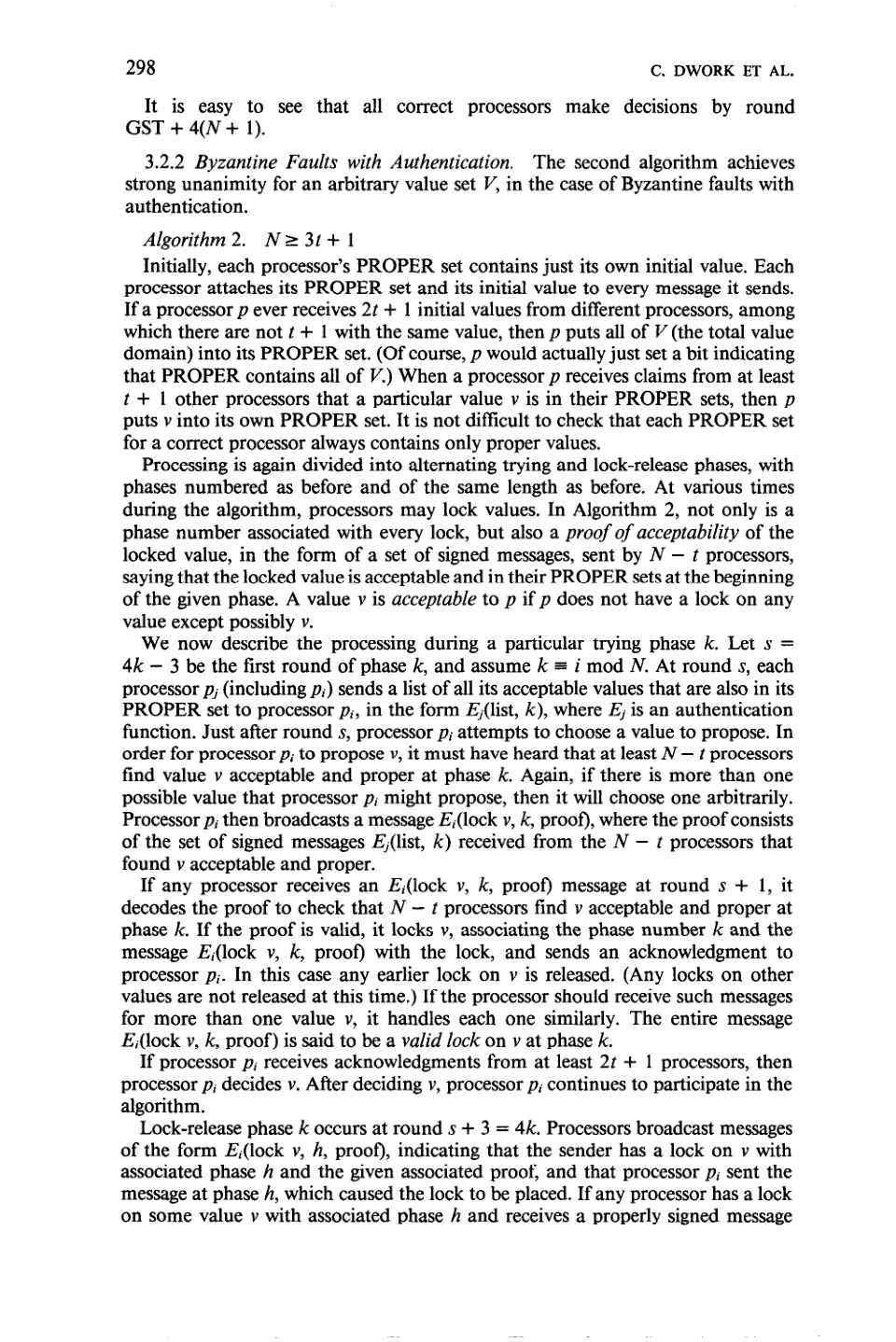
3.2.3 Byzantine Faults without Authentication
本节修改 Algorithm 2,以处理没有 authentication 的 Byzantine faults;仍保持 N ≥ 3t + 1 的 processor 要求,并保持 polynomial time complexity 和 polynomial message lengths。
修改使用 Srikanth 与 Toueg 引入的 broadcast primitive 的一个 minor variation;该 primitive 模拟 authentication 的关键 properties。
首先陈述这些 properties,然后给出 broadcast primitive,最后描述新的 agreement protocol。
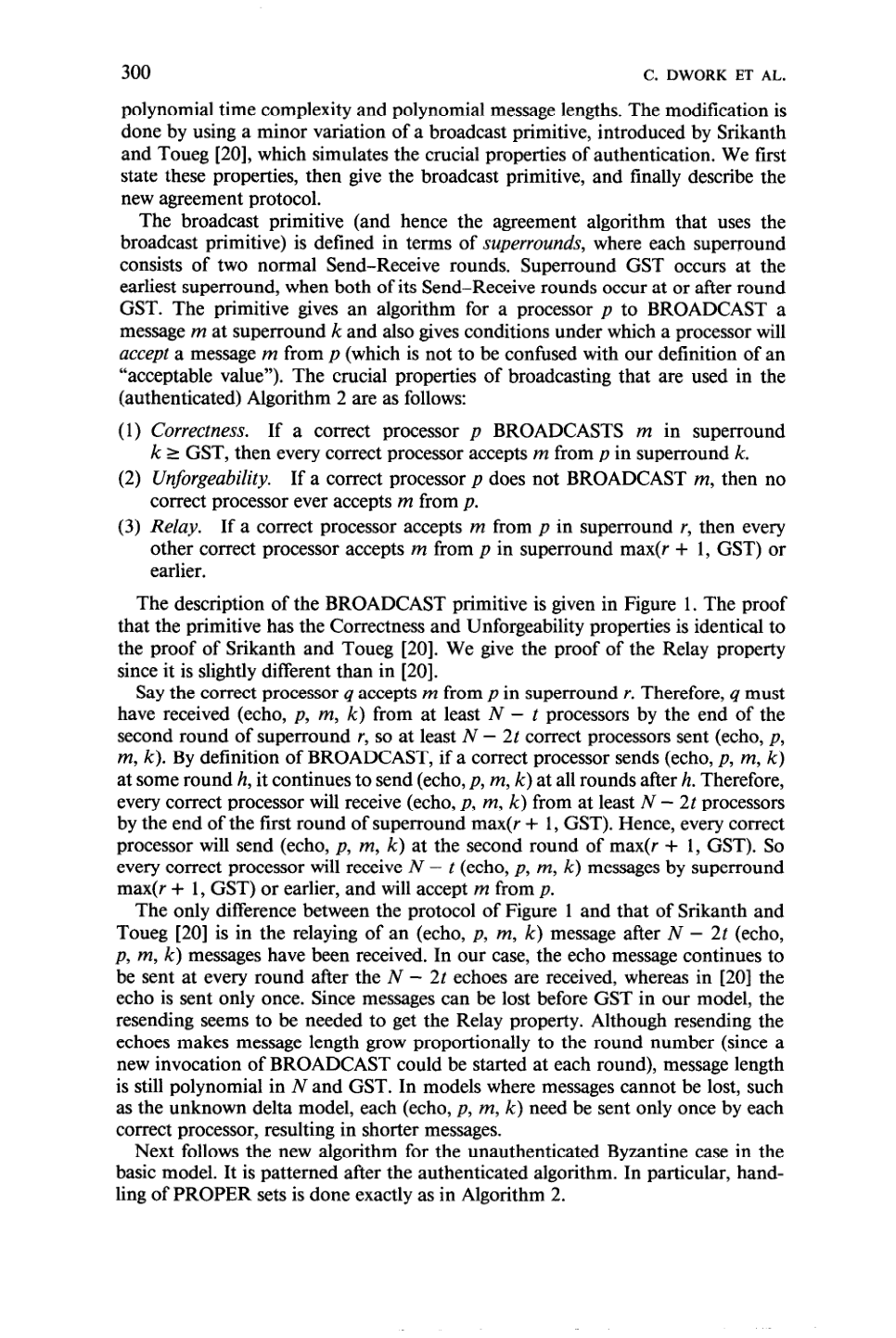
Broadcast primitive(以及使用它的 agreement algorithm)以 superrounds 定义;每个 superround 由两个普通的 Send-Receive rounds 构成。
Superround GST 是最早的 superround,使其中两个 Send-Receive rounds 都发生在 round GST 或之后。
Primitive 允许 processor p 在 superround k BROADCAST message m,并规定 processor 何时可以接受来自 p 的 m。这里的 message acceptance 不应与 value “acceptable” 混淆。
Authenticated Algorithm 2 使用的 broadcast properties 是:
- Correctness:如果 correct processor
p在k ≥ GST的 superround BROADCASTm,那么每个 correct processor 都会在 superroundk接受来自p的m。 - Unforgeability:如果 correct processor
p没有 BROADCASTm,则任何 correct processor 都不会接受来自p的m。 - Relay:如果 correct processor 在 superround
r接受来自p的m,则其他每个 correct processor 都会在max(r + 1, GST)或更早的 superround 接受来自p的m。
原文 Figure 1 的 primitive 如下:
BROADCAST of m by p at superround k: N ≥ 3t + 1

Superround k:
  First round:
    p sends (init, p, m, k) to all.
  Second round:
    如果在 first round 从 p 收到 (init, p, m, k),且只收到一个来自 p 的 init message,
      就向 all 发送 (echo, p, m, k);
    如果在本 round 从至少 N - t 个不同 processors 收到 echo,
      就 accept m from p。

All subsequent rounds:
    如果在 previous rounds 从至少 N - 2t 个不同 processors 收到 echo,
      就向 all 发送 echo;
    如果在本 round 或 previous rounds 从至少 N - t 个不同 processors 收到 echo,
      就 accept m from p。
原文对 Relay 的证明如下:若 correct processor q 在 superround r 接受 m,则到该 superround 第二个 round 结束时,q 至少收到来自 N − t 个 processors 的 (echo, p, m, k),其中至少 N − 2t 个发送者是 correct。
按照 BROADCAST 定义,correct processor 一旦在某 round 发送 echo,就会在之后所有 rounds 继续发送。因此,到 max(r + 1, GST) 的 first round 结束时,每个 correct processor 都会从至少 N − 2t 个 processors 收到 echo;它们会在 second round 发送 echo,于是每个 correct processor 都会在该 superround 或更早收到 N − t 个 echo,并 accept m。
与 Srikanth/Toueg protocol 的唯一差异,是在收到 N − 2t 个 echoes 后如何 relay echo:本文让 echo 在之后每个 round 继续发送,而原文献只发送一次。由于 GST 之前 messages 可能 lost,持续重发似乎是得到 Relay property 所必需的。
虽然 resending echoes 会使 message length 随 round number 增长(因为每个 round 都可能启动新的 BROADCAST),但 message length 仍然是 N 和 GST 的 polynomial。在 messages 不会 lost 的 models(例如 unknown-Δ model)中,每个 correct processor 只需发送一次每个 echo,messages 会更短。
接下来给出 basic model 中 unauthenticated Byzantine case 的新 algorithm。它仿照 authenticated algorithm,尤其是 PROPER sets 的处理完全相同。
第 12 页:Algorithm 3 的 lock protocol 与 theorem
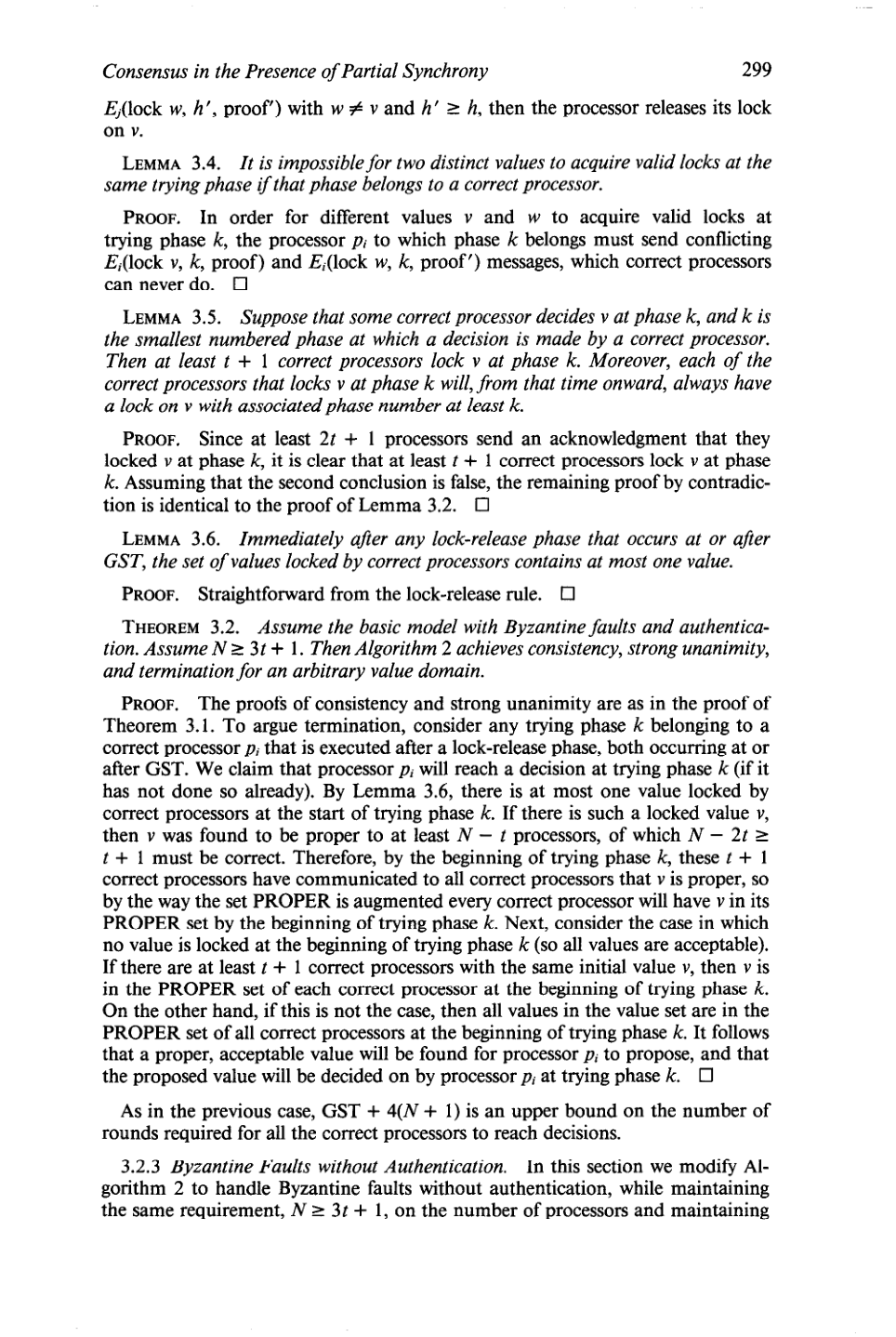
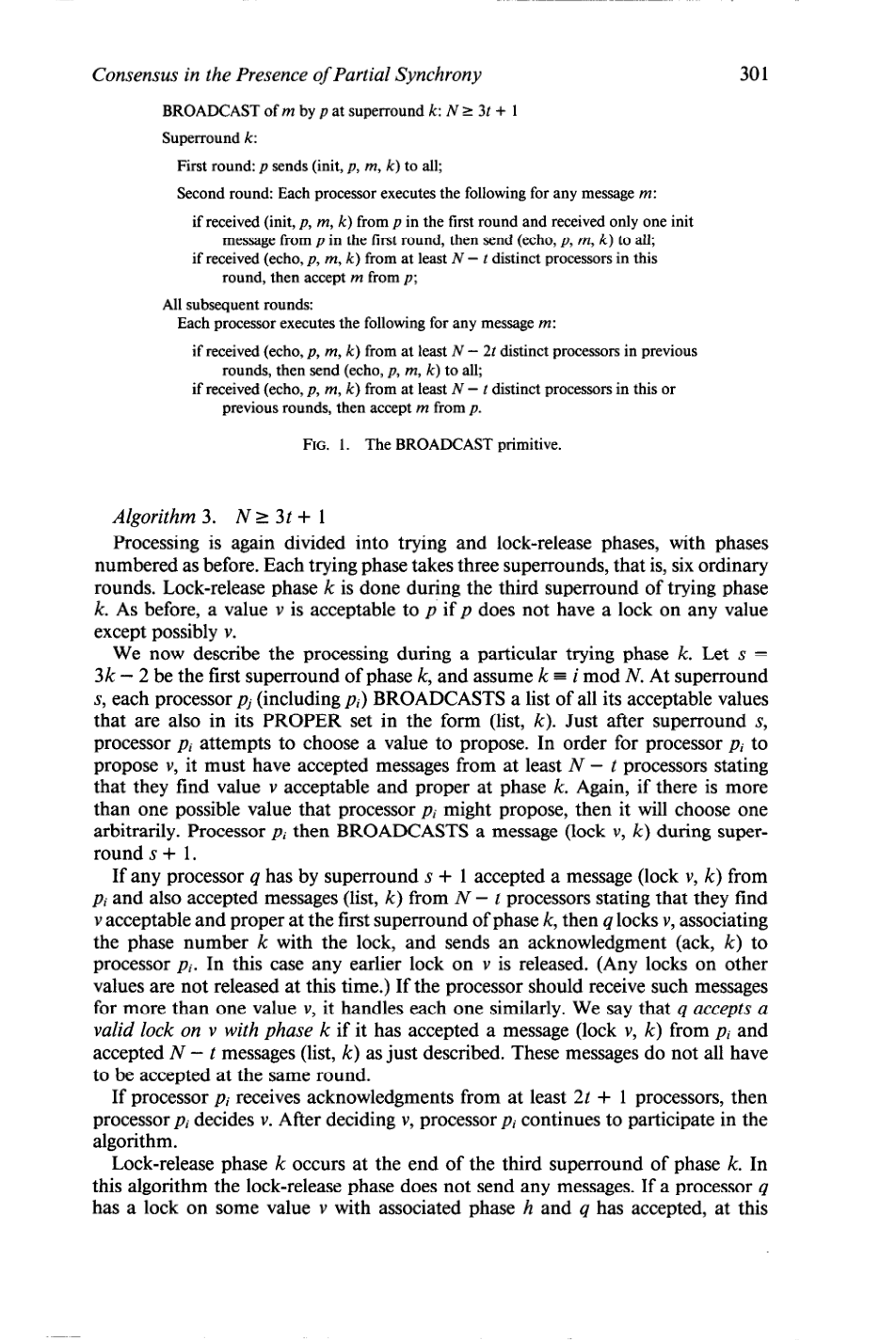
Algorithm 3 要求 N ≥ 3t + 1。Processing 仍分为 trying 和 lock-release phases,phase 编号方式不变。
每个 trying phase 由 3 个 superrounds(即 6 个普通 rounds)构成;phase k 的 lock-release phase 在其第三个 superround 中完成。
和以前一样,value v 对 p acceptable,当且仅当 p 没有 lock 除 v 外的其他 value。
设 phase k 的 first superround 是 s = 3k − 2,且 k = i (mod N)。在 superround s,每个 processor pj(包括 pi)以 (list, k) 形式 BROADCAST 自己的 proper acceptable values list。
刚过 superround s,pi 尝试选择 propose value。为了 propose v,它必须从至少 N − t 个 processors 接受消息,声明它们在 phase k 认为 v acceptable 且 proper;如果有多个候选,任意选择一个。
接着,pi 在 superround s + 1 BROADCAST (lock v, k)。
如果 processor q 在 superround s + 1 前,既接受来自 pi 的 (lock v, k),又接受来自 N − t 个 processors 的 (list, k),且这些 processors 声明在 phase k 的 first superround 认为 v acceptable、proper,则 q lock v,把 k 与 lock 关联,并向 pi 发送 (ack, k)。
此时释放 q 之前对 v 的 lock,但不释放其他 values 的 locks。如果 q 对多个 values 收到这类 messages,就分别处理。若 q 接受来自 pi 的 lock message,并接受上述 N − t 个 list messages,就称它在 phase k 接受了 v 的 valid lock;这些 messages 不必在同一个 round 接受。
如果 pi 收到至少 2t + 1 个 acknowledgments,就决定 v,之后继续参与 algorithm。
Phase k 的 lock-release phase 在第三个 superround 结束时发生。本 algorithm 中,lock-release phase 不发送 messages。
如果 processor q 对 v 有 associated phase h 的 lock,并且到当前 round(包括当前 round)为止已经接受了 w 的 valid lock,且 w ≠ v、h' ≥ h,则 q 释放 v 的 lock。
Lemma 3.7
如果 phase k 属于 correct processor,correct processors 不可能接受两个不同 values、且 associated phase 都是 k 的 valid locks。
证明:若不成立,由 Unforgeability,拥有 phase k 的 pi 必须 BROADCAST 冲突的 (lock v, k) 与 (lock w, k);correct processor 不会这样做。
Lemma 3.8
假设某 correct processor 在 phase k 决定 v,且 k 是 correct processor 作出 decision 的最小 phase。则至少 t + 1 个 correct processors 在 phase k lock v;它们之后始终保持至少 phase k 的 v lock。
证明要点:至少 2t + 1 个 processors 发送 acknowledgment,因此至少 t + 1 个 correct processors lock v。其余证明类似 Lemmas 3.2 和 3.5,使用 Unforgeability 说明:如果 correct q 接受了 phase h 的 w ≠ v valid lock,那么在 phase h 的 first round,除至多 t 个 correct processors 外,其他 correct processors 都认为 w acceptable。
Lemma 3.9
在 GST 或之后发生的 lock-release phase 之后,correct processors 所持有的 locked values 至多有一个。证明直接来自 lock-release rule 和 Relay property。
Theorem 3.3
假设 basic model 中存在没有 authentication 的 Byzantine faults,且 N ≥ 3t + 1。Algorithm 3 对 arbitrary value domain 达到 consistency、strong unanimity 和 termination。
证明几乎与 Theorem 3.2 完全相同,只是在 termination 论证中使用 GST 之后的 Correctness 和 Relay properties。
所需 rounds 的 upper bound 是 GST + 6(N + 1)。
Remark 1
Algorithms 1–3 具有如下 property:所有 correct processors 在 GST 之后 O(N) 个 rounds 内作出 decisions。通过一些简单 modifications,GST 之后达成 agreement 的时间可以改进为 O(t) rounds。
O(t) 在常数因子内是 optimal 的,因为即使 communication 和 processors 都 synchronous、且 faults 为 fail-stop,也至少需要 t + 1 rounds。
一种对所有 algorithms 的修改,是让 processor 在决定 v 后反复 broadcast “Decide v”。对于 Algorithm 1,processor 收到任意一个 “Decide v” message 就可以决定 v;对于 Algorithms 2 和 3,processor 收到来自不同 sources 的 t + 1 个 “Decide v” messages 后就可以决定 v。
容易证明,修改后的 algorithms 仍正确,并且所有 correct processors 在 GST 后 O(t) rounds 内决定;细节留给读者。
第 13 页:从 basic round model 到 partially synchronous communication
4. Partially Synchronous Communication and Synchronous Processors
本节假设 processors 完全 synchronous(Φ = 1),而 communication partially synchronous。我们展示如何使用这些 models 模拟 Section 3.1 的 basic model,从而解决同一个 consensus problem。
由于 processors lock-step synchronous,可以设想每个 correct processor 都有一个与其他 correct processors 完全同步的 clock。初始 clock 为 0;processor 每执行一次 step,clock 加 1。Φ = 1 意味着在任意 real-time step,所有 correct processors 的 clocks 完全相同。
communication partial synchrony 有两种定义:Δ unknown,以及 Δ holds eventually。本文分别处理:Section 4.1 讨论 Δ eventually 的 upper bounds;Section 4.2 讨论 Δ unknown;Section 4.3 给出 lower bounds。
第 14 页:GST model 的 round simulation
4.1 UPPER BOUNDS WHEN Δ HOLDS EVENTUALLY
先考虑 Δ eventually holds 的 model。固定四种 fault models 中任意一种。我们说明:如果 basic model 中存在 t-resilient consensus protocol,那么在 Δ eventually holds 的 model 中也存在一个。
固定 Δ,假设 algorithm A 对 basic model 正确。从 A 定义新 algorithm A',用于 Δ 从 GST 开始成立的 model。
令 R = N + Δ。每个 processor 把自己的 steps 分成长度为 R 的 groups,每个 group 用来模拟 algorithm A 的一个 round。
具体来说,processor 使用 group r 的前 N steps,把 algorithm A 的 round r messages 逐个发送给 N 个 processors;使用最后 Δ steps 执行 Receive operations;round r 的 state transition 在 group r 的最后一个 step 模拟。
R 足够大,使 GST 到达后,所有 processors 能够在一个 group 内完成相互 message exchange。
每个 processor 总是给 messages 加上 round identifier;在 round r 发送、却在更晚的 round r' > r 到达的 message 会被忽略。因此每个 round 的 communication 与其他 rounds 独立。
对 A' 的任意 run e',都容易构造 A 的对应 run e,满足:
e'中 correct 的 processors 在e中也 correct;- faulty processors 展现的 fault types 在两个 runs 中相同;
e中 correct processor 的每次 state transition 都由e'中对应 correct processor 模拟。
因为 A 是 basic round model 中的 t-resilient consensus protocol,所以 e 最终达成 consensus,e' 也一样。
把这个 transformation 应用到 Algorithms 1–3,就得到 Algorithms 1'–3'。
第 15 页:Theorem 4.1 与 Δ unknown 的模拟
Theorem 4.1
假设 processors completely synchronous(Φ = 1),communication partially synchronous 且 Δ eventually holds:
- fail-stop 或 omission faults:若
N ≥ 2t + 1,Algorithm1'对 arbitrary value domain 达到 consistency、strong unanimity 和 termination; - authenticated Byzantine faults:若
N ≥ 3t + 1,Algorithm2'达到这些 properties; - unauthenticated Byzantine faults:若
N ≥ 3t + 1,Algorithm3'达到这些 properties。
Algorithms 1' 和 2' 保证所有 correct processors 在 GST 后 4(N + 1)(N + Δ) 时间内决定;Algorithm 3' 的 bound 是 6(N + 1)(N + Δ)。
因此 1'–3' 的 time upper bound 是 GST 加上 N 和 Δ 的 polynomial。Section 3 的 Remark 1 说明如何进一步改善这些 bounds;而且如果 Δ 在 GST 后只在有限时间内继续成立,所给 bounds 也正好给出所需 interval。
4.2 UPPER BOUNDS FOR Δ UNKNOWN
现在考虑 Δ unknown。固定任意 fault model。若 basic model 有 t-resilient protocol A,就构造 A',使 A' 的每次 execution 都模拟 A 的一次 execution。
令 Rr = N + r。A' 中每个 processor 把 steps 分成 groups,第 r 个 group 恰好包含 Rr steps。
和之前一样,每个 group 模拟 A 的一个 round:前 N steps 逐个向 processors 发送 round r messages,最后 r steps 执行 Receive operations;round r state transition 在 group 最后一步模拟。
每个 processor 给 messages 附加 round identifier;在 round r 发送却在更晚 round 到达的 messages 被忽略。
考虑 A' 的某个 run e',并假设本次 execution 中 communication bound Δ 成立。对于任何 r ≥ Δ,e' 中用于模拟 round r 的 steps 足够让该 round 的所有 messages 被收到。因此可以定义 A 的对应 run e,把 round Δ 作为其 GST round。
于是 e 是 basic model 的 allowable run,A 最终达到 consensus,A' 也达到 consensus。
由此得到 Algorithms 1''–3'',并得到 Theorem 4.2:在 processors completely synchronous、communication partially synchronous 且 Δ unknown 的 model 中,Theorem 4.1 的三个 claims 分别对 1''–3'' 成立。
第 16 页:Δ unknown 的时间 bound 与 lower-bound 导入
考虑 Algorithm 1'' 的某次 execution,设对应 message bound 为 Δ。模拟 algorithm 1 的前 Δ rounds,最多需要 Δ(N + Δ) 时间;之后最多还需模拟 4(N + 1) 个 rounds,额外时间上界为:
Δ(N + Δ) + 4(N + 1)(N + Δ + 4(N + 1)) = O(N² + Δ²)
Algorithm 2'' 具有相同 bound;Algorithm 3'' 的 bound 为:
Δ(N + Δ) + 6(N + 1)(N + Δ + 6(N + 1))
因此 Algorithms 1''–3'' 的 time upper bound 是 N 和 Δ 的 polynomial。Section 3 Remark 1 可以进一步改善它们。
Remark 2
如果把 Δ eventually model 加强为“messages 永远不丢失,但 GST 之前发送的 messages 可以迟到”,则可以修改 1'–3',让 processors terminate。
具体使用 Section 3 Remark 1 的 ideas。每个 processor 在决定 v 时只需 broadcast 一条不带 round number 的 “Decide v” message;其他 processors 任意时刻都应接受它。
对于 fail-stop/omission faults,processor broadcast “Decide v” 后可以立刻停止参与,并在收到该 message 后立即决定 v。
对于 Byzantine faults,processor 收到 t + 1 个 “Decide v” messages 后可以决定 v;但只有在它 broadcast 自己的 message,并从总计 2t + 1 个 processors 收到 “Decide v” 后,才可停止参与。
如果 GST 之前 messages 可以 lost,则任何能容忍一个 fail-stop fault 的 consensus protocol,都存在某次 execution 使至少一个 correct processor 必须永远继续发送 messages。实际系统只要能够可靠地把 “Decide v” delivery 给每个其他 correct processor,就能保证 halting;没有 network partition 时,可以通过 repeated sending 实现。
Remark 3
本节所有结果假设 Φ = 1。如果 processors synchronous 但 Φ > 1,我们希望获得相同 results。Section 5 将证明更一般的 result:本节 protocols 的 resiliency,在 communication 和 processors 都 partial synchronous 时也可实现;这也意味着 communication partial synchronous、processors synchronous 且 Φ > 1 时可以实现同样 resiliency。
第 17 页:Theorem 4.1 的续结与 Δ unknown 的模拟
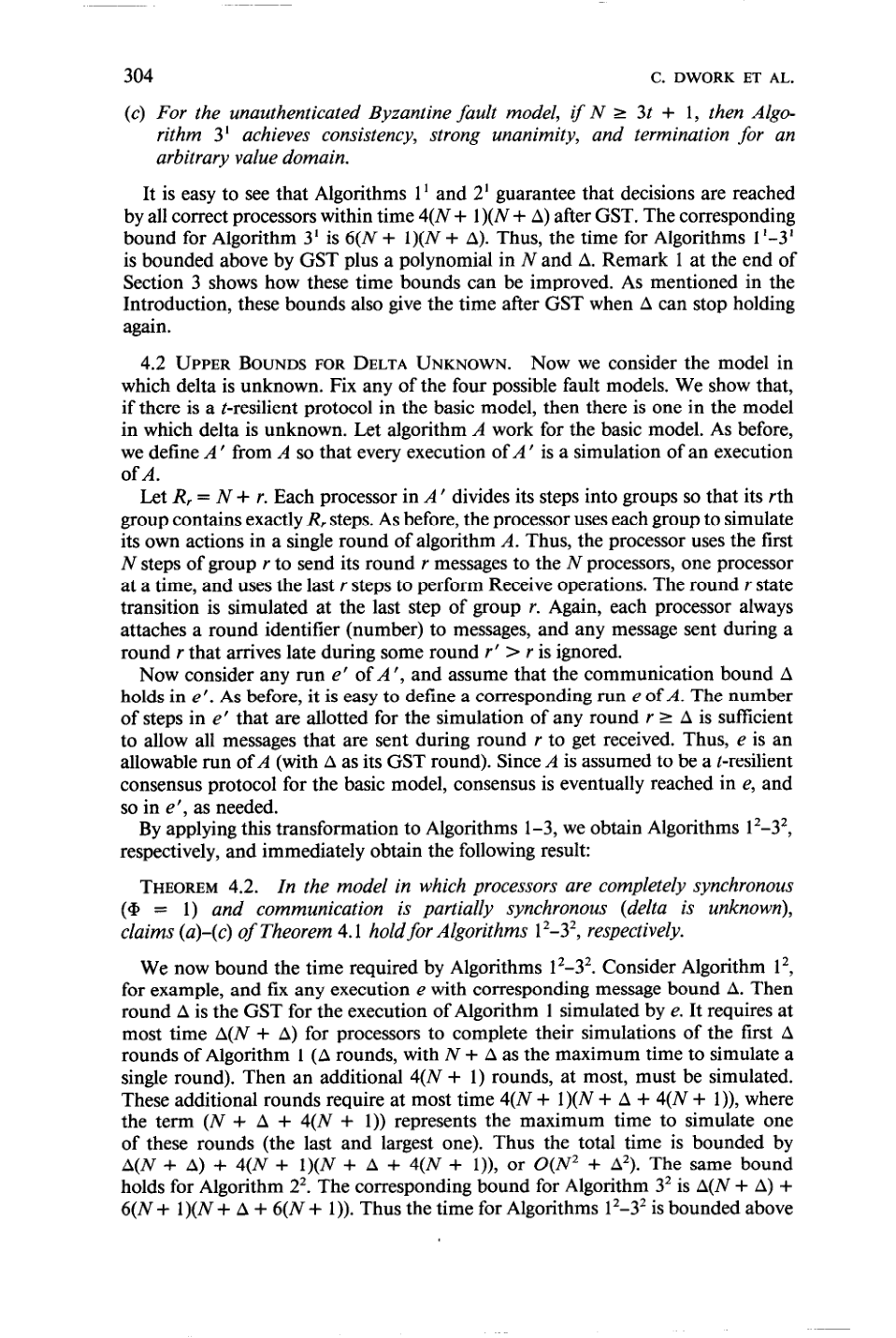
Theorem 4.1 的第三种情况是:对于 unauthenticated Byzantine fault model,若 N ≥ 3t + 1,Algorithm 3' 对 arbitrary value domain 达到 consistency、strong unanimity 和 termination。
容易看出,Algorithms 1'、2' 保证所有 correct processors 在 GST 之后 4(N + 1)(N + Δ) 时间内作出 decisions;Algorithm 3' 的对应 bound 是 6(N + 1)(N + Δ)。因此 1'–3' 的时间上界是 GST 加上 N 和 Δ 的 polynomial。
Section 3 末尾的 Remark 1 说明如何改善这些 time bounds;如 Introduction 所说,这些 bounds 也给出 Δ 可以在 GST 之后再次停止成立时所需的稳定 interval 长度。
4.2 UPPER BOUNDS FOR Δ UNKNOWN
现在考虑 Δ unknown 的 model。固定四种 fault models 中任意一种。若 basic model 中有 t-resilient protocol,就在 Δ unknown model 中构造一个。
令 algorithm A 在 basic model 中工作。像前面一样,从 A 定义 A',使 A' 的每次 execution 都模拟 A 的一次 execution。
令 Rr = N + r。A' 中每个 processor 把 steps 分成 groups,使第 r 个 group 恰好包含 Rr steps。每个 group 模拟 A 的一个 round:前 N steps 逐个给 N 个 processors 发送该 round messages,最后 r steps 执行 Receive;round r 的 state transition 在 group 最后一步模拟。
每个 processor 始终给 messages 附加 round identifier;在 round r 发送、却在更晚 round r' > r 到达的 message 被忽略。
考虑 A' 的某个 run e',并假设该 run 中 communication bound Δ 成立。对任何 r ≥ Δ,为模拟 round r 分配的 steps 足够让该 round 的所有 messages 被接收。因此可定义 A 的对应 run e,把 round Δ 作为它的 GST round。由于 A 是 basic round model 的 t-resilient consensus protocol,e 最终达成 consensus,e' 也达成。
把这个 transformation 应用到 Algorithms 1–3,分别得到 Algorithms 1''–3'',从而得到下一页的 Theorem 4.2。
第 18 页:Partial communication synchrony 的 lower bounds
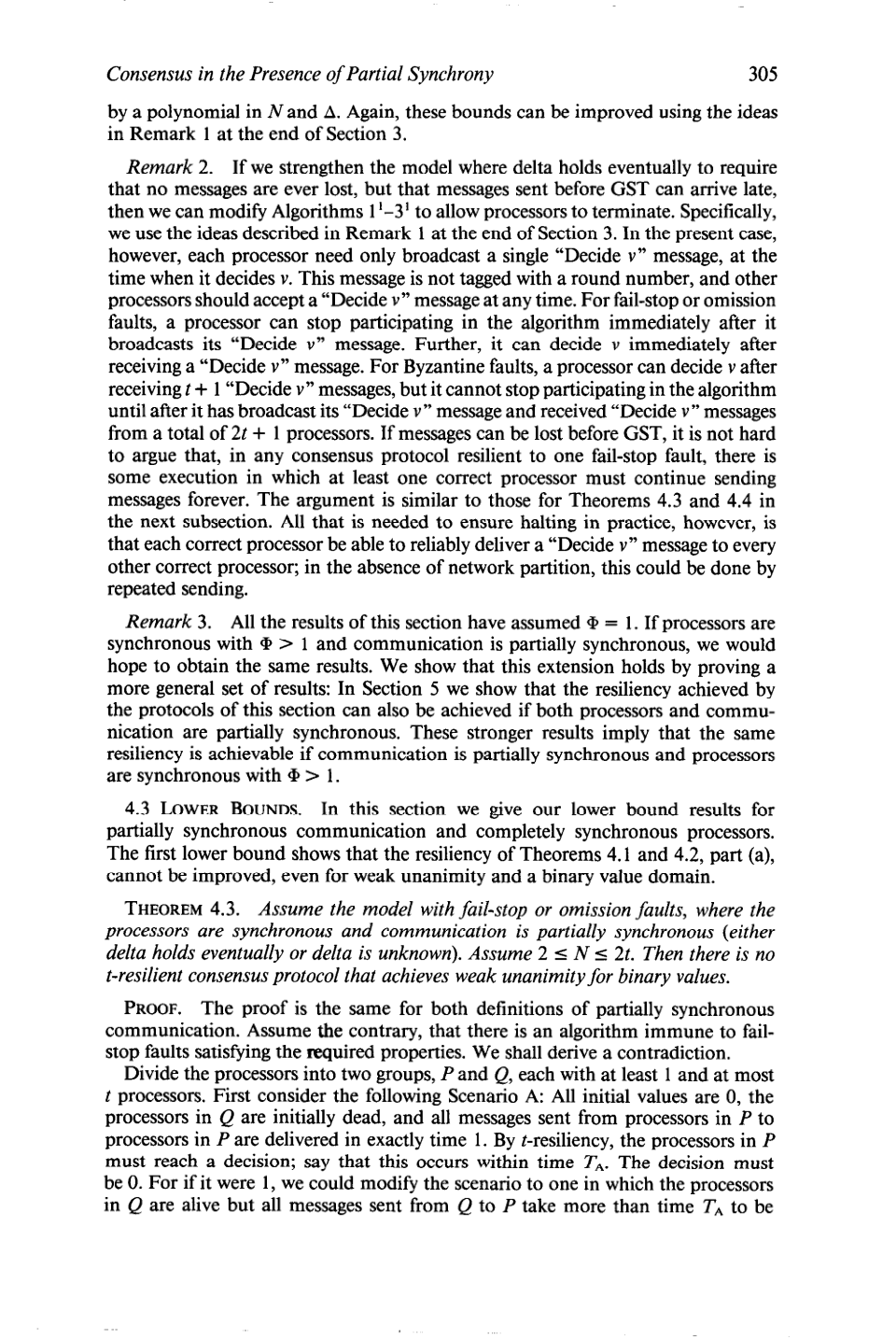
4.3 LOWER BOUNDS
本节给出 processors completely synchronous、communication partially synchronous 的 lower-bound results。
第一个 lower bound 说明 Theorems 4.1 和 4.2 的 (a) resiliency 即使只要求 weak unanimity、且 value domain 只有两个 values,也不能提高。
Theorem 4.3
假设 fail-stop 或 omission faults,processors synchronous、communication partially synchronous(Δ eventually 或 Δ unknown)。若 2 ≤ N ≤ 2t,则不存在对 binary values 达到 weak unanimity 的 t-resilient consensus protocol。
证明:两种 partial communication synchrony 定义的证明相同。反设存在满足要求、免疫 fail-stop faults 的 algorithm。
把 processors 分成两组 P 和 Q,每组至少 1 个、至多 t 个 processors。
Scenario A:所有 initial values 是 0;Q 中 processors initially dead;P 到 P 的 messages 都恰好在 time 1 delivery。由 t-resiliency,P 中 processors 必须作出 decision;设它在有限时间 TA 内发生。decision 必须是 0。
如果 decision 是 1,可以把 scenario 修改为:Q 中 processors alive,但从 Q 到 P 的所有 messages 都要超过 TA 才到达。P 仍会在 TA 内决定 1,这与 weak unanimity 矛盾,因为所有 initial values 都是 0。
Scenario B:所有 initial values 是 1;P initially dead;Q 到 Q 的 messages 恰好在 time 1 delivery。类似论证说明,Q 在某个有限 TB 内决定 1。
Scenario C(Contradiction):P 的 initial values 是 0,Q 的 initial values 是 1,所有 processors alive;P 到 P、Q 到 Q 的 messages 恰好在 time 1 delivery,而跨组 messages 的 delivery time 超过 max(TA, TB)。
P 中 processors 的行为与 Scenario A 完全相同,Q 中 processors 的行为与 Scenario B 完全相同,于是得到 contradiction。
接下来 lower bound 仍在 weak unanimity 和 binary value domain 下成立,说明 Theorems 4.1/4.2 的 (b) resiliency 也不能提高。
Theorem 4.4
假设 authenticated Byzantine faults,processors synchronous、communication partially synchronous(Δ eventually 或 Δ unknown)。若 2 ≤ N ≤ 3t,则不存在对 binary values 达到 weak unanimity 的 t-resilient consensus protocol。
证明:证明同样适用于两种 partial synchrony。N = 2 时由 Theorem 4.3 得出。设 N ≥ 3,把 processors 分成 P、Q、R 三组,每组至少 1 个、至多 t 个 processors。
Scenario A:所有 initial values 为 0,R initially dead,P ∪ Q 内 messages 恰好 time 1 delivery。由 t-resiliency,P ∪ Q 必须作出 decision;该 decision 必须是 0。
Scenario B:所有 initial values 为 1,P initially dead,Q ∪ R 内 messages 恰好 time 1 delivery;因此 Q ∪ R 在有限 TB 内决定 1。
Scenario C:P 初值 0,R 初值 1,Q 中 processors faulty。Q 对 P 的行为与 Scenario A 相同,对 R 的行为与 Scenario B 相同;P 到 P ∪ Q、R 到 R ∪ Q 的 messages time 1 delivery,而 P 与 R 之间的 messages 超过 max(TA, TB) 才到达。
于是 P 与 R 分别作出 0 和 1,产生 contradiction。
对于 unauthenticated Byzantine faults,前面的 lower bound 是 tight 的,因为 Theorems 4.1/4.2 的 (c) 已达到 N ≥ 3t + 1。
第 19 页:两者 partial synchrony 与 distributed clocks 的总体策略
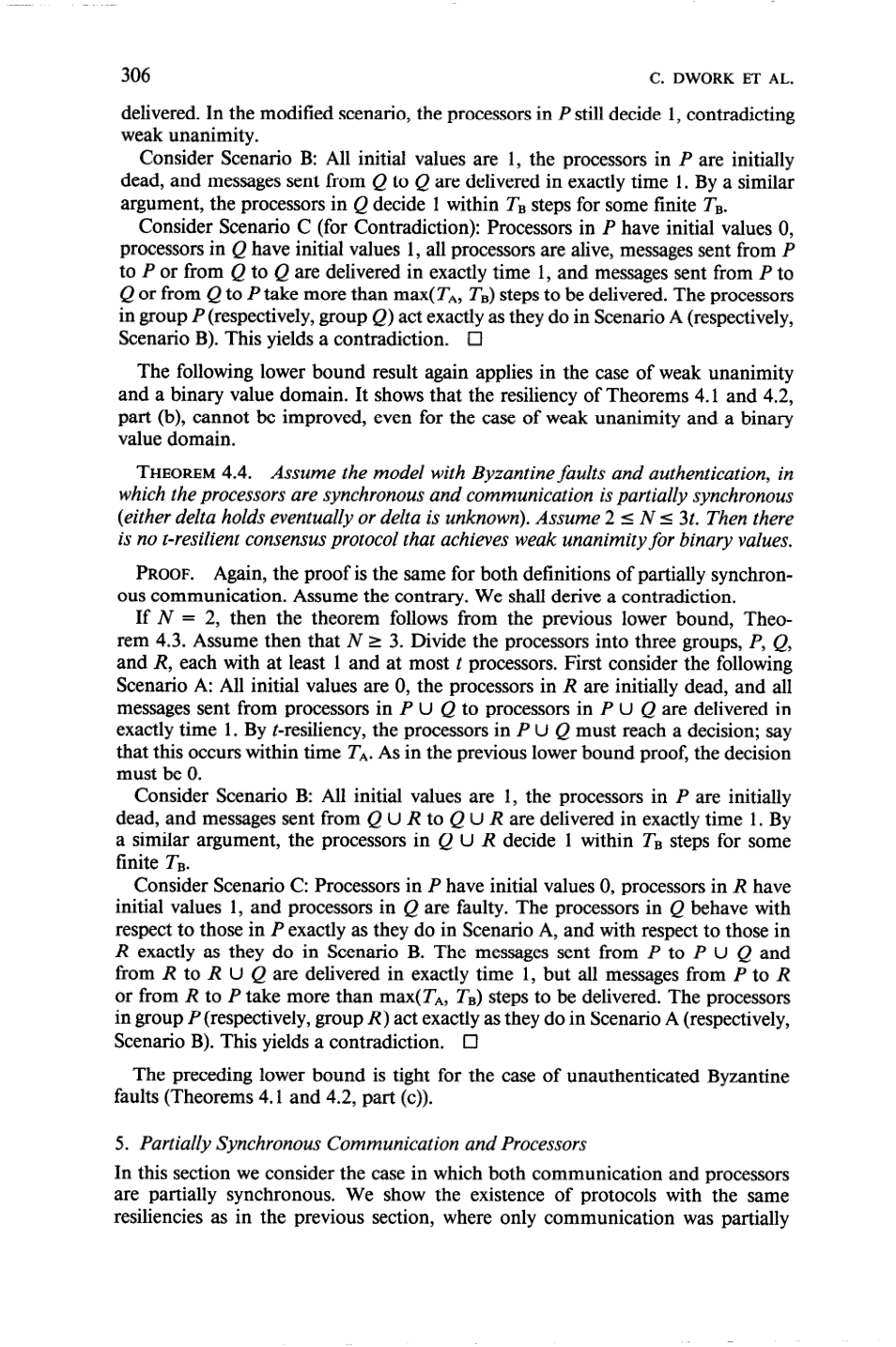
5. Partially Synchronous Communication and Processors
本节考虑 communication 和 processors 都 partially synchronous 的情况。我们证明可以使用与上一节(只有 communication partial synchronous)相同的 resiliencies;对应 algorithms 仍只需要相近的 polynomial time。
方法仍然是展示:如何使用本节 models 模拟 Section 3 的 basic model。
上一节中 processors 拥有共同 time notion,可以把 time 分成 rounds。现在 Φ 不是始终成立或未知,因此不存在共同 time notion。
所以,第一项任务是描述一组 protocols,使 processors 获得近似共同的 time notion。这些 protocols 称为 distributed clocks。
Distributed clocks 不使用 Δ 或 Φ 的显式 knowledge;它们既适用于 Δ、Φ eventually holds 的 model,也适用于 Δ、Φ unknown 的 model。但 clocks 展现出的 properties 依赖于某次 run 中实际(eventually)成立的 Δ 和 Φ。
每个 processor 维护一个 private software clock。private clocks 的增长速率与 real time 相差不超过某个 constant factor,并且彼此相差不超过某个 constant。
在 Δ、Φ unknown model 中,这些 conditions 始终成立;在 GST model 中,它们只保证在 GST 之后某个 constant time 之后成立。这里的三个 constants 都是 N、Φ 和 Δ 的 polynomial。
本文没有尝试优化这些 constants,因为那会使本来已经 difficult、technical 的 argument 更不清晰。Correct processors 发送的 message bits 数量,也被 N、Δ、Φ 和 GST polynomially bounded。
定义 distributed clocks 之后,就让每个 processor 使用自己的 private clock 判断当前 round,来模拟 Section 3 protocols。Basic model 的每个 round 使用 private clock 的若干 ticks 模拟。
模拟时,需要把 distributed-clock algorithm 的 steps 与被模拟 algorithm 的 steps interleave。Distributed-clock algorithm 本身也方便地描述为:交替执行增加对其他 processors local clocks knowledge 的 Receive steps,以及通知其他 processors 自己 local clock 的 Send steps。
具体地,假设 processors 交替执行:clock 的 Receive operation、clock 的 Send operation、以及被模拟 algorithm 的一个 step。
本节讨论两种 distributed clocks 的 clock-maintenance steps:Section 5.1 的 clock 处理没有 authentication 的 Byzantine faults,要求 N ≥ 3t + 1;Section 5.2 的 clock 处理 authenticated Byzantine faults,要求 N ≥ 2t + 1,因此也处理 fail-stop 与 omission faults。
Section 5.3 给出 Δ、Φ eventually 的 upper bounds,Section 5.4 给出 Δ、Φ unknown 的 upper bounds。本节不证明 lower bounds,因为 Section 4 的 lower bounds 同样适用于当前 models。
第 20 页:Unauthenticated Byzantine 的 distributed clock 定义
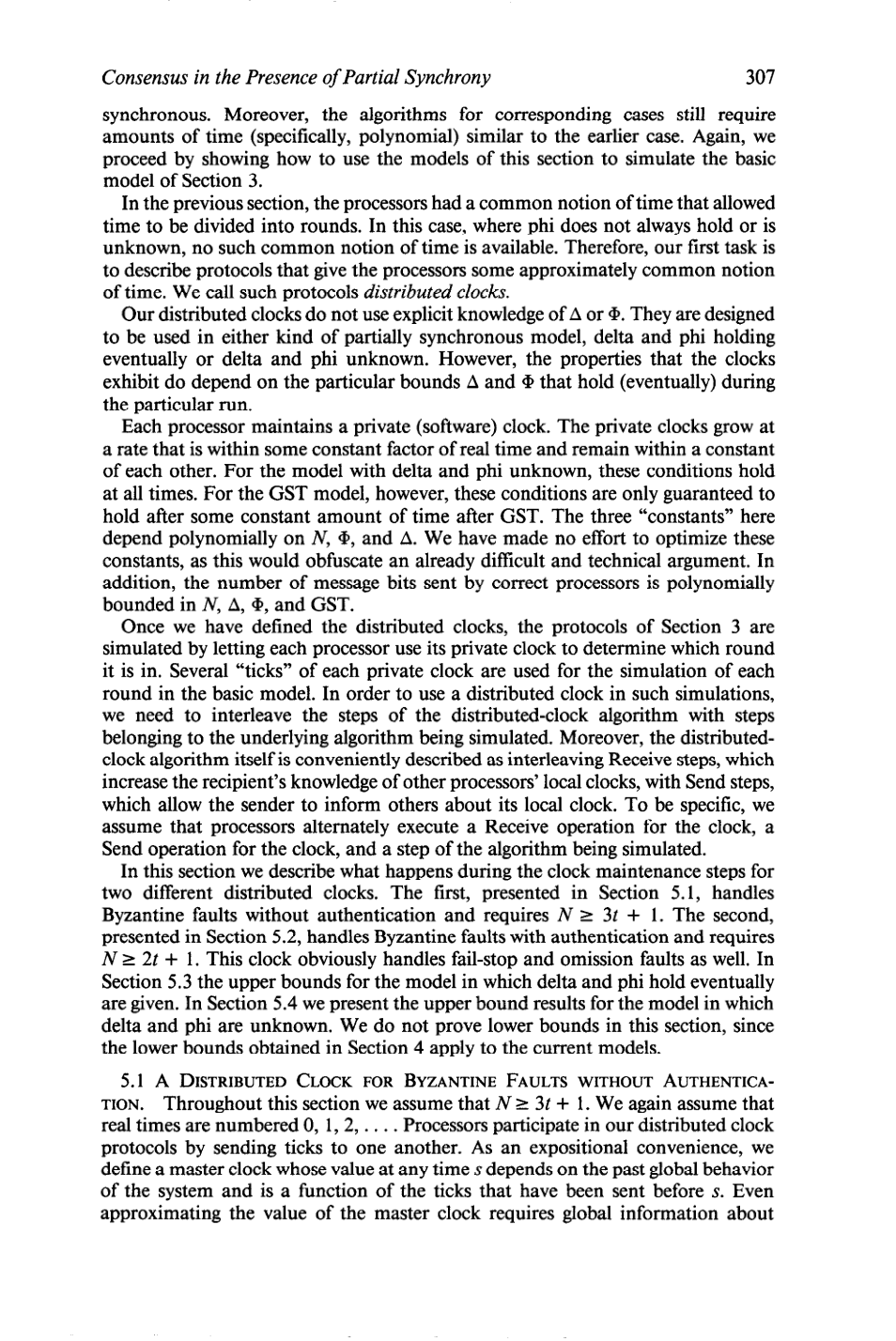
5.1 A DISTRIBUTED CLOCK FOR BYZANTINE FAULTS WITHOUT AUTHENTICATION
本节始终假设 N ≥ 3t + 1。real times 编号为 0, 1, 2, ...。Processors 通过彼此发送 ticks 参与 distributed-clock protocol。
为方便叙述,定义一个 master clock:它在任意时间 s 的 value,取决于 system 过去的 global behavior,是此前发送 ticks 的函数。
即使只是近似 master clock value,也需要知道哪些 ticks 已经发送给哪些 processors 的 global information。因此引入第二类 message:claim,即 processors 对自己发送过的 ticks 作 assertions。
i-tick是 messagei。i+ -tick是任意j ≥ i的j-tick。- 如果
p已向全部N个 processors 发送了某个i+ -tick,就说pbroadcast 了一个i-tick。 i-claim是 message “I have broadcast an i-tick”。i+ -claim是任意j ≥ i的j-claim。- 如果
p已向所有N个 processors 发送i+ -claim,就说pbroadcast 了一个i-claim。
约定:所有 processors 在 time 0 之前已经交换了 size 0 的 ticks 和 claims。这些 messages 实际没有发送,但认为已经发送和接收。
当说某 event(例如收到某 message)在 time s “by time s” 发生时,意思是该 event 在某个 ≤ s 的 real-time step 发生。
Master clock C: N → N 在任意 real time s 定义为:
C(s) = 最大的 j,使得截至 time s,至少 t + 1 个 correct processors
       已 broadcast 一个 j-tick。
约定所有 processors 在 time 0 前已经 broadcast 0-tick,因此 C(0) = 0。注意 C(s) 是 nondecreasing function。
对于每个 processor pi,private clock ci: N → N 定义为最大 j,使得截至 time s,pi 收到以下两种情况之一:
- 来自
2t + 1个 processors 的 messages,且每个 message 都是j+ -claim;或者 - 来自
t + 1个 processors 的 messages,每个 message 要么是(j + 1)+ -tick,要么是(j + 1)+ -claim。
因为每个 correct pi 在 time 0 之前已经从全部 N processors 收到 0-claims,所以 ci(0) = 0。ci(s) 对所有 correct pi 也是 nondecreasing。
correct pi 发送 ticks 的目标是 increment master clock;理想情况下,希望它在 time s 发送 (C(s) + 1)-tick。但 C(s) 需要 global information,所以 pi 使用自己对 C 的 view,即 ci,在 time s 发送 (ci(s) + 1)-tick。
Lemma 5.1 将证明 ci(s) ≤ C(s),所以 pi 不会迫使 master clock skip 某个 value;还会证明在 GST model 中 GST 之后不久,master clock 与 private clocks 的差距至多是一个 constant,因此 pi 不会把 master clock 推得远远领先于其他 processors 的 private clocks。
每个 processor 不断循环访问所有 N 个 processors,在不同 cycles 中发送 ticks 或 claims。pi 的 private clock 保存在 local variable Ci 中。每当它在 clock protocol 执行 Receive operation,就根据收到的 ticks 和 claims 更新 Ci。
因此 private clock 每执行两次 clock steps(即每三个 processor steps)更新一次。
Processor 以 Ci = 0 开始 protocol,并调用 Figure 2 的 TICK(0)。注意,TICK(b) 执行期间 Ci 可能变化,但 CLAIM(b) 执行时发送的是 (b + 1)-claim,而不是 (Ci + 1)-claim。这与“broadcast (b + 1)-tick”的定义一致。
第 21 页:TICK/CLAIM 与 Lemmas 5.1–5.3
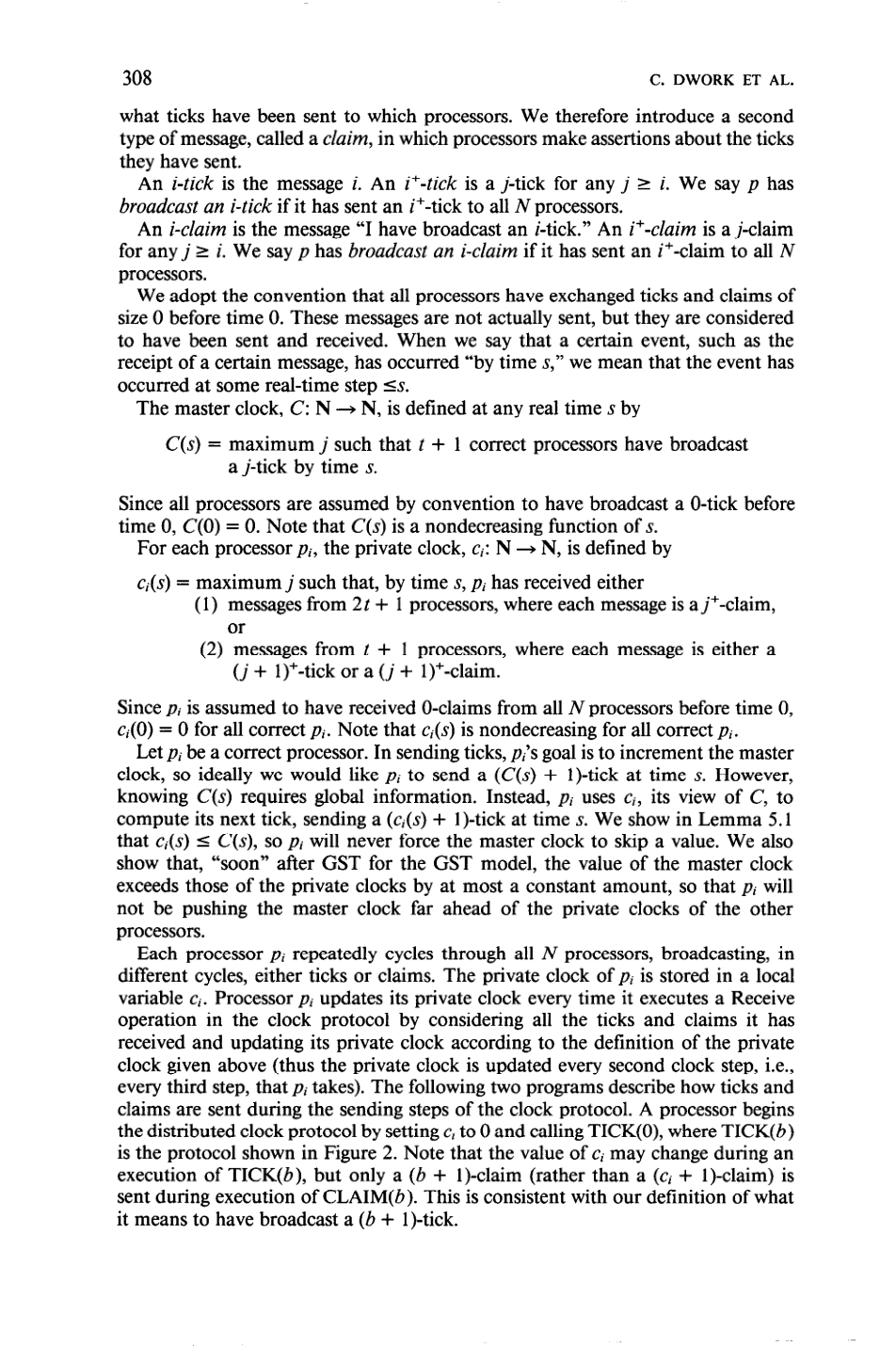
Figure 2 的两个 procedures:
TICK(b):
    for j = 1, ..., N do
        send (b + 1)-tick to pj;
    CLAIM(b).

CLAIM(b):
    for j = 1, ..., N do
        send (b + 1)-claim to pj;
    if Ci > b then TICK(Ci) else CLAIM(b).
Lemma 5.1
对所有 s ≥ 0 和所有 correct pi,Ci(s) ≤ C(s)。
证明:对 s induction。s = 0 时,定义给出 Ci(0) = C(0) = 0。
固定 s 和 correct pi,假设对所有 s' < s 与 correct pk 命题成立。令 j = Ci(s)。
有两种情况:
pi从 2t + 1 个不同 processors 收到j+ -claims。其中至少t + 1个 claims 来自 correct processors;由 master clock 定义,C(s) ≥ j。pi从t + 1个不同 processors 收到 messages,每个都是(j + 1)+ -tick或(j + 1)+ -claim。令s'为某 correct processorpk首次发送(j + 1)+ -tick的最早 real time。s' < s,因此由 induction hypothesis,ck(s') ≤ C(s');由 protocol 定义,ck(s') ≥ j。于是j ≤ ck(s') ≤ C(s') ≤ C(s)。
Lemma 5.2
对所有 s ≥ 0,correct processor 在 real time s 发送的最大 tick size 至多为 C(s) + 1。
证明直接来自 protocol 和 Lemma 5.1。
Lemma 5.3
对所有 s, x ≥ 0,C(s + x) ≤ C(s) + x。
证明:对 x induction。x = 1 时,Lemma 5.2 说明截至 time s,correct processor 发送的最大 tick 至多为 C(s) + 1;因此到 s + 1 时,至少 t + 1 个 processors broadcast 的最大 tick 也至多是 C(s) + 1,故 C(s + 1) ≤ C(s) + 1。
若命题对 x 成立,则:
C(s + (x + 1)) = C((s + 1) + x)
             ≤ C(s + 1) + x       (induction hypothesis)
             ≤ C(s) + (x + 1)     (basis)
第 22 页:GST 之后 clock convergence 的 Lemmas
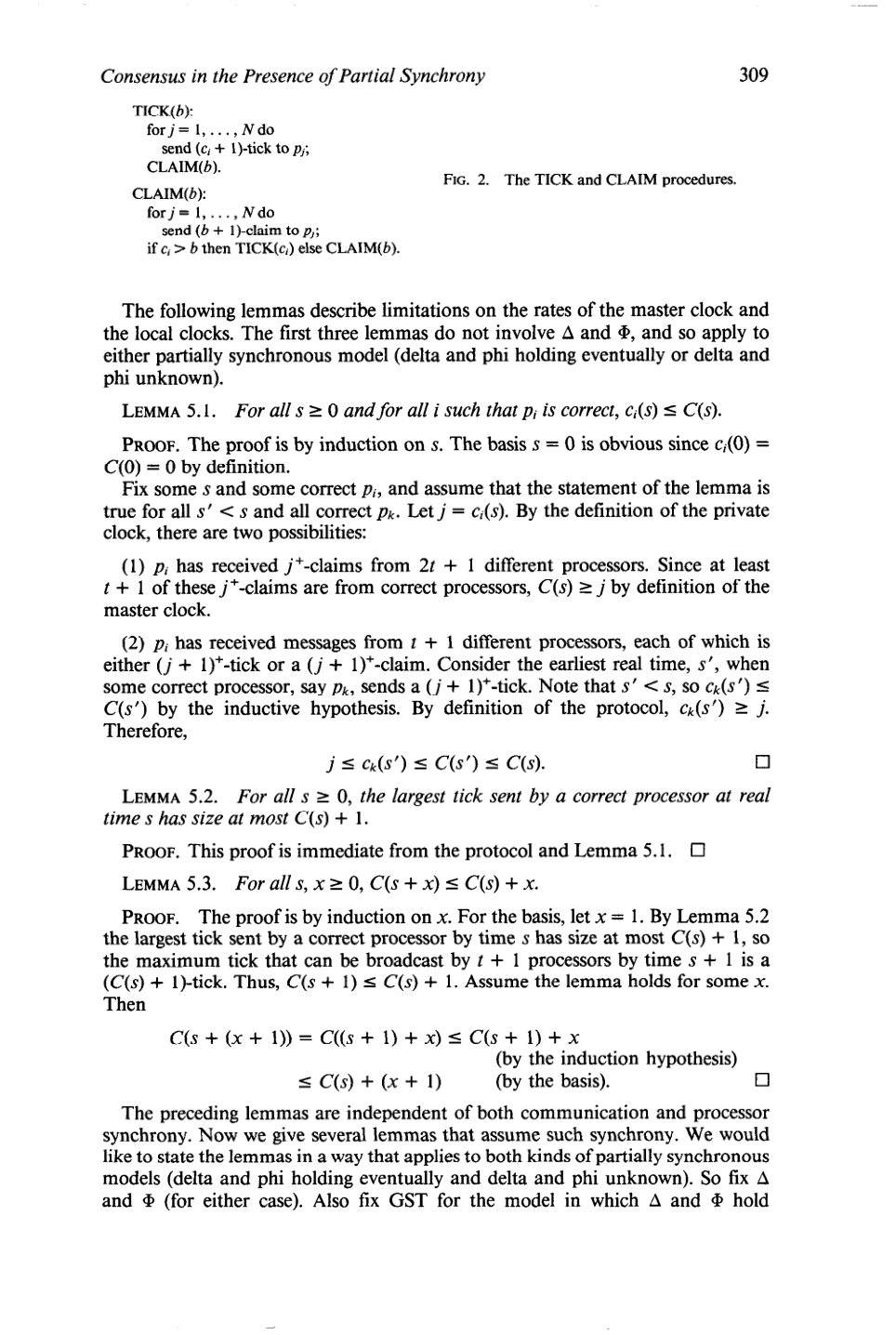
前面的 lemmas 与 communication/processor synchrony 无关。现在固定某个在两种 models 中成立的 Δ 和 Φ;在 Δ、Φ eventually model 中也固定 GST;在 Δ、Φ unknown model 中为统一叙述,令 GST = 0。
下面几个 lemmas 讨论 GST 之后不久 clocks 的行为。Lemma 5.4 说明 private clocks 的增长最多比 real time 慢一个 constant factor。Lemmas 5.5 和 5.6 是证明 Lemma 5.7 的 technical lemmas。Lemma 5.7 分两部分:第一部分说,在任意特定 real time,master clock 超过 private clocks 的量至多是 additive constant;第二部分说 master clock 的运行速率最多比 real time 慢某个 constant factor。
令 D = Δ + 3Φ。如果 message 在 s ≥ GST 被发送给 correct processor p,则 p 会在 s + D 前收到:message 最晚在 s + Δ delivery,而 p 至多再经过 3Φ 才会在 clock protocol 中执行 Receive。
Lemma 5.4
假设 s ≥ GST,令 s' = s + 12NΦ + D。如果对所有 correct pi 都有 Ci(s) ≥ j,则对所有 correct pi 都有 Ci(s') ≥ j + 1。
证明:time s 时,pi 可能正在执行某个 b < j 的 TICK(b)。但在 s 后 6NΦ 内,它会调用某个 b' ≥ j 的 TICK 或 CLAIM;再经过 6NΦ,它会 broadcast (j + 1)-claim。因此每个 correct processor 都会在 s + 12NΦ 前 broadcast (j + 1)+ -claim。到 s' 时,每个 correct pi 至少收到 2t + 1 个这样的 claims,因此 Ci(s') ≥ j + 1。
Lemma 5.5
假设 s ≥ GST,令 s' = s + 39NΦ + 4Δ。则 C(s') ≥ C(s) + 2。
令 j = C(s)。根据 master clock 定义,截至 s 已有 t + 1 个 correct processors broadcast j-tick。这些 processors 在 s 后前 3NΦ steps 内向每个 processor 发送至少 size j 的 tick 或 claim;因为这些 messages 在 GST 之后发送,会在 D steps 内收到,因此所有 correct pi 在 s + 3NΦ + D 时有 Ci ≥ j − 1。应用 Lemma 5.4 三次,即得 Ci(s') ≥ j + 2。再由 Lemma 5.1 得 C(s') ≥ j + 2。
Lemma 5.6
令 s0 是满足 C(s0) ≥ C(GST) + 2 的最小时间(由 Lemma 5.5 可知存在)。若 s ≥ s0 + D,则所有 correct pi 都有 Ci(s) ≥ C(s − D) − 1。
证明:令 j = C(s − D)。截至 s − D,至少 t + 1 个 correct processors broadcast j-tick。由 Lemma 5.2,在 GST 前发送的最大 tick 至多为 C(GST) + 1;因为 j ≥ C(GST) + 2,这些 j-ticks 完全在 GST 之后 broadcast,因此截至 s 都已被所有 correct processors 收到,故 Ci(s) ≥ j − 1。
Lemma 5.7
令 s0 是满足 C(s0) ≥ C(GST) + 2 的最小时间:
- 对所有
s ≥ s0 + D和所有 correctpi,Ci(s) ≥ C(s) − D − 1。 - 对所有
s ≥ s0,令s' = s + 24NΦ + 3D,则C(s') ≥ C(s) + 1。
证明使用 Lemmas 5.3、5.4、5.6 直接计算:第一部分由 Ci(s) ≥ C(s − D) − 1,再由 C(s) ≤ C(s − D) + D 得到;第二部分从 Ci(s + D) ≥ C(s) − 1 开始,应用 Lemma 5.4 两次即可。
第 23 页:Authenticated Byzantine distributed clock
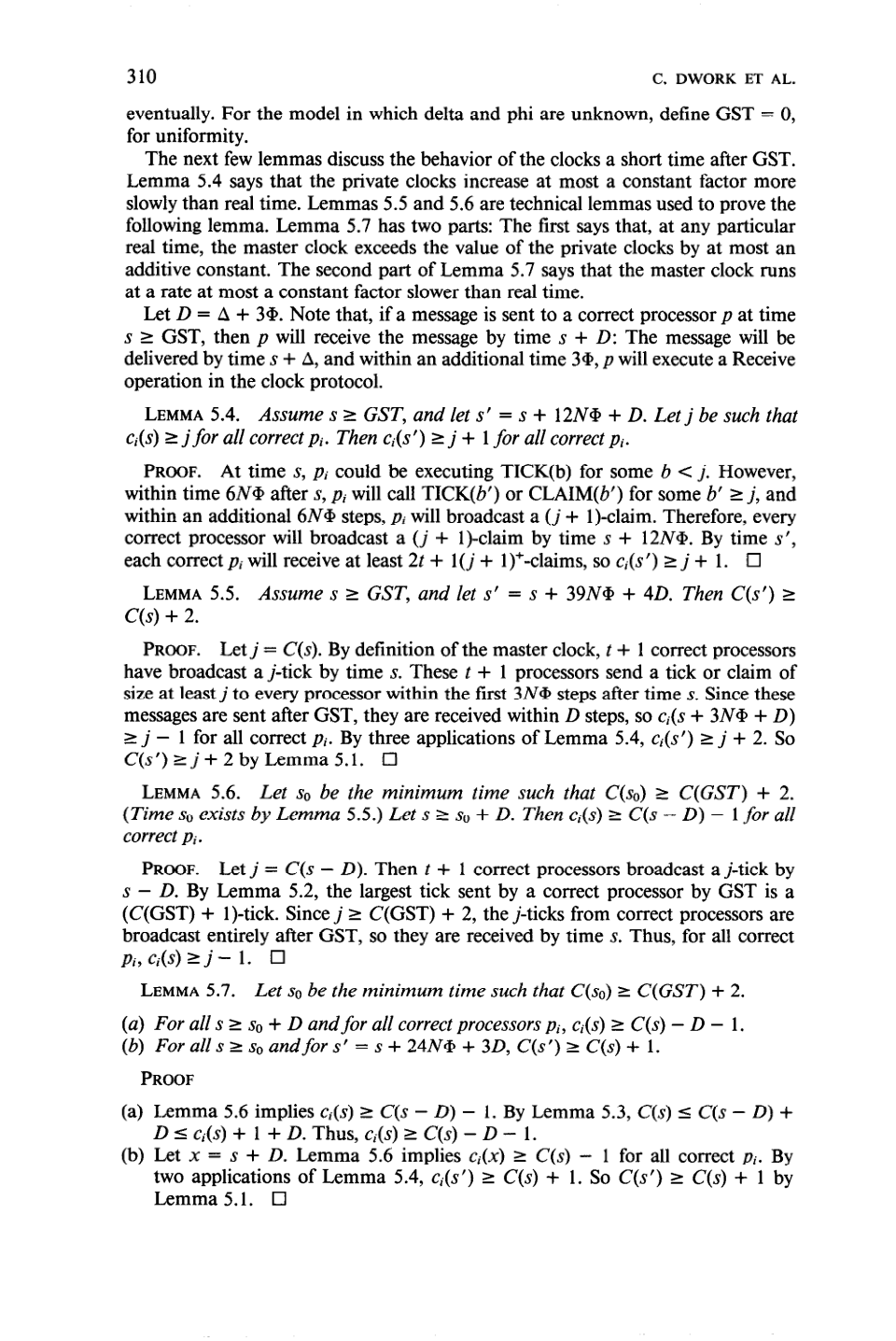
5.2 A DISTRIBUTED CLOCK FOR BYZANTINE FAULTS WITH AUTHENTICATION
新的 clock 与前一个非常相似,只说明差异。现在假设 N ≥ 2t + 1。
i-claim 是 signed message “I have broadcast an i-tick”;i+ -claim 是任意 j ≥ i 的 j-claim。
当 i ≥ 1 时,i-tick 是 message (i, i-proof):1-proof 是 empty string;i-proof(i > 1)是来自不同 processors、各自 signed 的 t + 1 个 (i − 1)+ -claims list。
i+ -tick 是任意 j ≥ i 的 j-tick。broadcast i-tick 和 broadcast i-claim 的 definitions 与之前相同。
Master clock 定义为:
C(s) = 截至 time s,某个 correct processor broadcast 的最大 j-tick 的 j。
Private clock 定义为:
Ci(s) = 截至 time s,pi 从不同 sources 收到 t + 1 个 j+-claims 的最大 j;
       这些 claims 可以直接收到,也可以作为某个 tick 的一部分间接收到。
clock protocol 与之前相同;增加一条:processor 在 CLAIM(b) 中发送 (b + 1)-claim 时,还附加它能构造的最大 size tick(总是某个 (b + 1)+ -tick)。
Correct processor 会忽略没有附带 j+ -tick 的 j-claim。这样修改,是为了避免 correct processors 接受 faulty processors 的过大 claims,并把这些过大 claims 加入 proofs。
Lemma 5.8
Lemmas 5.1–5.7 对 authenticated Byzantine clock 仍成立。
证明与 unauthenticated Byzantine clock 几乎相同。主要差异是:Lemma 5.1 更简单,因为只有一种情况。令 j = Ci(s);pi 已从不同 processors 收到 t + 1 个 j+ -claims,其中至少一个来自 correct processor。Correct processor 只有在 broadcast j-tick 后才发送 j+ -claim,因此由 master clock 定义 C(s) ≥ j。
Lemmas 5.2、5.3 的证明不变。Lemma 5.4 中把 2t + 1 改为 t + 1。Lemma 5.5 中,令 j = C(s) 时只能知道至少一个 correct processor 在 s 前 broadcast j-tick;但该 tick 自带由 t + 1 个 (j − 1)+ -claims 组成的 j-proof,所以仍能得到 Ci(s + 3NΦ + D) ≥ j − 1。Lemma 5.6 类似修改,Lemma 5.7 由前面的 lemmas 计算得到。
还需要一个 lemma,支持“correct processors 发送的 message bits 数量被 GST、N、Δ、Φ polynomially bounded”的 claim。
Lemma 5.9
在任意 real time s ≥ 0,任何 processor(correct 或 faulty)发送的最大 tick size 至多为 C(s) + 2。
证明:time s 发送的 j-tick 包含 t + 1 个 (j − 1)+ -claims,其中至少一个由 correct processor 发送。结论由 Lemma 5.2 得出。
由 protocol definition 可知,correct processor 在 s 发送的任意 tick 或 claim,都可编码为 O(t log C(s)) bits。
Remark 4:Sections 5.1 和 5.2 的 clocks 与 Attiya 等人独立发现的 clock 相似。
第 24 页:两种 distributed clocks 的 upper-bound simulation
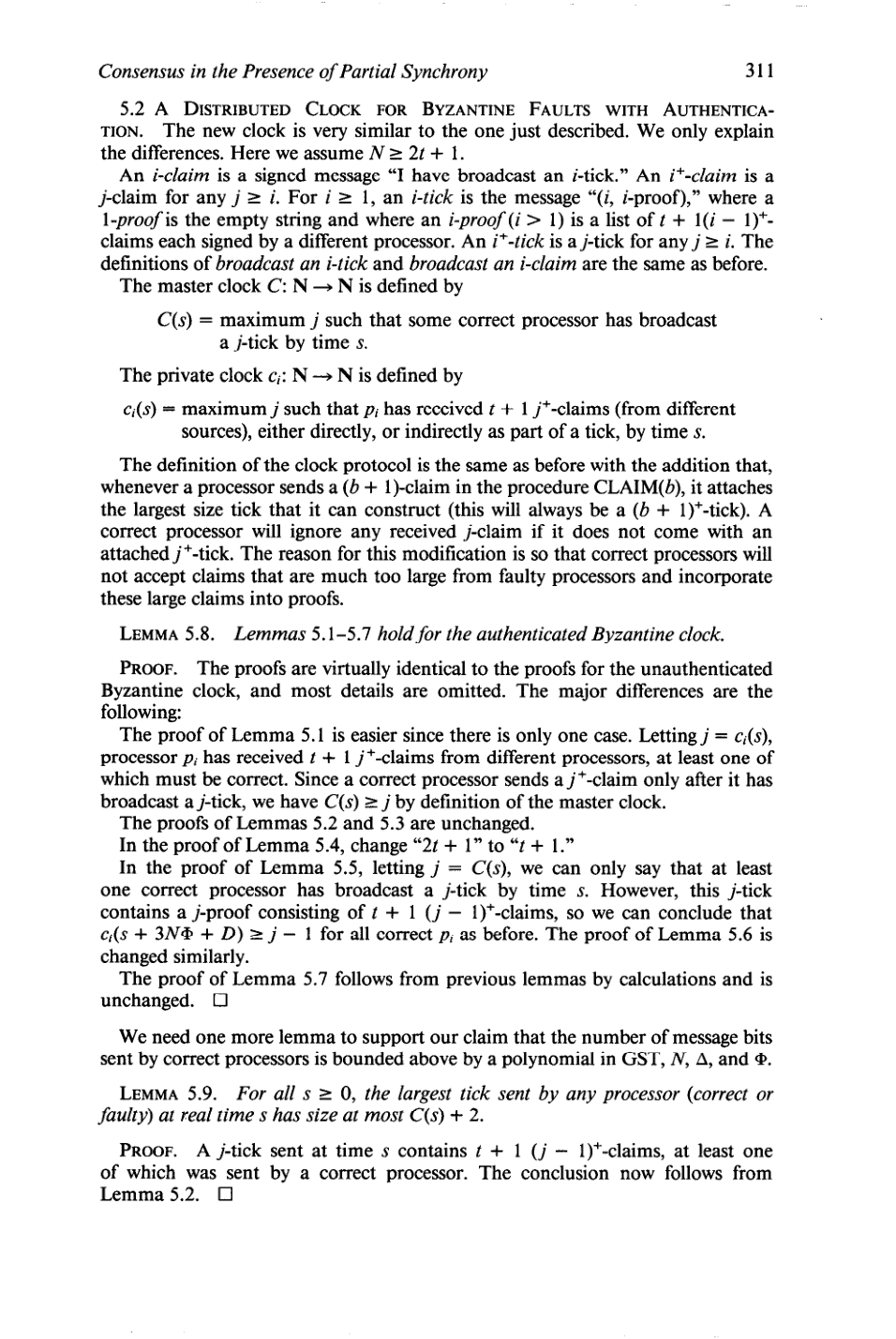
由 Lemma 5.9 和 protocol definition 很容易得到:correct processor 在 time s 发送的任意 tick 或 claim,都可以用 O(t log C(s)) bits 编码。
5.3 UPPER BOUNDS WHEN Δ AND Φ HOLD EVENTUALLY
现在给出 communication 和 processors 都 partial synchronous、且 Δ 与 Φ eventually holds model 的 upper bounds。
固定四种 fault models 中任意一种。我们说明:如果 basic model 中存在 t-resilient protocol,那么 Δ、Φ eventually holds 的 model 中也存在一个。
固定 Δ 和 Φ,假设 algorithm A 对 basic model 工作。构造 A':
- 每个 processor 每三个 steps 中有两个用于维护 distributed clock,另一个用于模拟
A。 - fail-stop 或 omission faults 使用 authenticated Byzantine clock 的适当简化版本;不需要 signatures,也不能假设 authentication capability。
- consensus protocol 和 distributed clock protocol 对 processor 数量有相同 constraint:
N ≥ 2t + 1。 - unauthenticated Byzantine faults 使用 unauthenticated Byzantine clock;authenticated Byzantine faults 可以使用任一 clock。
A' 的 Receive steps 分为 clock simulation 或 algorithm simulation。但每次 Receive 可能收到任一 simulation 或两者的 messages。
因此,每个 processor 维护两个 message buffers:一个给 clock simulation,一个给 algorithm simulation。执行 clock Receive 时,把 algorithm messages 保存到 algorithm buffer,反之亦然;执行某个 simulation 的 Receive 时,不仅取新到 messages,还取该 simulation buffer 中已有的全部 messages。
令 D = Δ + 3Φ,并令:
R = 3NΦ + 2D + 2
每个 processor 使用 private clock 判断当前模拟 A 的 round:若
(r − 1)R ≤ Ci(s) < rR
则 pi 在 real time s 认为当前 round 是 r。
Processors 给 messages 加 round numbers。只要 processor 认为当前 round 是 r,就用 protocol-simulation steps 模拟 basic model 的 round r:前 N 个 algorithm-simulation steps 向所有 processors 发送 round r messages,其余 steps 执行 Receive operations。
与 Section 4 的 simulation 不同,某个 processor 可能没有足够时间真正发送完 round r 的所有 messages。
当 pi 在某个 algorithm-simulation step 首次判断 current round 严格大于 r 时,它模拟 round r 的 state transition。更具体地,若 pi 当前 algorithm-simulation step 的 round 是 k,而上一个 algorithm-simulation step 的 round 是 h < k,则它在当前 step 开始时模拟 rounds h, h + 1, ..., k − 1 的 state transitions。
模拟这些 transitions 时,它会模拟所有 sending steps,即执行适当 state transitions,但不实际发送 messages;同时模拟 algorithm message buffer 中全部 messages 的 receipt。
对 A' 的任意 run e' 都可以定义 A 的对应 run e;correct processors 和 faulty processors 的 fault types 在两个 runs 中保持对应。
需要证明 GST 之后不久,分配给任意 round r simulation 的 ticks 足够发送和接收该 round 的所有 messages。选择这个 “short time after GST”,使 Lemma 5.7 的 (a)、(b) 成立。
首先,必须证明每个 correct pi 有足够时间发送 round r 的所有 messages,并至少执行一次 Receive。若 s 是 pi 的 private clock 首次达到 (r − 1)R 的 real time,那么 pi 在 s + 3(N + 1)Φ 前可以发完 round r messages 并执行一次 Receive;需要证明:
Ci(s + 3(N + 1)Φ) < rR. (5.1)
其次,round r 的每条 message 都必须在 receiver 开始模拟 round r + 1 前到达。令 s 为 ci(s) ≥ (r − 1)R 的第一个 real time;pi 在 s + 3NΦ 前把 message 发给 pj,pj 在 s + 3NΦ + D 前收到,因此要证明:
Cj(s + 3NΦ + D) < rR. (5.2)
因为 D ≥ 3Φ 且 clocks nondecreasing,证明任意 correct pk 都满足
ck(s + 3NΦ + D) < rR
即可。由 Lemmas 5.1、5.3、5.7(a) 和 R 定义,可得到:
ck(s + 3NΦ + D)
≤ C(s + 3NΦ + D)
≤ C(s − 1) + 3NΦ + D + 1
≤ Ci(s − 1) + 3NΦ + 2D + 2
< (r − 1)R + 3NΦ + 2D + 2
= rR.
因为 A 是 basic model 的 t-resilient consensus protocol,e eventually 达到 consensus,因此 e' 也达到。
第 25 页:Theorem 5.1 与 unknown Δ/Φ simulation
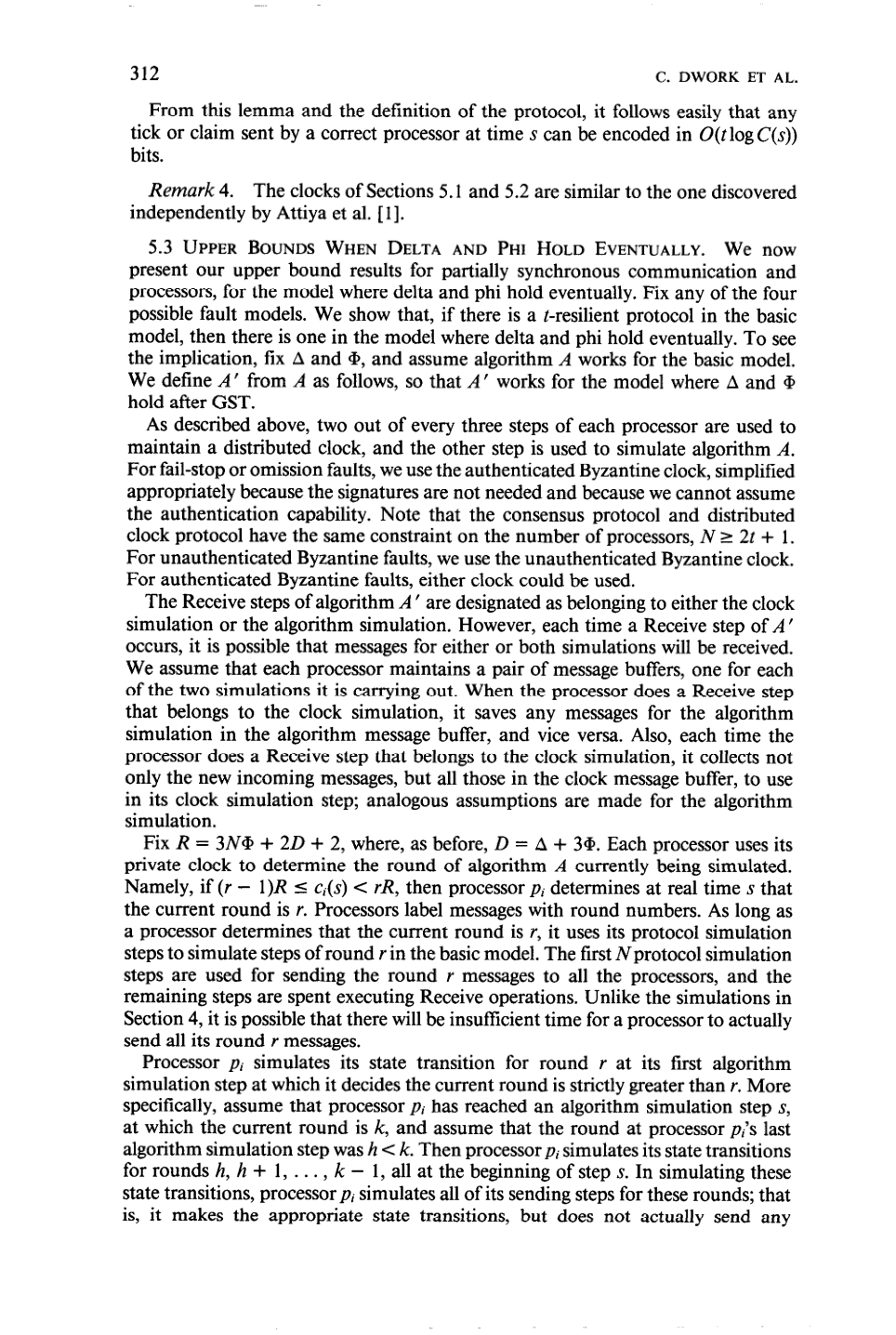
将上述 transformation 应用到 Algorithms 1–3,得到 Algorithms 1'''–3'''。
Theorem 5.1
假设 communication 和 processors 都 partially synchronous,且 Δ 与 Φ eventually holds:
- fail-stop 或 omission faults:若
N ≥ 2t + 1,Algorithm1'''对 arbitrary value domain 达到 consistency、strong unanimity 和 termination; - authenticated Byzantine faults:若
N ≥ 3t + 1,Algorithm2'''达到这些 properties; - unauthenticated Byzantine faults:若
N ≥ 3t + 1,Algorithm3'''达到这些 properties。
如前所述,1'''–3''' 在 GST 之后、以 N、Δ、Φ 为参数的 polynomial 时间内达成 agreement。理由是 Lemma 5.7(b) 表明 master clock 在 GST 之后以至少某个 1/(24NΦ + 3(Δ + 3Φ)) 的 real-time fraction 运行。
此外,correct processors 发送的 total message bits 也被 N、Δ、Φ、GST polynomially bounded,因为每条 message 的 bits 数量有相同的 polynomial bound。
5.4 UPPER BOUNDS WHEN Δ AND Φ ARE UNKNOWN
现在给出 Δ、Φ 都 unknown 的 upper bounds。基本思想是 Section 4.2 与 Section 5.3 的简单组合。
使用 Section 5.3 的 algorithm,但模拟 basic model round r 时,分配:
Rr = 3Nr + 8r + 2
这是把 Section 5.3 的 R 中的 Δ 和 Φ 都替换为 r 得到的 bound。
Correctness proof 与之前相同:当 r 超过该 run 中成立的(但 unknown 的)Δ 和 Φ 时,GST 已经达到,round simulation 足够长。
把 transformation 应用到 Algorithms 1–3,得到 1''''–3''''。
Theorem 5.2
假设 communication 和 processors partially synchronous,且 Δ 与 Φ unknown。Theorem 5.1 的 (a)–(c) 分别对 Algorithms 1''''–3'''' 成立。
同样容易看出,1''''–3'''' 在 N、Δ、Φ 的 polynomial 时间内达成 agreement。
Remark 5
在 Sections 5.3、5.4 描述的 basic-model simulation 中,如果 processor 上一次 algorithm-simulation step 的 round 是 h,本次 clock update 后发现当前模拟 round 是 k > h,那么必须模拟 rounds h 到 k − 1 的所有 state transitions(但不发送 messages)。
对一般 basic-model simulation,这是必要的,因为这些 transitions 可能改变 pi 的状态,而它必须正确模拟 basic algorithm。
但对 Section 3.2 专门设计的 Algorithms 1–3,pi 可以只模拟 round h 的 state transition,然后直接继续到 round k,而不模拟 h + 1 到 k − 1 的 transitions。
这是因为 Algorithms 1–3 的 state information(不包括 current round number)只有 PROPER sets、locked values,以及与 locks 相关的其他 information;这些 state information 的变化只由收到某些 messages 引起。
由于已经证明,即使 GST 之前 messages lost,Algorithms 1–3 仍保持 consistency,因此即使 processors(包括 correct processors)在 GST 之前 skip state transitions,algorithms 仍然保持 consistency。
第 26 页:Signals model 与 Algorithm 4
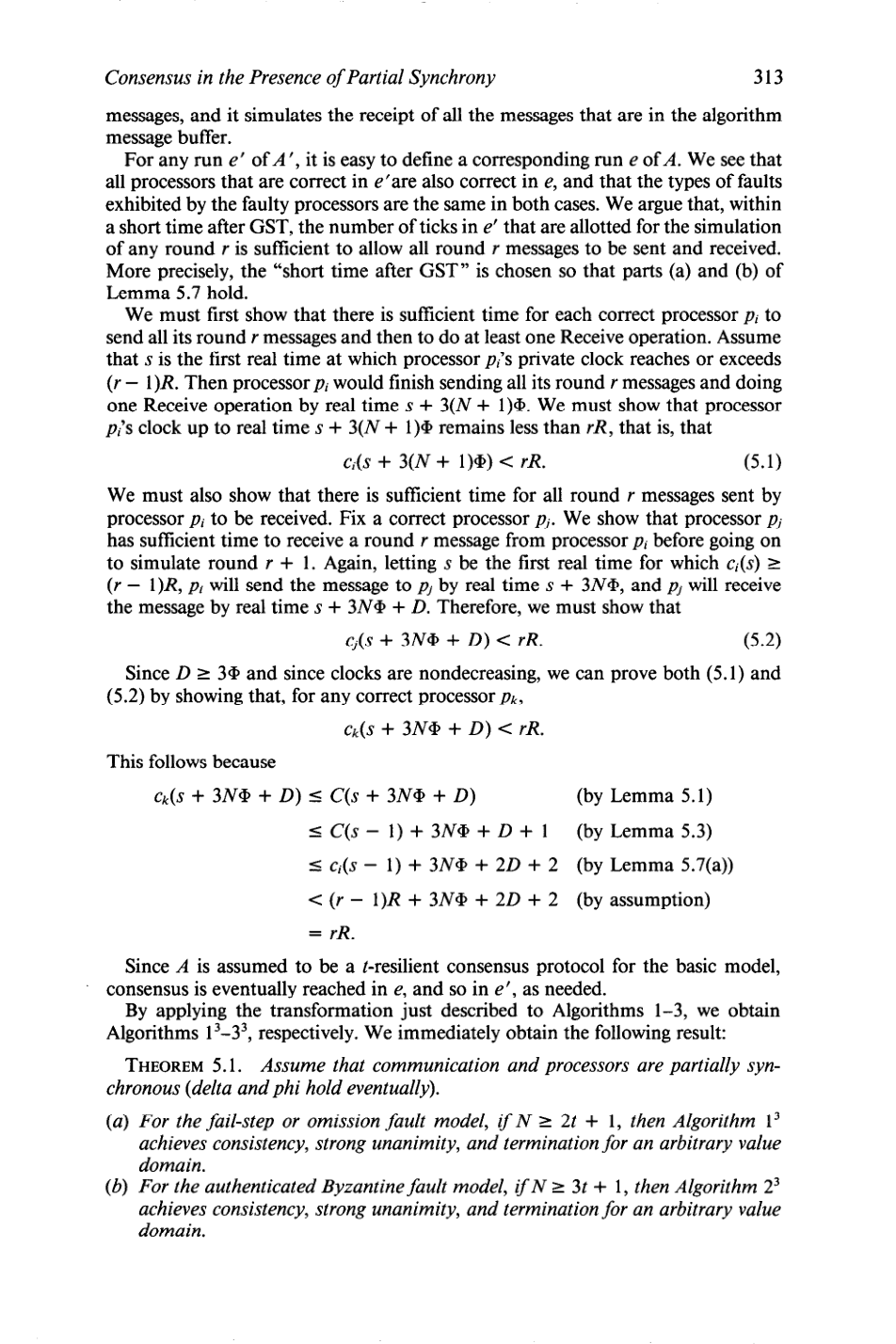
6. Partially Synchronous Processors and Synchronous Communication
本节考虑 processors partially synchronous、communication synchronous 的 models:存在一个始终成立的固定 message-transmission upper bound Δ(特别地,messages 不会 lost)。
上一节 protocols 及其 resiliencies 当然也适用于这些 models;但利用 communication synchronous 这一事实,在某些 cases 中可以获得更高 resiliencies。
我们把 consensus algorithms 建立在另一个 basic model 上,称为 basic model with signals。
Section 6.1 定义该 model,并给出为它设计的 consensus algorithms;之后展示如何用 Φ eventually 和 Φ unknown models 模拟 basic model with signals。和 Section 5 一样,使用 distributed clocks 给 processors 提供近似共同 time notion。Section 6.2 讨论 clocks,6.3 讨论 Φ eventually,6.4 讨论 Φ unknown,6.5 给出 lower bounds。
6.1 A BASIC MODEL WITH SIGNALS
Basic model with signals 与 basic model 相同,但 Receive subround 还允许每个 processor 收到 signal。
在任意 round r,processor pi 收到 signal,意味着所有 correct processors 都收到了 processor pi 在 round r 发给它们的 messages。
没有收到 signal 不意味着任何事情。GST round 及之后,假设所有 correct processors 每个 round 都收到 signals。
6.1.1 Fail-Stop Faults
下面 algorithm 对 arbitrary value domain V 达到 strong unanimity。
Algorithm 4:N ≥ t
每个 processor 有 local variable VALUE,初始为自己的 initial value。令每个 k = i (mod N) 的 round 属于 pi。
当 round k 属于 pi 时:
Broadcast VALUE;
If 收到 signal,则 decide VALUE。
当 round k 不属于 pi 时:
If 收到 contents 为 v 的 message,则 VALUE := v。
Lemma 6.1
假设 pi 在 round k 决定 v,且这是最小 decision round。则在任何 r ≥ k 的 round 中,都不会发送包含 w ≠ v 的 message。
证明:反设不成立,令 h ≥ k 是发送包含 w ≠ v message 的最小 round。由于 fault 是 fail-stop,h ≠ k;令 pj 为拥有 round h 的 processor。
因为 pi 在 round k 收到 signal,所以 pj 在 round k 必须从 pi 收到 value v,并把 VALUE 设置为 v。根据 h 的最小性,在 k 之后、h 之前没有发送不同于 v 的 message,因此 pj 的 VALUE 在 round h 开始前仍为 v;这与它在 h 发送 w 相矛盾。
第 27 页:Algorithm 4 的 theorem 与 Algorithm 5
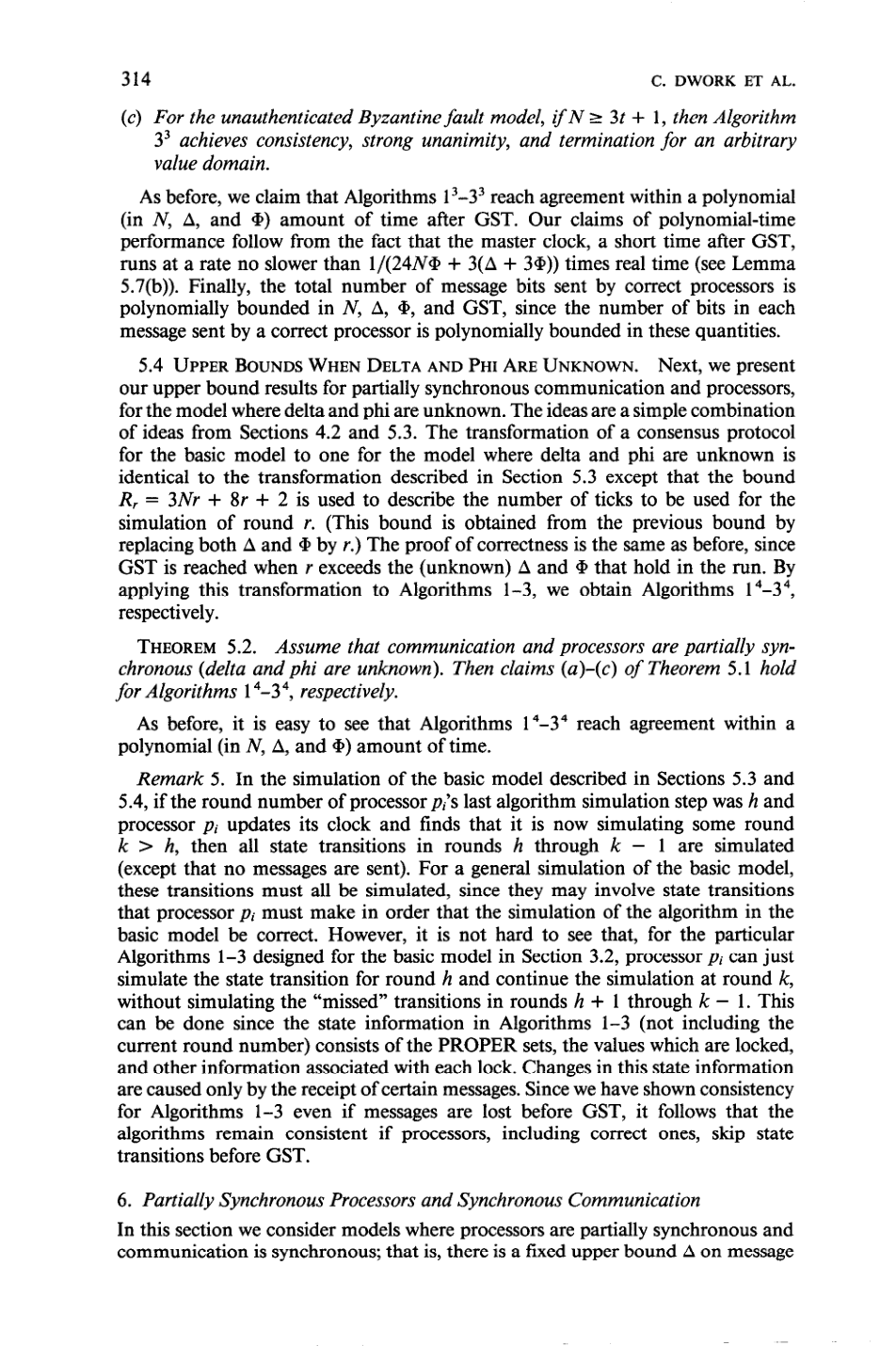
Theorem 6.1
假设 basic model with signals、fail-stop faults,且 N ≥ t。Algorithm 4 对 arbitrary value domain 达到 consistency、strong unanimity 和 termination。
证明:若 correct pi 在最小 decision round k 决定 v,由 Lemma 6.1,r ≥ k 的任何 round 都不会发送 w ≠ v;processor 只有先发送某个 value 的 messages 才可能决定该 value,所以不会有 processor 决定 w。
strong unanimity 显然成立,因为只有某 processor 的 initial value 是 v 时才会发送 contents 为 v 的 message。
GST 及之后,每个 correct processor 每一 round 都收到 signal;因此如果该 round 的 owner 尚未决定,round 会导致 owner 作出 decision。
6.1.2 Authenticated Byzantine Faults
下面的 Algorithm 5 对 arbitrary value domain 达到 weak unanimity。
Algorithm 5:N ≥ 2t + 1
protocol 类似 Section 3.2.2 的 Algorithm 2,但有以下变化:由于只处理 weak unanimity,不使用 PROPER sets。
这次 rounds 分成两-round 的 trying phases 和一-round 的 lock-release phases。Algorithm 5 的 trying phase 与 Algorithm 2 对应 phase 的前两个 rounds 相同;但如果 processor 正在自己的 trying phase 选择 propose value,且多个 values acceptable,它优先选择自己的 initial value(如果该 value acceptable),否则任意选择。
第三个 round 被省略:pi 不等待其他 processors 对 Ei(lock v, k, proof) 响应并 lock v 的 messages,而是在 trying phase 第二个 round 检查是否收到 signal。如果收到 signal,pi 就决定 v。
在 Algorithm 2 中,pi 需要至少 2t + 1 个 acknowledgment,才能推断至少 t + 1 个 correct processors 实际 lock v。现在,如果收到 signal,就能推断所有 correct processors 实际都在 phase k lock v;因为 N ≥ 2t + 1,至少有 t + 1 个 correct processors。
下面 theorem 的 proof 与 Theorem 3.2 非常相似,细节留给读者。
Theorem 6.2
假设 basic model with signals、authenticated Byzantine faults,且 N ≥ 2t + 1。Algorithm 5 对 arbitrary value domain 达到 consistency、weak unanimity 和 termination。
文献中还研究了一种 consensus problem:某个 distinguished processor “general” 把 initial values vi 提供给所有 processors。
在 authenticated Byzantine faults 情形,通常假设 general 用自己不可伪造的 signature 对这些 initial values 签名。如果 general correct,那么它会向每个 processor 提供同一个 signed value v,strong unanimity 要求所有 correct processors 决定 v。
如果 general faulty,它可以提供不同 values,甚至给同一个 processor 两个不同且都 signed 的 values;此时 strong unanimity 不要求某个特定 value。
第 28 页:Signed initial values 与 Algorithm 6
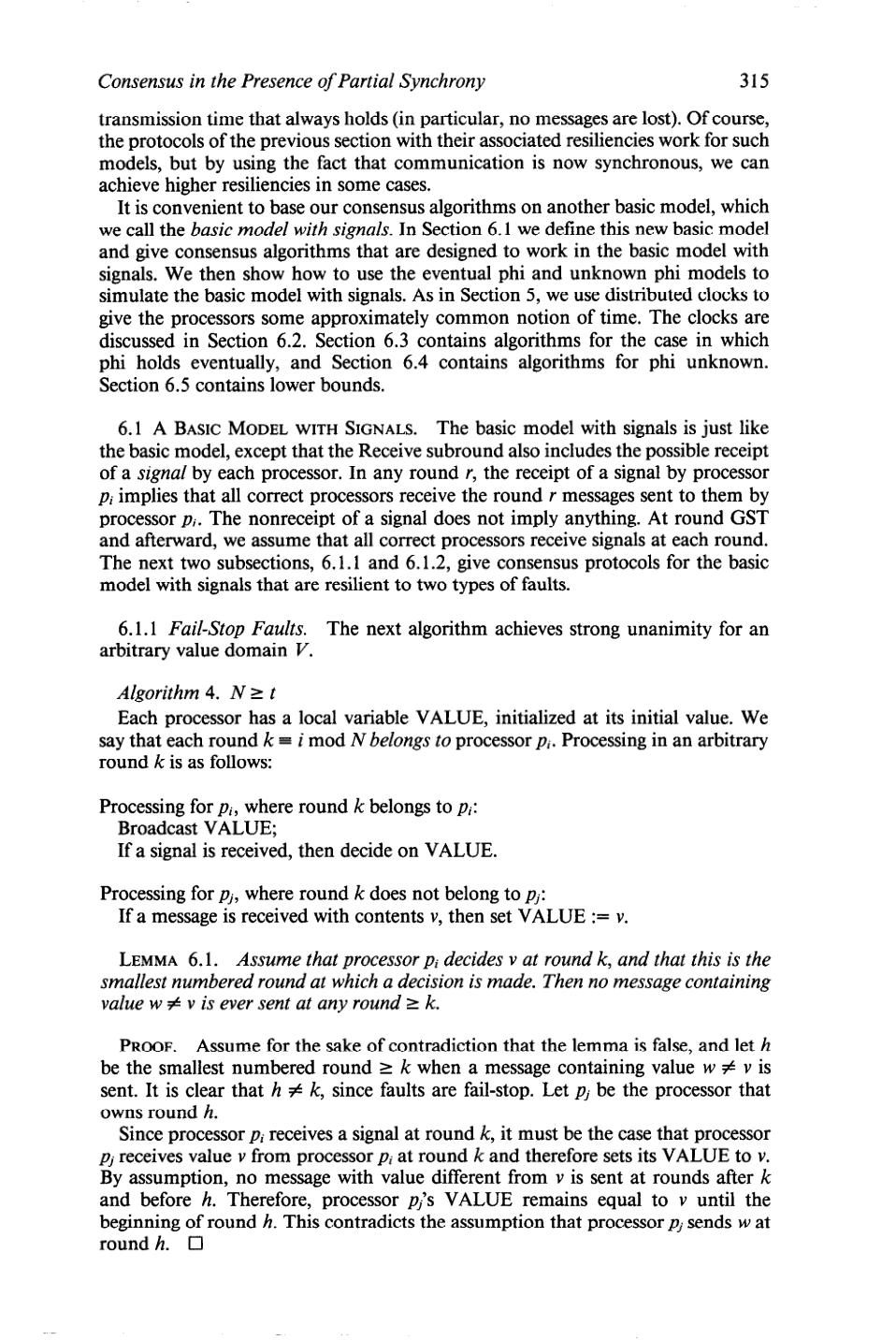
前面没有提出这个 distinction,因为它与 Sections 3–5 的 results 无关:那些 sections 的 authenticated Byzantine protocols 即使 general 不签 initial values 也能工作,Theorem 4.4 的 lower bound 即使 general 签了 initial values 仍然成立。
如果 general 签 initial values,Algorithm 2 中对 PROPER sets 的 update 可以简化。
但在 completely synchronous case 中,这个 distinction 很重要:authenticated Byzantine case 只有在 general 签 initial values 时,才可能实现 N-resilient strong unanimity(表 1 第一列、第三行)。
本节同样受这个 distinction 影响。如果 basic model with signals 中 general 签 initial values,且 N ≥ 2t + 1,Algorithm 5 的一个 slight variant 可以对 arbitrary value domain 达到 consistency、strong unanimity 和 termination。
Algorithm 6:N ≥ 2t + 1
Algorithm 6 与 Algorithm 5 相同,但使用 PROPER sets:
- 初始时,processor
pi的PROPERset 包含由 general 签名的 initial valuevi; - 每个 processor 把 general 签名的 initial value piggyback 在所有 messages 上;
- 如果
pi收到一个不同于vi、但同样由 general 签名的 value,则把整个V放入自己的PROPERset。
显然,correct processor 的 PROPER set 始终只包含 proper values。
6.2 DISTRIBUTED CLOCKS
本节存在一个始终成立的 known communication bound Δ。由于前面的 clocks resiliency 有限,先描述一个能够容忍任意数量 fail-stop faults 的 distributed clock。
该 clock 的 general form 与 Sections 5.1、5.2 的 clocks 相似:i-tick 是 message i,i-claim 是 “I have broadcast an i-tick”,i+ -tick、i+ -claim、broadcast definitions 也相同;clock protocol 仍由 Figure 2 的 TICK(b)、CLAIM(b) 给出。
Master clock:
C(s) = 截至 time s,某个 processor broadcast 的最大 j-tick 的 j。
Private clock:
Ci(s) = 截至 time s,pi 收到 j+ -claim 或 (j + 1)+ -tick 的最大 j。
本文声称:在本节 model 中使用新的 fail-stop clock 和 Section 5.2 的 authenticated Byzantine clock,都满足以下 properties:
- (A1) 对所有
s和所有 correctpi,Ci(s) ≤ C(s)。 - (A2) 对所有
s, x ≥ 0,C(s + x) ≤ C(s) + x。 - (A3) 若 processor bound Φ 从 GST 后成立(unknown-Φ model 中为统一叙述令 GST = 0),令
D = 3Φ + Δ,则存在依赖N、Δ、Φ的 polynomial constantsa1、a2:- 对所有
s ≥ GST + a1和所有 correctpi,Ci(s) ≥ C(s) − D − 1; - 对所有
s ≥ GST + a1,C(s + a2) ≥ C(s) + 1。
- 对所有
- (A4) 对 correct
pi在 clock protocol 执行 Receive 的任意s,Ci(s) ≥ C(s) − (Δ + 1)。
在 fail-stop case 中,processor 在 failure 之前都视作 “correct”;因此以上 properties 对 processor 失效之前的时间成立。
第 29 页:Fail-stop clock 的 properties 与 simulation
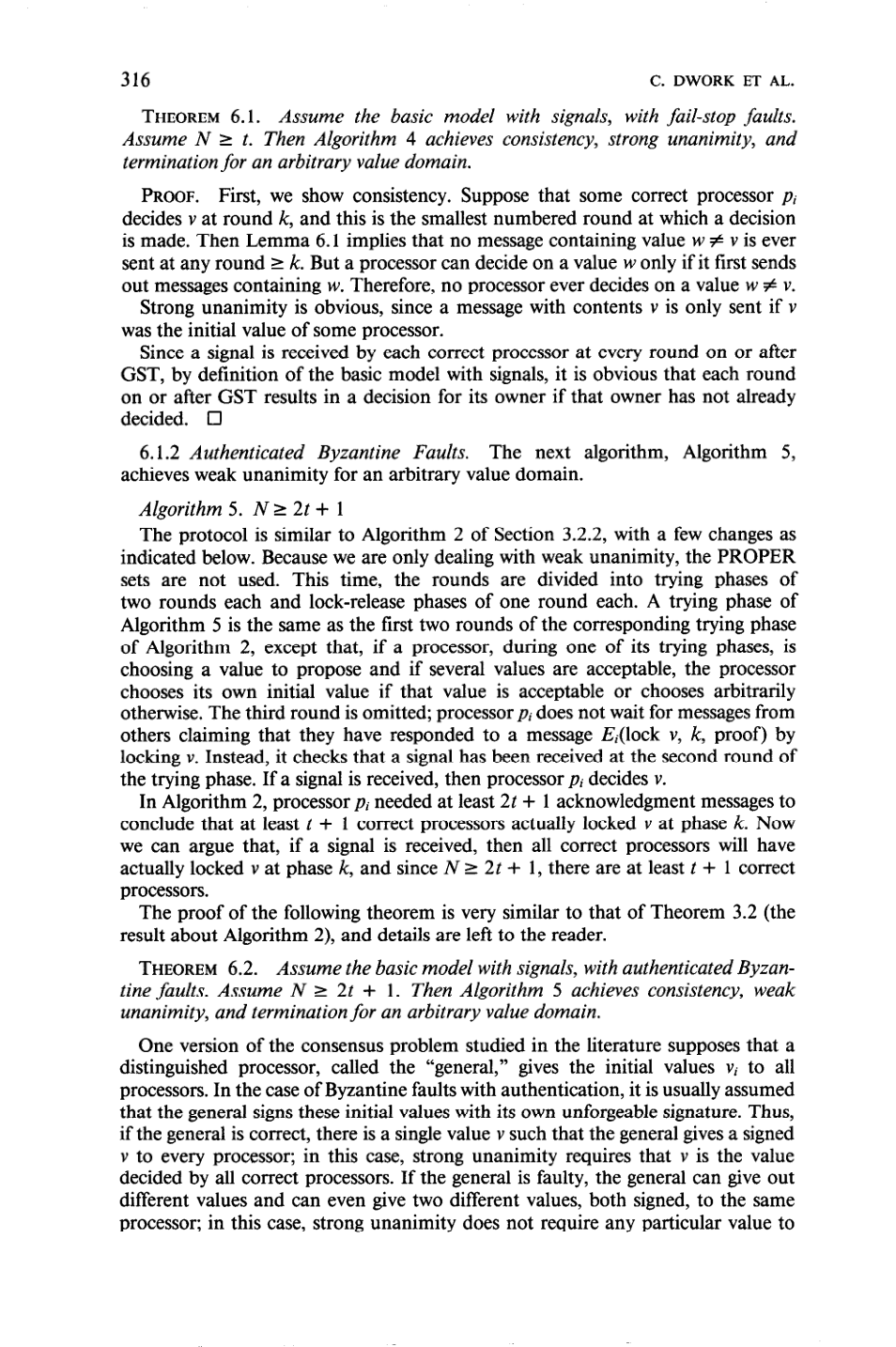
对 authenticated Byzantine clock,(A1)、(A2)、(A3) 已分别由 Lemmas 5.1、5.3、5.7(加上 Lemma 5.8 的 modifications)证明。
对 fail-stop clock,Lemmas 5.1–5.4 也成立,证明与 Section 5.1 类似;不需要 Lemma 5.5。因为 Δ 始终成立,可以为 fail-stop clock 证明更强版本:
Lemma 5.6'
对所有 s ≥ GST + D 和所有 correct pi,Ci(s) ≥ C(s − D) − 1。
证明:令 j = C(s − D)。根据 master clock 定义,截至 s − D 某个 processor 已 broadcast j-tick;因此每个 correct processor 都会在 time s 前收到 j+ -tick,由 private clock definition 得 Ci(s) ≥ j − 1。
由 Lemma 5.6' 和前面的 lemmas,Lemma 5.7 也能照常得到(但 (a) 只需 s ≥ GST + D,(b) 只需 s ≥ GST)。
Property (A4) 对两种 clocks 的 proof 类似。令 j = C(s − Δ);截至 s − Δ 已 broadcast j-tick,所以 pi 在 s 前会收到 j+ -tick。
对 authenticated Byzantine clock,该 tick 包含 t + 1 个 (j − 1)+ -claims;由 private clock definition 和 (A2):
Ci(s) ≥ j − 1 = C(s − Δ) − 1 ≥ C(s) − Δ − 1。
6.3 UPPER BOUNDS WHEN Φ HOLDS EVENTUALLY
相对于 communication 和 processors 都 eventually partial synchronous 的 case,本节只有两类 improvements:fail-stop faults,以及 authenticated Byzantine faults(weak unanimity,或 general 签 initial values 时的 strong unanimity)。
固定其中一个 fault model。若 basic model with signals 中有 t-resilient protocol,则可以构造 Φ eventually model 中的 protocol。
固定 Δ 和 Φ,假设 algorithm A 对 basic model with signals 正确。每三个 steps 中两个用于 distributed clock,另一个用于模拟 A:fail-stop 使用新的 fail-stop clock,authenticated Byzantine 使用 authenticated Byzantine clock;message buffers 按 Section 5.3 管理。
令:
R = 3NΦ + (2D + 2) + (Δ + 1), 其中 D = Δ + 3Φ。
每个 processor 按 Section 5.3 判断当前模拟 round,并执行其余 simulation。
第 30 页:Signals 的模拟
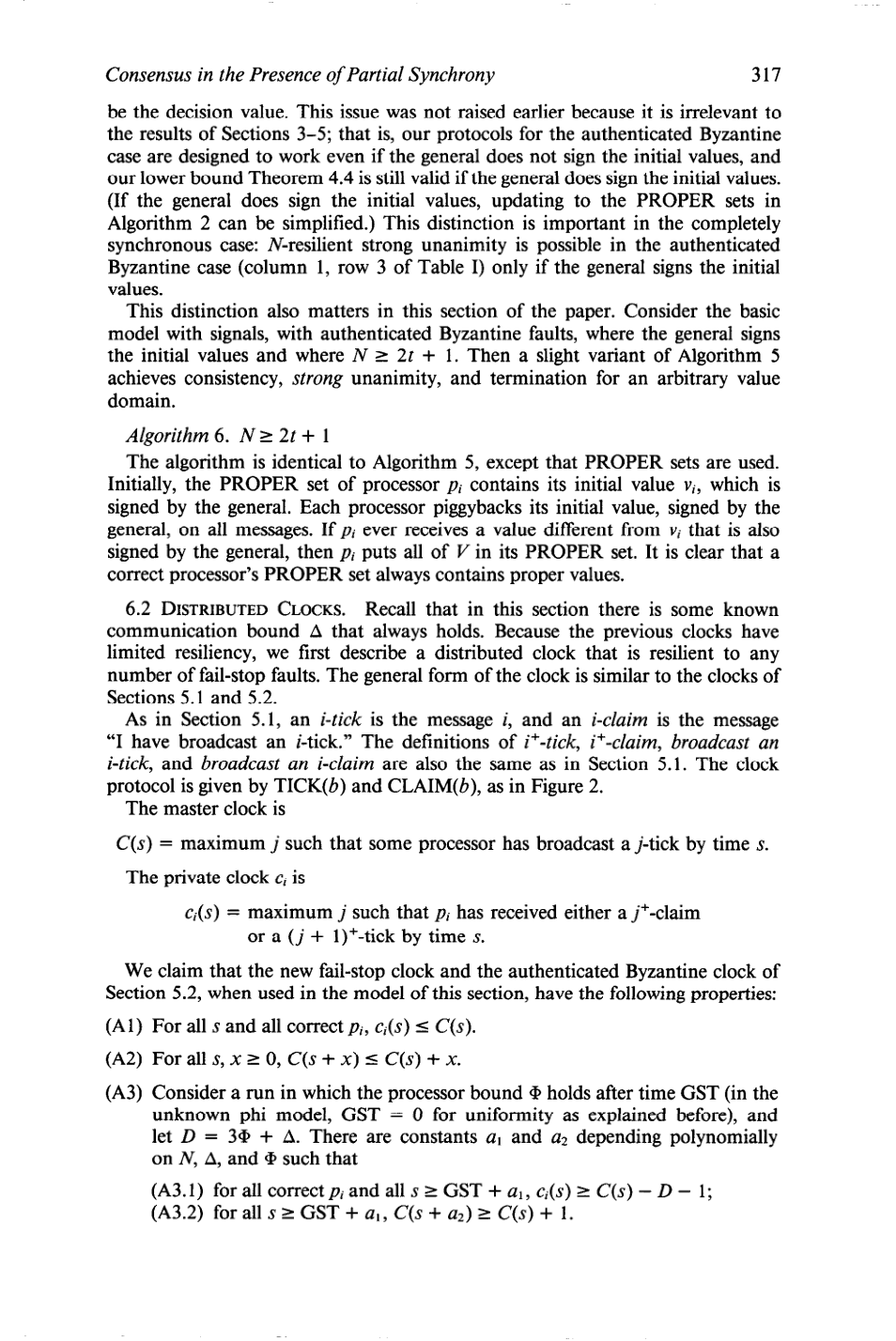
Signals 的模拟方式是:如果 pi 已经发送完 round r 的所有 messages,在 clock protocol 中执行 Receive、更新 private clock,并且 clock 满足
Ci < rR − (2Δ + 1),
则 pi 在 A' 中像收到 round r 的 signal 一样行动。
对 A' 的任意 run e' 定义 A 的 corresponding run e,faults 保持对应。
由于本节的 R 大于 Section 5.3 的 R,可按 Section 5.3 证明:GST 之后不久,每个 round r simulation 分配的 ticks 足够发送和接收该 round 的 messages。
还需证明 signals behavior 正确:
- correct
pi在任意 roundr收到 signal,意味着pi在 roundr发给 correct processors 的所有 messages 都确实被收到; - GST 之后不久,所有 correct processors 在所有 rounds 都收到 signals。
先证明 (1)。假设 correct pi 在 round r 收到 signal,pi 在 round r 向 correct pj 发送 message,发送时间为 s。message 在 s + Δ 前到达 pj,但 pj 可能当时没有执行 Receive。
关键是:pj 下次执行 Receive 时仍未开始任何大于 r 的 round。即需证明:
Cj(s + Δ) < rR。
因为 pi 收到 round r signal,所以存在 s' > s,使 pi 在 time s' 执行 clock Receive,且 Ci(s') < rR − (2Δ + 1)。
由 (A1)、(A2)、(A4) 得:
Cj(s + Δ) = C(s + Δ)
            ≤ C(s' + Δ)
            ≤ C(s') + Δ
            ≤ Ci(s') + 2Δ + 1
            < rR。
所以 message 在 pj 开始更晚 round 前已被接收。
再证明 (2)。固定 GST 之后的某个 round r,令 s 是 pi 的 private clock 首次达到 (r − 1)R 的 earliest time。
pi 可以在 s + 3(N + 1)Φ steps 内向所有 processors broadcast message,并在 clock protocol 执行 Receive。因此要证明:
Ci(s + 3(N + 1)Φ) < rR − (2Δ + 1)。
这由 (A1)、(A2)、(A3.1) 及 R 的计算直接得出。
第 31 页:Theorem 6.3 与 lower-bound setup
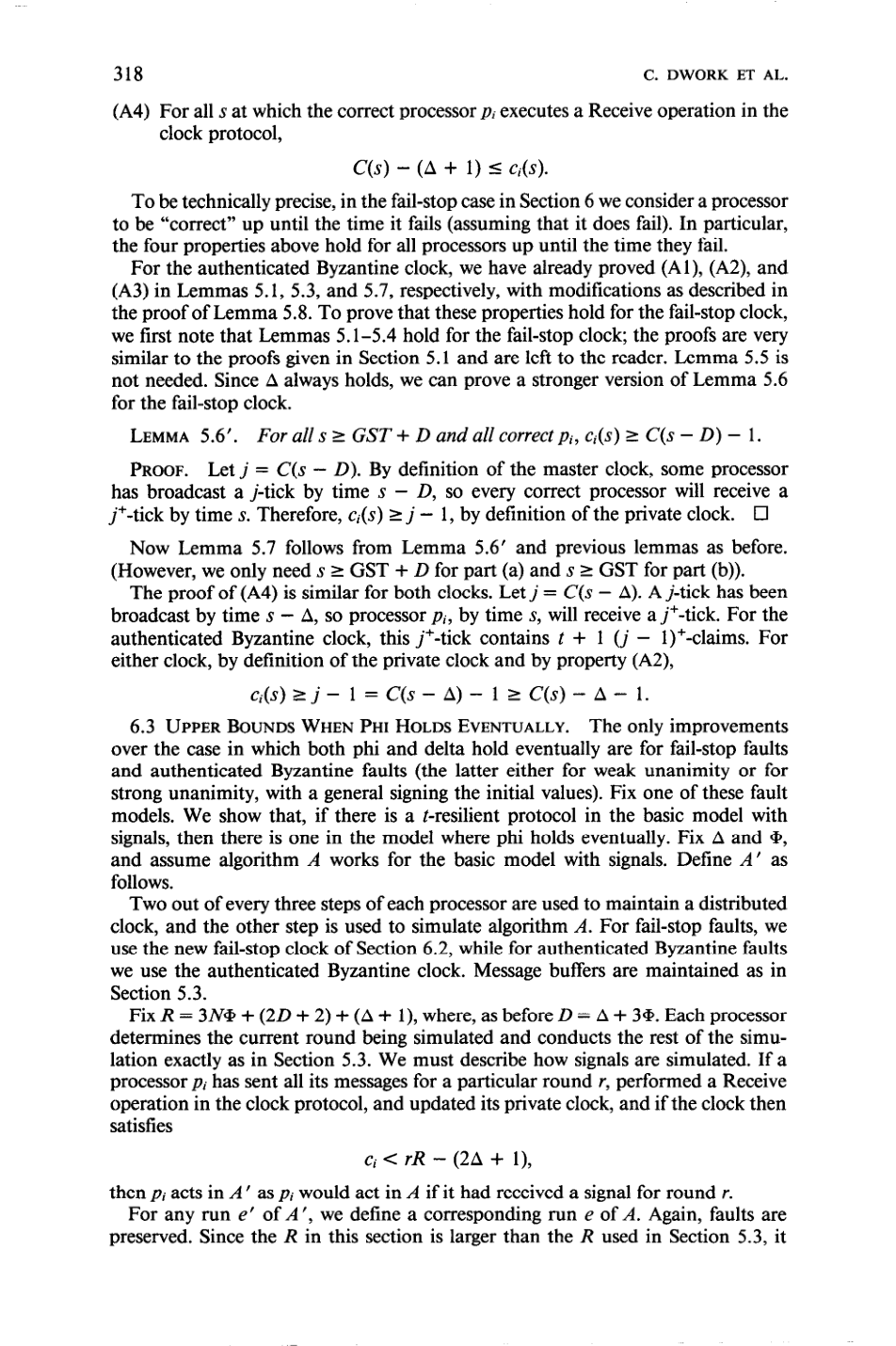
把该 transformation 应用到 Algorithms 4、5、6,分别得到 Algorithms 4'、5'、6'。
Theorem 6.3
假设 communication synchronous、processors partially synchronous,且 Φ eventually holds:
- fail-stop model 中,若
N ≥ t,Algorithm4'对 arbitrary value domain 达到 consistency、strong unanimity 和 termination; - authenticated Byzantine faults 中,若
N ≥ 2t + 1,Algorithm5'达到 consistency、weak unanimity 和 termination; - authenticated Byzantine faults 中,若
N ≥ 2t + 1且 general 签 initial values,Algorithm6'达到 consistency、strong unanimity 和 termination。
6.4 UPPER BOUNDS FOR Φ UNKNOWN
strategy 与 Sections 4.2、5.4 相同:使用 Section 6.3 algorithm,但把模拟 round r 的 steps 数设置为:
Rr = 3Nr + 6r + 3Δ + 3。
这是把 Section 6.3 的 R 中 Φ 替换为 r 得到的。
要注意,Section 6.3 中关于 signal correctness 的 (1) 并不依赖 Φ。因此,即使 r 小于 run 中实际(unknown)的 Φ,(1) 仍成立。
把 transformation 应用到 Algorithms 4、5、6,得到 4''、5''、6''。
Theorem 6.4
假设 communication synchronous、processors partially synchronous 且 Φ unknown,则 Theorem 6.3 的 (a)、(b)、(c) 分别对 Algorithms 4''、5''、6'' 成立。
Sections 6.3、6.4 的 polynomial time bound(GST 之后)来自 clock property (A3.2),它说明 master clock 在 GST 之后运行得足够快。
还要注意,Section 5 末尾 Remark 5 不适用于 Sections 6.3、6.4 的 simulations。这里如果 processor clock 大幅 jump,导致 skip rounds,则 consensus protocol 在 missed rounds 中的所有 steps 都必须模拟。
如果 correct pi 在 round r 向 correct pj 发 message,并收到 signal,那么 pj 必须收到该 message,并作出由该 receipt 导致的适当 state transition,即使 pi clock 的大 jump 使它 skip 了 round r。
第 32 页:Authenticated Byzantine 的 lower bound
6.5 LOWER BOUNDS
以下 lower bound 说明 Theorems 6.3、6.4 的 (b)、(c) resiliency 不能提高。这个 lower-bound method 由 Dolev 提出。
Theorem 6.5
假设 authenticated Byzantine faults、synchronous communication、processors partially synchronous。若 4 ≤ N ≤ 2t,则即使 general 签 initial values,也不存在对 binary values 达到 weak unanimity 的 t-resilient consensus protocol。
证明:反设存在 consensus algorithm。两种 partial-synchronous processors 定义的 proof 相同。为简化,假设所有 messages 都在一个 real-time step 内 delivery。
把 processors 分成四组 P、Q、b、r:P 和 Q 各包含至少 1、至多 t − 1 个 processors;b、r 各是单个 processor。
若 processor 在 real time s 执行 protocol 的 first step,称它在 s wake up;若它在 [s1, s2] 的每个 real-time step 执行一个 protocol step,称它在该 interval run fast。
Scenario CP:P ∪ {b} 的 initial values 为 0,在 time 1 wake up,并在 [1,∞) run fast;其他 processors initially dead。
由 t-resiliency,P 中 processors 在某个 finite TP 内作出 decision。该 decision 必须是 0:若是 1,可以修改 scenario,让所有 initial values 都为 0,Q ∪ {r} correct 但在 TP 之后才 wake up;P 仍会决定 1,与 weak unanimity 矛盾。
Scenario CQ:对称地,P ∪ {r} initially dead,Q ∪ {b} 在 time 1 以 initial value 1 wake up 并 run fast。因此 Q 在某个 finite TQ 后决定 1。
第 33 页:Scenario BP/BQ contradiction
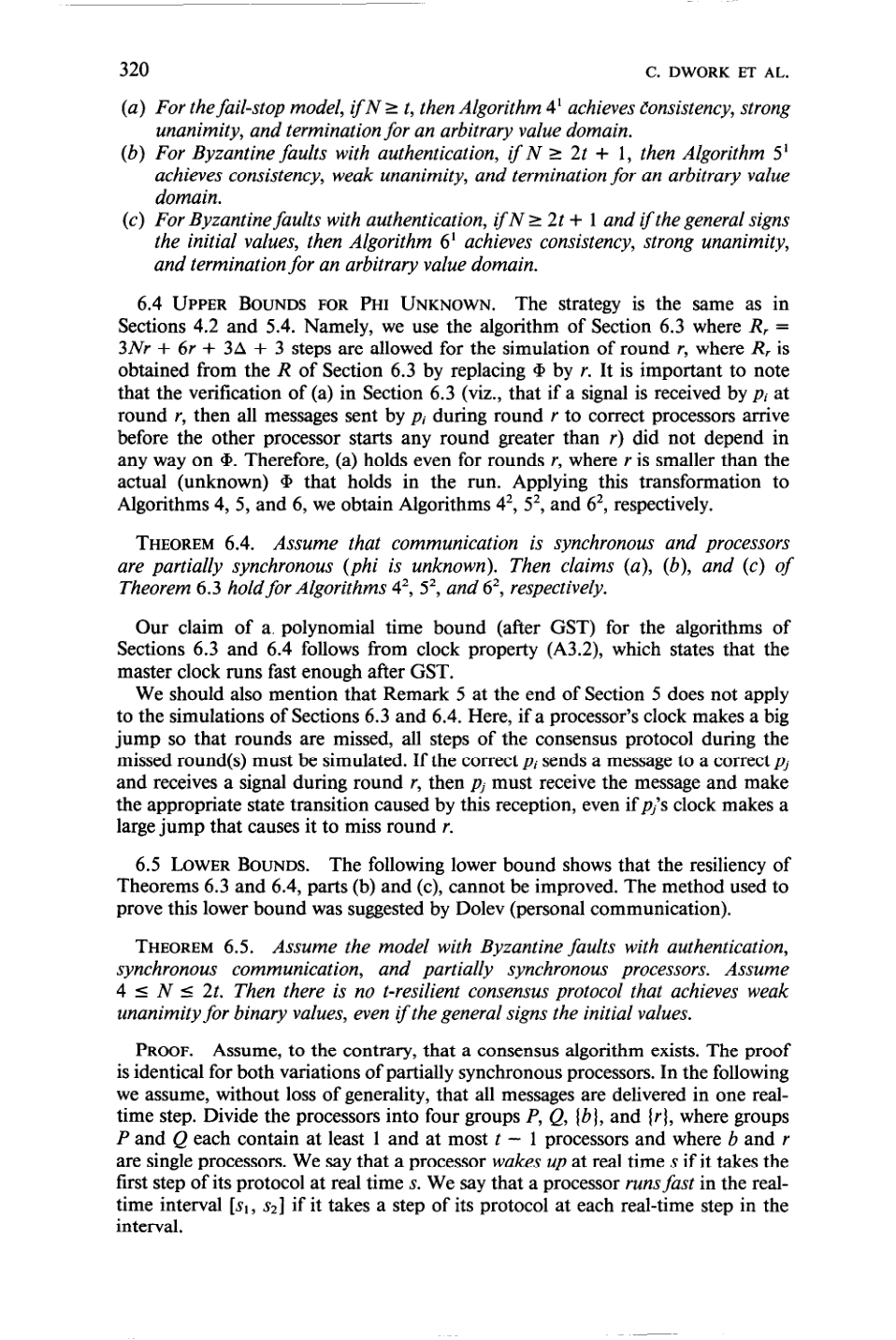
Scenario BP:P ∪ {b} Byzantine。P 的 value 是 0,b 同时具有 0 和 1(因此 general Byzantine)。它们 time 1 wake up,并在 [1, TP] run fast。
它们向 r 发送与 Scenario CP 相同的 messages,但不向 Q 发送。TP 之后,P die。Q correct,在 TP + 1 wake up,并从此 run fast。
从 TP + 1 开始,Byzantine b 对 Q 和 r 的行为,完全像 Scenario CQ 中 value 为 1 的 b;但 Scenario CQ 中 time s 发送的 message,在 Scenario BP 中于 TP + s 发送。
因为 Q 没有收到来自 P 的 messages,它们在 TP + TQ 决定 1,并完全按 Scenario CQ 行为,只是整体延迟 TP steps。TP + TQ + 1 时,correct r wake up 并 run fast;r 的 initial value 无关紧要。
本 run 至多有 t 个 faulty processors。Φ unknown model 中,该 run 满足 processor bound Φ = TP + TQ + 1;Φ eventually model 中,Φ = 1 从 GST = TP + TQ + 1 开始成立。
由于 Q 中 correct processors 已在 r wake up 前决定 1,r 必须在某个 real time T 决定 1。
Scenario BQ:P correct,initial value 为 0;它们在 [1, TP] run fast,但直到 T 之后不再执行 steps。
在 [1, TP] 中,Byzantine b 对 P 和 r 的行为与 Scenario CP 相同,表现得像 initial value 0,因此 P 在 time TP 决定 0。
Q Byzantine,在 TP + 1 以 value 1 wake up;它们对 r 的行为与 Scenario BP 相同,即忽略 [1, TP] 中 P 发给 Q 的 messages。
TP + 1 时,b 开始对 r 的行为与 Scenario BP 相同,表现得像 initial value 1。Correct r 在 TP + TQ + 1 wake up 并 run fast。
容易看出,从 TP + TQ + 1 到 T,r 在 Scenario BQ 收到的 messages 与 Scenario BP 完全相同。因此 r 在 T 决定 1,但这与 correct processors in P 已经决定 0 矛盾。
前面的 proof 中,P 和 Q 只展示 omission faults:Scenario BP 中 P 不向 Q 发送,Scenario BQ 中 Q 不接收来自 P 的 messages。只有 b 展示了比 omission 更强的 Byzantine behavior。
因此,可以用三组 P、Q、{r}、且 P/Q 各包含 1 到 t − 1 个 processors,重做同一 proof,得到 omission faults 的 lower bound。
第 34 页:Omission lower bound、strong unanimity lower bound 与 open questions
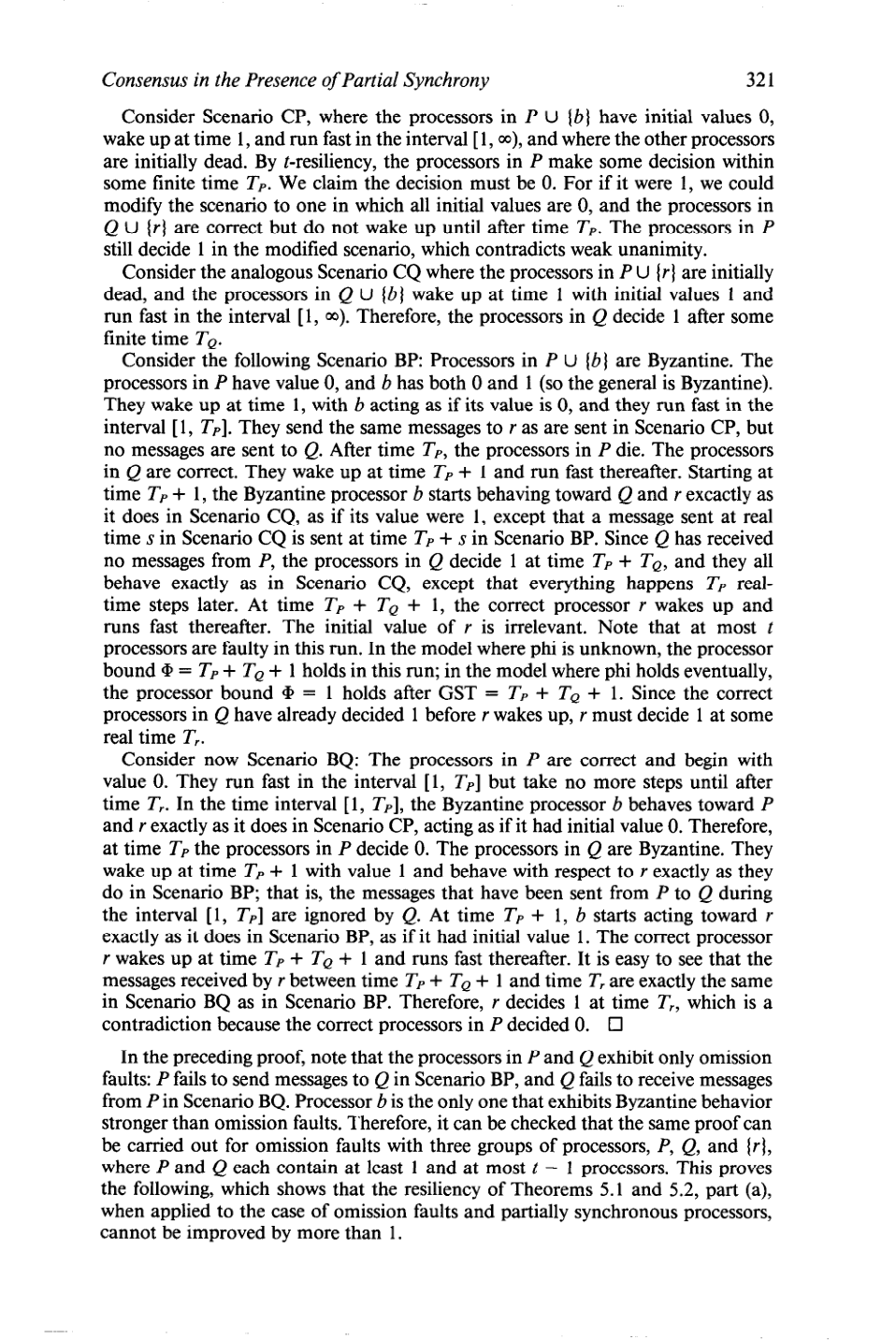
Theorem 6.6
假设 omission faults、synchronous communication、processors partially synchronous。若 3 ≤ N ≤ 2t − 1,则不存在对 binary values 达到 weak unanimity 的 t-resilient consensus algorithm。
对于 strong unanimity 和 authenticated Byzantine faults,如果 initial values 没有由 general 签名,Theorems 5.1、5.2 的 (b) 给出 N ≥ 3t + 1 时的 consensus algorithms。下面说明在这种情形下,这个 resiliency 是 best possible。
Theorem 6.7
假设 authenticated Byzantine faults、synchronous communication、processors partially synchronous。若 3 ≤ N ≤ 3t,且 general 不签 initial values,则不存在对 binary values 达到 strong unanimity 的 t-resilient consensus protocol。
证明:假设 N ≤ 3t。把 processors 分成 P、Q、R 三组,每组至少 1 个、至多 t 个 processors。
Scenario A:P 的 initial values 为 0,Q 的 initial values 为 1;P ∪ Q 在 time 1 wake up 并从此 run fast;R initially dead。因此 P ∪ Q 必须在某个 finite time 作出 decision。由 symmetry,不妨设它们在 TA 内决定 1。
Scenario B:所有 processors 的 initial values 都为 0;R correct,但直到 TA 之后才 wake up;Q Byzantine,并且对 P 的行为与 Scenario A 相同。
于是 P 的行为完全与 Scenario A 相同,仍决定 1;但在 Scenario B 中所有 initial values 都是 0,这与 strong unanimity 矛盾。
7. Open questions
-
Section 3 末尾的 Remark 1 指出,basic consensus Algorithms 1–3 只需 minor modifications,就能使 GST 之后达成 agreement 的 rounds 数在 constant factors 内 optimal(最多差 12 倍)。本文没有尝试降低这些 constants。
通过把 trying phases 与 lock-release phases overlap,可能还可以减少一些 rounds;但如果 rounds 数能达到已知的
t + 1lower bound,反而会令人意外。另一方面,partial synchrony 也许提供了一个 model,使t + 1lower bound 可以加强为更大的值。 -
一个 general direction 是研究 partially synchronous models 中的其他 distributed-computing problems。
ACKNOWLEDGMENTS
Joe Halpern 曾询问:如果 parameters Φ 或 Δ 存在但事先未知,Dolev 等人的 impossibility results 是否仍成立;这个问题促成了“Φ 或 Δ unknown”的 partial synchrony 版本。
感谢 Jennifer Lundelius Welch 阅读本文 draft 并提出许多有帮助的 comments。
第 35 页:References [1]–[2]
REFERENCES
- Attiya, A.; Dolev, D.; Gil, J. “Asynchronous Byzantine consensus.” Proceedings of the 3rd ACM Symposium on Principles of Distributed Computing,Vancouver, B.C., Canada,August 27–29,ACM,New York,1984,pp. 119–133。
- Bracha, G.; Toueg, S. “Asynchronous consensus and broadcast protocols.” Journal of the ACM 32(4),October 1985,pp. 824–840。
第 36 页:References [3]–[20]
- Dolev, D.; Strong, H. R. “Authenticated algorithms for Byzantine agreement.” SIAM Journal on Computing 12,1983,pp. 656–666。
- Dolev, D.; Dwork, C.; Stockmeyer, L. “On the minimal synchronism needed for distributed consensus.” Journal of the ACM 34(1),January 1987,pp. 77–97。
- Dolev, D.; Fischer, M. J.; Fowler, R.; Lynch, N. A.; Strong, H. R. “Efficient Byzantine agreement without authentication.” Information and Control 52,1982,pp. 257–274。
- Dolev, D.; Lynch, N. A.; Pinter, S. S.; Stark, E. W.; Weihl, W. E. “Reaching approximate agreement in the presence of faults.” Journal of the ACM 33(3),July 1986,pp. 499–516。
- Dwork, C.; Moses, Y. “Knowledge and common knowledge in a Byzantine environment I: Crash failures.” Proceedings of the 1986 Conference on Theoretical Aspects of Reasoning about Knowledge,Monterey, California,March 19–22,Kaufmann,Los Altos,1986,pp. 149–169。
- Fischer, M. J. “The consensus problem in unreliable distributed systems (a brief survey).” Report YALEU/DSC/RR-273,Department of Computer Science,Yale University,New Haven,June 1983。
- Fischer, M. J.; Lamport, L. “Byzantine generals and transaction commit protocols.” Technical Report Gp. 62,SRI International,Menlo Park,1982。
- Fischer, M. J.; Lynch, N. A.; Paterson, M. S. “Impossibility of distributed consensus with one faulty process.” Journal of the ACM 32(2),April 1985,pp. 374–382。
- Garcia-Molina, H.; Pate[l]li, F.; Davidson, S. “Is Byzantine agreement useful in a distributed database?” Proceedings of the 3rd SIGACT-SIGMOD Symposium on Principles of Database Systems,Waterloo, Ontario,April 2–4,ACM,1984,pp. 61–69。
- Gray, J. N. “Notes on database operating systems.” In Operating Systems: An Advanced Course,Lecture Notes in Computer Science,Vol. 60,Springer-Verlag,New York,1978,pp. 393–481。
- Lamport, L. “Time, clocks, and the ordering of events in a distributed system.” Communications of the ACM 21(7),July 1978,pp. 558–565。
- Lamport, L. “The weak Byzantine generals problem.” Journal of the ACM 30(3),July 1983,pp. 668–676。
- Lamport, L.; Shostak, R.; Pease, M. “The Byzantine generals problem.” ACM Transactions on Programming Languages and Systems 4(3),July 1982,pp. 382–401。
- Pinter, S. Distributed Computation Systems: Modelling, Verification and Algorithms. Ph.D. dissertation,Department of Computer Science,Boston University,Boston,1984。
- Reischuk, R. “A new solution for the Byzantine generals problem.” Information and Control 64,1985,pp. 23–42。
- Schneider, F. B. “Byzantine generals in action: Implementing fail-stop processors.” ACM Transactions on Computer Systems 2(2),May 1984,pp. 145–154。
- Skeen, D. “A quorum based commit protocol.” Technical Report TR 82-483,Computer Science Department,Cornell University,Ithaca,February 1982。
- Srikanth, T. K.; Toueg, S. “Simulating authenticated broadcasts to derive simple fault-tolerant algorithms.” Report 84-623,Computer Science Department,Cornell University,1984。
原刊页尾:Received October 1985;Revised July 1986 and March 1987;Accepted March 1987。Journal of the Association for Computing Machinery,Vol. 35,No. 2,April 1988。
结果与模型索引
| 场景 | fail-stop / omission | authenticated Byzantine | unauthenticated Byzantine |
|---|---|---|---|
| Synchronous communication + synchronous processors | N ≥ t(signals model 中可达) | N ≥ 2t + 1(weak;signed initial values 时 strong) | 依赖完全同步 Byzantine lower bound,通常 N ≥ 3t + 1 |
| Partial communication,processors synchronous | N ≥ 2t + 1 | N ≥ 3t + 1 | N ≥ 3t + 1 |
| Communication + processors both partial | N ≥ 2t + 1 | N ≥ 3t + 1 | N ≥ 3t + 1 |
| Communication synchronous,processors partial | N ≥ t | N ≥ 2t + 1(weak;signed initial values时 strong) | 本文重点 upper bound 为前两类 |
设计判断与边界
- Partial synchrony 是对 FLP 的结构化放松:它不假设永远同步,也不承诺一开始就知道 bound;它只要求最终存在足够长的稳定区间,或存在某个未知但固定的 bound。
- Safety 与 termination 应分开:消息在 GST 前可以任意迟到或丢失时,仍可保证 consistency/validity;termination 只在 timing assumption 最终成立时要求。
- Basic round model 是证明桥梁:先在 round number 和 GST 可表达的强模型中设计 locks、proper sets 和 broadcast,再用 simulation 降到实际 timing model。
- Distributed clock 的作用不是同步真实时钟:它只需让各 processor 的 private clocks 速率可控、彼此差距有界,足以模拟 consensus rounds。
- Authentication 的收益取决于 timing model:在 partial communication synchrony 的主要 cases 中,authenticated 与 unauthenticated Byzantine 的 resiliency 都是
3t + 1;但在 synchronous communication、partially synchronous processors 的 signals model 中,authentication 可以把上界降到2t + 1。 - Strong unanimity 需要额外 initial-value 语义:authenticated Byzantine、完全同步/部分同步 processors 的更强结果,取决于 distinguished general 是否为 initial values 签名。
- Lower bounds 用 indistinguishability 构造:把 processors 分组,延迟跨组 messages,或让 Byzantine processor 对不同组模拟不同 executions,使各组必须作出相互冲突的 decisions。
- 时间复杂度与 message complexity 同时受控:论文不仅证明 consensus eventually reached,还证明时间和 correct processors 发送的 message bits 对
N、Δ、Φ、GST为 polynomial。
本篇验收
- [x] 已固定 JACM 1988 版本,共 36 页;SHA-256 为
d307503b15594d2cbd6c1ca6be1bd13666e03e90c097096d9cd35aedc19777cb。 - [x] 已按 PDF 页序保留第 1–36 页页面图;36 张 PNG 均按原始 page rectangle 渲染并按
600宽度嵌入。 - [x] 已覆盖 Abstract、Introduction、两种 partial synchrony、Table I、fail-stop/omission、authenticated/unauthenticated Byzantine、basic round model、Algorithms 1–6、BROADCAST primitive、Lemmas 3.1–3.9、Theorems 3.1–6.7、distributed clocks、GST simulations、lower bounds、open questions 和 20 条 References。
- [x] 已保留 Δ/Φ/GST 定义、round/superround、PROPER set、lock/release、TICK/CLAIM、signal、clock properties、公式和算法伪代码。
- [x] 已补充结果矩阵、模型索引、safety/termination 边界和与 FLP、Paxos、Byzantine、distributed clocks 笔记的导航。
参考资料
评论 (0)