论文:Impossibility of Distributed Consensus with One Faulty Process
本篇整理 Michael J. Fischer、Nancy A. Lynch、Michael S. Paterson 的《Impossibility of Distributed Consensus with One Faulty Process》。每一页保留 MIT 论文 PDF 的原始页面图;页面图保留原文排版、Figure、configuration graph、proof、定理、版权声明和 References,下面严格按 PDF 页序给出中文译文。consensus、configuration、schedule、run、admissible、bivalent、univalent、faulty、nontermination 等术语按语境保留 English 或中英并列。
论文:Impossibility of Distributed Consensus with One Faulty Process
相关文章:论文:Paxos Made Simple · 论文:The Byzantine Generals Problem · 论文:Time, Clocks, and the Ordering of Events in a Distributed System · 6.5840:Lecture 21 Byzantine Fault Tolerance
TL;DR
- FLP 结论:在完全 asynchronous 的 message-passing system 中,只要允许一个 process crash,任何 deterministic consensus protocol 都存在一个 admissible run 永远不 decision。
- 模型很强:messages reliable、exactly once delivery,process 可以 atomic broadcast;但 message delay arbitrary,process speed 无界,不能依赖 synchronized clocks、timeout 或 failure detector。
- 证明主线:先证明存在 bivalent initial configuration;再证明从任意 bivalent configuration 出发,总能选择下一步后仍保持 bivalent;最后构造一个公平、可容忍一个 faulty process 的 infinite nondeciding run。
- 关键术语:
bivalent表示从 configuration 可达的 decision values 同时包含 0 和 1;univalent表示只能导向一个 decision value。 - 工程含义:FLP 不是说实践中不能做 consensus,而是说明必须加入 partial synchrony、failure detector、randomization、timing bound 或更弱的 termination 要求。
名词解释
| 名词 | 含义 | 本文译法 |
|---|---|---|
| consensus | reliable processes 对 binary value 达成 agreement,并满足 termination 条件 | consensus;共识 |
| configuration | 所有 processes 的 internal states 与 message buffer 内容 | configuration;配置 |
| event | 单个 process 对一次 receive 结果执行的 deterministic transition | event;事件 |
| schedule | 从 configuration 出发可依次应用的 finite/infinite events sequence | schedule;调度 |
| run | schedule 对应的 execution steps sequence | run;运行 |
| admissible run | 最多一个 faulty process,且发往 nonfaulty processes 的 messages 最终都收到的 run | admissible run;可接受运行 |
| deciding run | 至少一个 process 进入 decision state 的 run | deciding run |
| bivalent | reachable configurations 的 decision values 同时包含 0 和 1 | bivalent;双价 |
| univalent | reachable configurations 只有一个 decision value | univalent;单价 |
| partially correct | 不出现两个 decision values,且 0、1 都可在某些 accessible configurations 中决定 | partially correct |
| totally correct in spite of one fault | 每条 admissible run 即使有一个 fault 也最终 decision | total correctness |
目录
| 章节 | 内容 |
|---|---|
| 版本与来源 | MIT technical report、JACM 版本和本地源文件 |
| 原文页面与逐页翻译 | 9 个 PDF 页面按原页保留并翻译 |
| 机制索引 | bivalence proof、admissible run 与 FLP 边界 |
| 本篇验收 | 页数、图片、定理、proof 与 References 覆盖范围 |
版本与来源
- 论文标题:Impossibility of Distributed Consensus with One Faulty Process。
- 作者与机构:Michael J. Fischer,Yale University;Nancy A. Lynch,Massachusetts Institute of Technology;Michael S. Paterson,University of Warwick。
- JACM 发表信息:Journal of the Association for Computing Machinery,Vol. 32,No. 2,April 1985,pp. 374–382。
- MIT 记录:MIT Open Scholarship / DSpace record;记录中的 technical report 为
MIT-LCS-TR-282.pdf,Date Issued 为 September 1982。 - 本地固定文件:
source/flp-impossibility.pdf。实际下载使用 MIT CSAIL 的公开论文 PDF 镜像:MIT CSAIL PDF。 - PDF 固定信息:9 页;SHA-256:
80e1c33be45362d6ce0eeaba0259939df16eaff592cd612d42d783e4686c82b7。 - 附件处理:每页按原始 page rectangle 以 2× 渲染为 PNG,存放于
assets/49 FLP Impossibility/,正文按原图比例嵌入。Figure 1–3、proof 中的 configuration 交换图和文中所有公式均由原始页面图保留。 - 翻译边界:覆盖 Abstract、Introduction、system assumptions、consensus protocol model、Lemma 1–3、Theorem 1、bivalence proof、admissible nondeciding run、Initially Dead Processes、Theorem 2、Conclusion、Acknowledgment 和 25 条 References。
原文页面与逐页翻译
第 1 页:Abstract 与 Introduction 开始
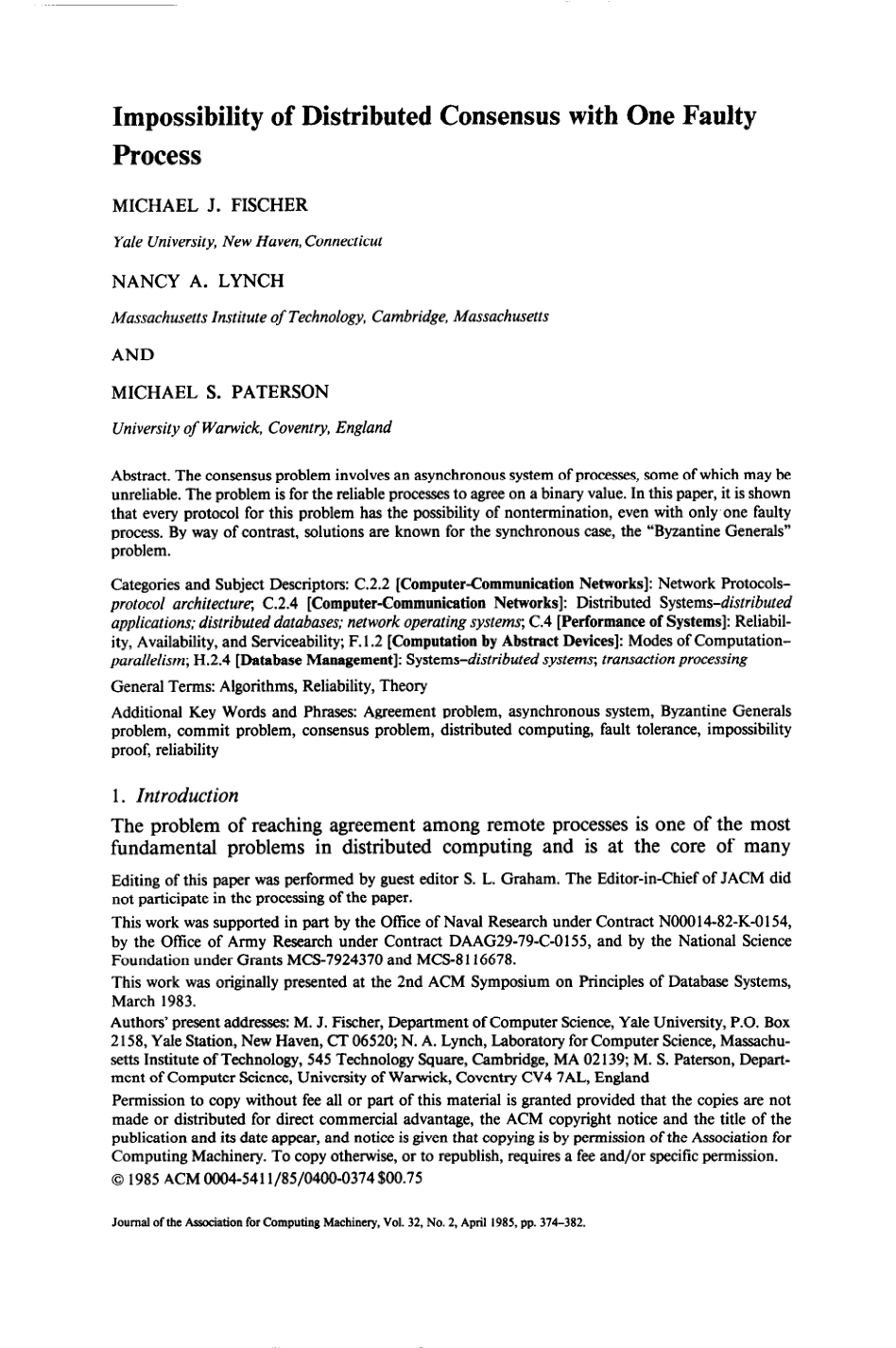
Impossibility of Distributed Consensus with One Faulty Process
作者:Michael J. Fischer,Yale University, New Haven, Connecticut;Nancy A. Lynch,Massachusetts Institute of Technology, Cambridge, Massachusetts;Michael S. Paterson,University of Warwick, Coventry, England。
Abstract
consensus problem 涉及一个 asynchronous processes system,其中一些 processes 可能不可靠。问题是:让 reliable processes 就一个 binary value 达成 agreement。
本文证明:即使只有一个 faulty process,任何解决该问题的 protocol 都存在 nontermination 的可能。作为对比,在 synchronous case,也就是 “Byzantine Generals” problem 中,已经存在 solutions。
分类与主题词:C.2.2「Computer-Communication Networks:Network Protocols——protocol architecture」;C.2.4「Computer-Communication Networks:Distributed Systems——distributed applications、distributed databases、network operating systems」;C.4「Performance of Systems——Reliability、Availability、Serviceability」;F.1.2「Computation by Abstract Devices——Modes of Computation、parallelism」;H.2.4「Database Management:Systems——distributed systems、transaction processing」。
General Terms:Algorithms、Reliability、Theory。
Additional Key Words and Phrases:Agreement problem、asynchronous system、Byzantine Generals problem、commit problem、consensus problem、distributed computing、fault tolerance、impossibility proof、reliability。
1. Introduction
remote processes 之间达成 agreement,是 distributed computing 中最 fundamental 的问题之一,也是 distributed data processing、distributed file management 和 fault-tolerant distributed applications 中许多 algorithms 的核心。
这个问题的一个 well-known form 是 transaction commit problem。它出现在 distributed database systems 中:参与处理某个 transaction 的所有 data-manager processes,必须一致决定是把 transaction 的 results 安装进 database,还是丢弃它们。例如,如果某些 data managers 因为任何原因无法完成所需的 transaction processing,就可能必须 discard results。无论决定是什么,所有 data managers 都必须作出相同决定,才能保持 database consistency。
如果参与的 processes 和 network 完全 reliable,完成 commit 所需的 agreement 很 straightforward。然而,real systems 会遭遇多种 possible faults:process crashes、network partitioning,以及 messages lost、distorted 或 duplicated。
还可以考虑更 Byzantine 的 failure [5, 7, 8, 11, 14, 18, 19]:faulty processes 可能完全 haywire,甚至按照某种 malevolent plan 发送 messages。因此,人们希望 agreement protocol 在这些 faults 存在时尽可能 reliable。当然,任何 protocol 都可能被过于频繁或过于严重的 faults 压垮;最多只能希望 protocol 能容忍预先规定数量的 “expected” faults。
本文证明一个 surprising result:完全 asynchronous 的 consensus protocol 连一个未预告的 process death 都无法容忍。
本文不考虑 Byzantine failures,并假设 message system reliable:它正确地、exactly once 地 delivery 所有 messages。即便有这些假设,single process 在不合适的时刻停止,也足以让任何 distributed commit protocol 无法达到 agreement。因此,如果不对 computing environment 增加假设,或者不进一步限制允许容忍的 failures 类型,这个重要问题没有 robust solution!
第 2 页:Asynchrony、consensus 约束与 system model 开始
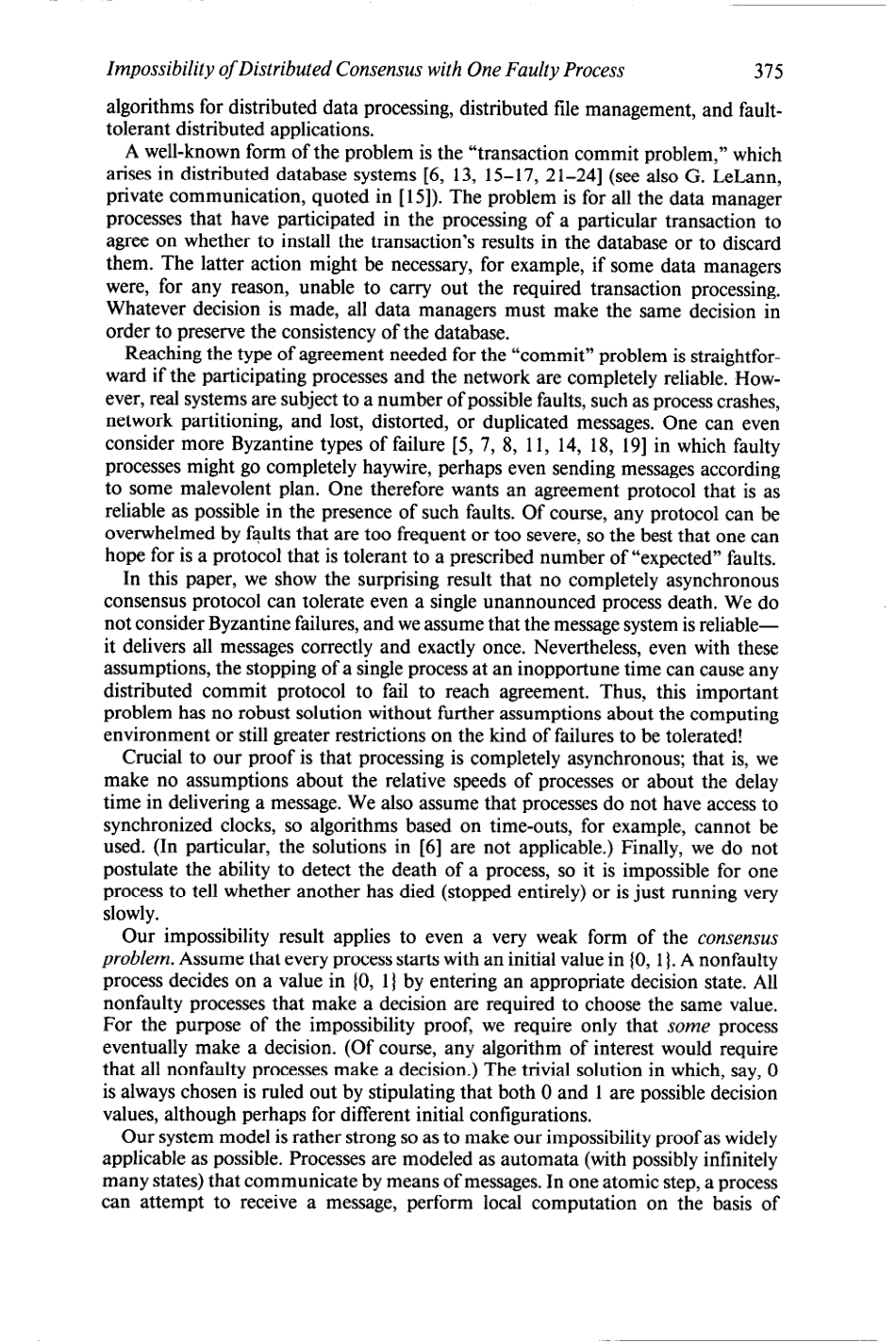
proof 的关键在于 processing 是 completely asynchronous 的:不对 processes 的 relative speeds 或 message delivery delay 作任何假设。我们还假设 processes 不能访问 synchronized clocks,因此不能使用基于 timeouts 的 algorithms。(特别地,文献 [6] 中的 solutions 不适用。)最后,我们不假设具有 detect process death 的能力;所以,一个 process 无法判断另一个 process 是死了(完全停止),还是只是运行得非常慢。
我们的 impossibility result 甚至适用于 consensus problem 的一个 very weak form。假设每个 process 都从 (0, 1) 中的一个 initial value 开始。nonfaulty process 通过进入适当的 decision state,决定 (0, 1) 中的一个 value。所有作出 decision 的 nonfaulty processes 都必须选择相同 value。
为了 impossibility proof,我们只要求至少有某个 process 最终作出 decision。(当然,任何有实际意义的 algorithm 都会要求所有 nonfaulty processes 作出 decision。)通过规定 0 和 1 都必须是 possible decision values(也许来自不同的 initial configurations),排除了 “永远选择 0” 这种 trivial solution。
我们的 system model 相当强,从而使 impossibility proof 尽可能广泛适用。Processes 被建模为 automata(可以有 infinitely many states),并通过 messages 通信。
在一个 atomic step 中,process 可以尝试 receive 一个 message,根据 message 是否 delivery 以及(如果 delivery)是哪个 message 进行 local computation,并向其他 processes 发送任意但 finite set 的 messages。
特别地,model 假设 process 具备 “atomic broadcast” 能力:process 可以在一个 step 中向所有其他 processes 发送同一个 message,并且知道:如果任何 nonfaulty process 收到了该 message,那么所有 nonfaulty processes 都会收到。
只要 destination process 无限次尝试 receive,每条 message 最终都会被 delivery;但 message 可以被任意长时间 delay,也可以 out of order delivery。
当前使用的 asynchronous commit protocols 似乎都有一个 “window of vulnerability”:algorithm 执行期间存在一个时间区间,单个 process 的 delay 或 inaccessible 就可能让整个 algorithm 无限等待。由本文 impossibility result 可知,每个 commit protocol 都有这样的 “window”,这也证实了 distributed-systems folklore 中一个被广泛相信的观点。
2. Consensus Protocols
consensus protocol P 是一个 asynchronous system,包含 N 个 processes(N ≥ 2)。每个 process p 有:
- 一个 one-bit input register
xₚ; - 一个 output register
yₚ,取值为{b, 0, 1}; - 无界的 internal storage。
input 和 output registers 中的 values、program counter 以及 internal storage 共同组成 process 的 internal state。initial states 为除 input register 外的所有部分规定 fixed starting values;特别地,output register 初始为 b。output register 为 0 或 1 的 states 被称为 decision states。
p 按照 transition function deterministic 地行动。process 一旦进入 decision state,transition function 就不能再改变 output register 的值;output register 是 “write-once” 的。
整个 system P 由各 processes 的 transition functions 以及 input registers 的初始 values 指定。
第 3 页:Message buffer、configuration 与 Lemma 1
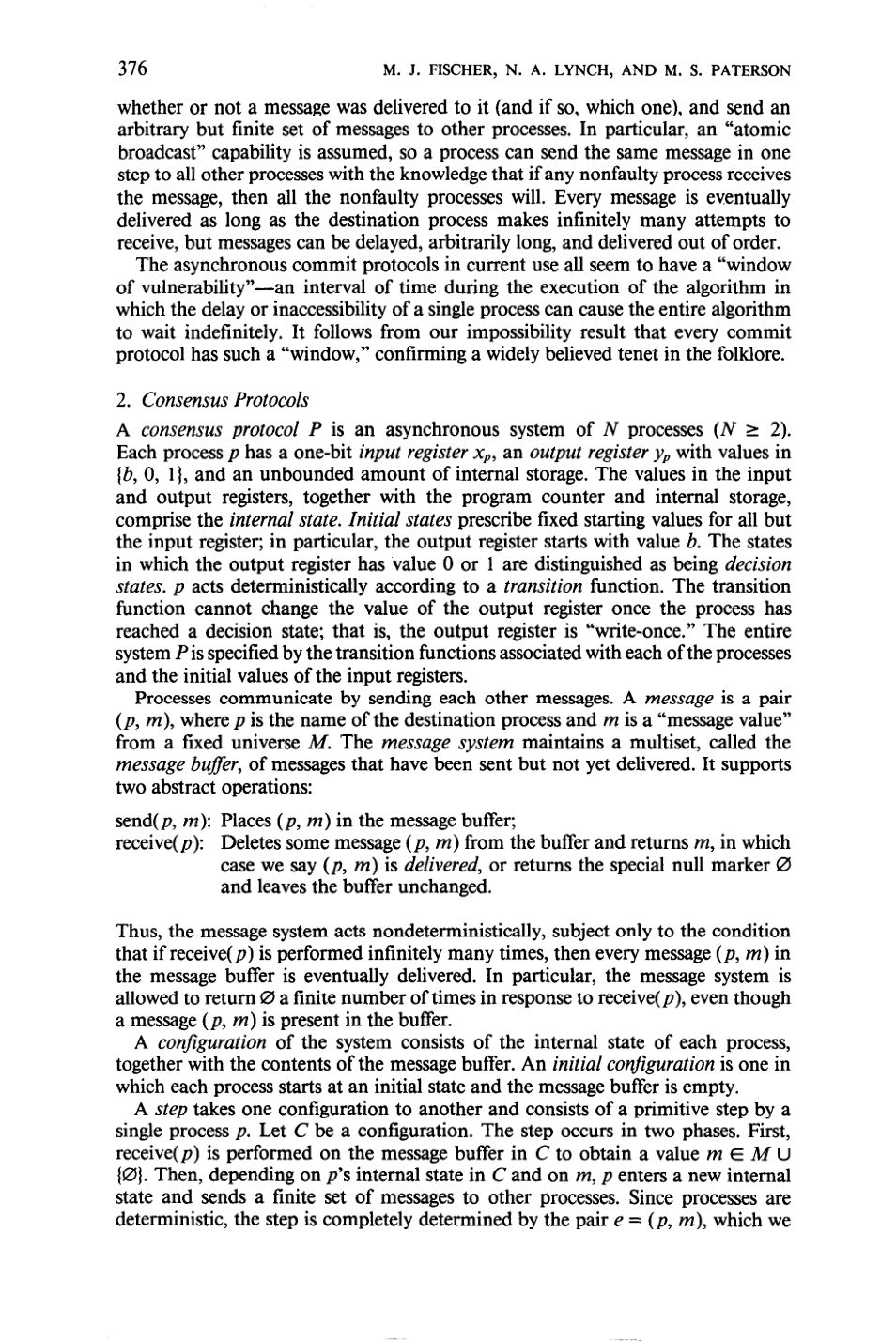
Processes 通过互相发送 messages 通信。一个 message 是 pair (p, m),其中 p 是 destination process 的 name,m 是固定 universe M 中的一个 message value。
message system 维护一个称为 message buffer 的 multiset,其中保存已经发送但尚未 delivery 的 messages。它支持两个 abstract operations:
send(p, m): 将 (p, m) 放入 message buffer;

receive(p): 从 buffer 删除某个 message (p, m) 并返回 m;
           此时称 (p, m) 已 delivery;
           或返回特殊 null marker ∅,并保持 buffer 不变。
message system 是 nondeterministic 的,只受以下条件约束:如果 receive(p) 被执行 infinitely many times,那么 message buffer 中的每个 (p, m) 最终都会被 delivery。
特别地,即使 buffer 中已经存在 (p, m),message system 仍允许对 receive(p) 有限次返回 ∅。
system 的 configuration 由每个 process 的 internal state 与 message buffer 的 contents 组成。initial configuration 中,每个 process 都处于 initial state,message buffer 为空。
一个 step 把一个 configuration 变为另一个 configuration,并由单个 process p 的 primitive step 组成。令 C 为 configuration。step 分两个 phases:
- 对 configuration
C的 message buffer 执行receive(p),得到m ∈ M ∪ {∅}; - 根据
p在C中的 internal state 和m,p进入新的 internal state,并向其他 processes 发送一个 finite set 的 messages。
由于 processes 是 deterministic 的,一个 step 完全由 pair e = (p, m) 决定。这个 pair 称为一个 event。(这个 event 应理解为 p 接收 m。)记 e(C) 为 event e 作用后的 configuration,并称 event e 可以应用于 C。
注意,event (p, b) 总能应用于 C,所以 process 总能再执行一个 step。
从 configuration C 出发的 schedule,是一个可以从 C 开始依次应用的、有限或无限的 events sequence。对应的 steps sequence 称为一个 run。
如果 schedule u 是 finite 的,记 α(C) 为结果 configuration;这个 configuration 称为从 C reachable 的。能从某个 initial configuration reachable 的 configuration,称为 accessible。下文提到的所有 configurations 都假设是 accessible 的。
下面的 lemma 表达了 schedules 的一个 “commutativity” property。
LEMMA 1. 假设从某个 configuration
C出发,schedulesu₁、u₂分别到达 configurationsC₁、C₂。如果u₁、u₂中执行 steps 的 processes 集合互不相交,那么可以从C₁应用u₂,也可以从C₂应用u₁,且两者都会到达同一个 configurationC₃。(见 Figure 1。)
证明:根据 system definition,结论立即成立,因为 u₁ 与 u₂ 不会相互影响。
第 4 页:Consensus protocol 的 correctness 与 Theorem 1
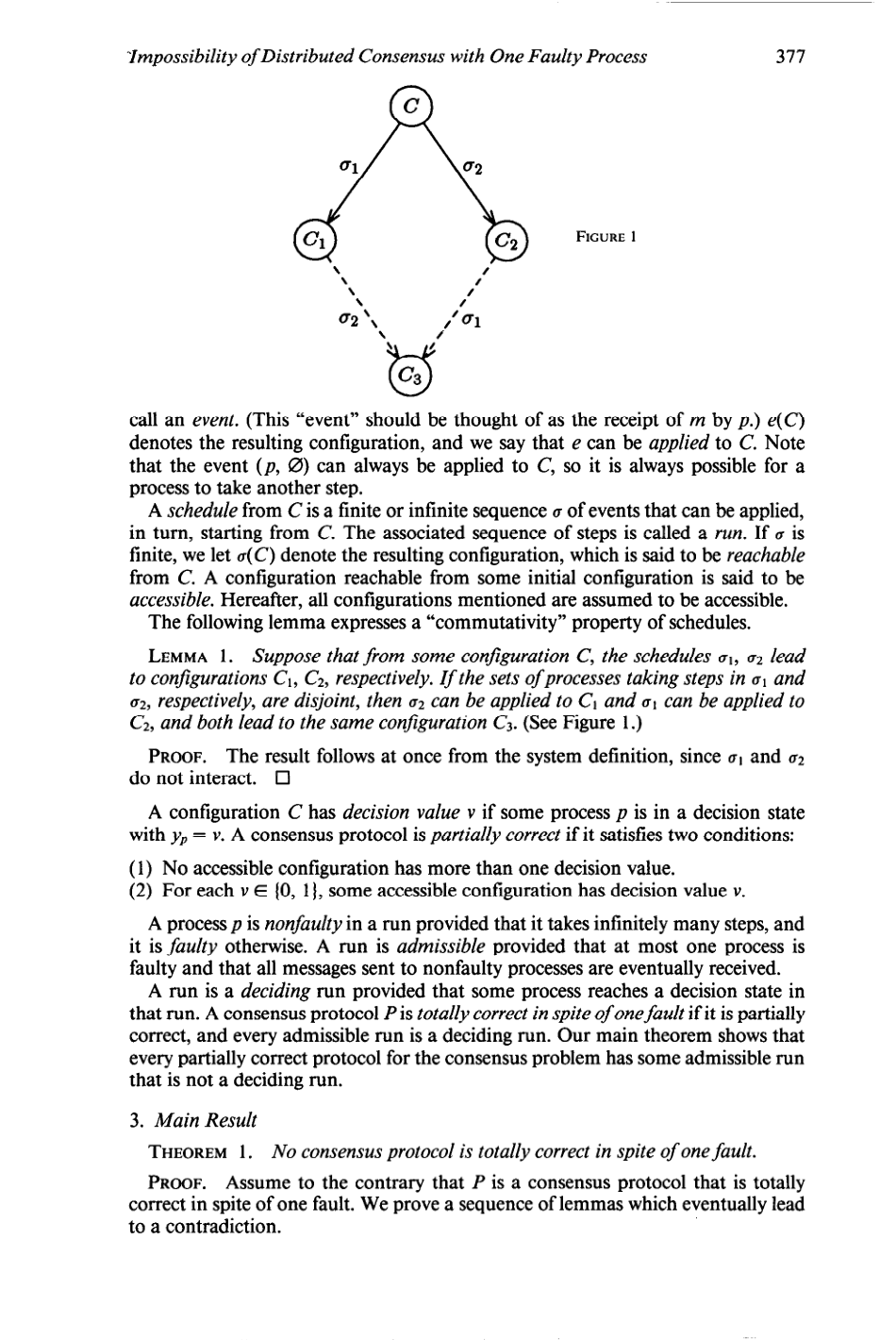
如果某个 configuration C 中有 process p 处于 decision state,且 yₚ = v,就称 C 具有 decision value v。
如果 consensus protocol 满足下面两个条件,则称它是 partially correct:
- 没有 accessible configuration 具有多于一个 decision value;
- 对每个
v ∈ {0, 1},至少有一个 accessible configuration 具有 decision valuev。
如果 process p 在某个 run 中执行 infinitely many steps,则称 p 在该 run 中是 nonfaulty;否则称 p 是 faulty。
如果一个 run 至多有一个 faulty process,并且发往 nonfaulty processes 的所有 messages 最终都被接收,那么称该 run 是 admissible。
如果某个 process 在 run 中进入 decision state,则称该 run 是 deciding run。
如果 consensus protocol P 是 partially correct,并且每条 admissible run 都是 deciding run,则称 P totally correct in spite of one fault。
本文的 main theorem 将证明:每个 partially correct consensus protocol 都存在一条 admissible run,而这条 run 不是 deciding run。
3. Main Result
THEOREM 1. 没有 consensus protocol 能够在 spite of one fault 的情况下保持 totally correct。
证明:反设 P 是一个在 spite of one fault 的情况下 totally correct 的 consensus protocol。下面依次证明一系列 lemmas,最终导出 contradiction。
证明的基本思路是找出 protocol 永远保持 indecisive 的情形。这分两步:
- 先论证存在一个 initial configuration,其中 decision 尚未被预先确定;
- 再构造一条 admissible run,避免执行任何会把 system 提交到某个特定 decision 的 step。
令 C 为 configuration,令 V 为从 C reachable 的 configurations 的 decision values 集合。如果 |V| = 2,称 C 是 bivalent;如果 |V| = 1,称 C 是 univalent,并根据相应的 decision value 称为 0-valent 或 1-valent。
根据 P 的 total correctness,并且因为总存在 admissible runs,V 非空。
LEMMA 2.
P具有一个 bivalent initial configuration。
证明:假设不存在 bivalent initial configuration。由假设的 partial correctness,P 必须同时具有 0-valent 和 1-valent initial configurations。
如果两个 initial configurations 只在某个 process p 的 initial value xₚ 上不同,就称它们 adjacent。任意两个 initial configurations 都可以由一条 initial configurations chain 连接,chain 中相邻的 configurations 彼此 adjacent。因此,必然存在一个 0-valent initial configuration C₀,它与一个 1-valent initial configuration C₁ adjacent。令 p 是它们 initial values 不同的 process。
现在考虑从 C₀ 出发的一条 admissible deciding run,其中 process p 不执行任何 steps;令 u 为对应的 schedule。这个 u 也可以从 C₁ 应用,且两条 runs 中对应的 configurations 除了 process p 的 internal state 外都相同。
很容易证明,两条 runs 最终会到达相同的 decision value。如果这个 value 是 1,那么 C₀ 是 bivalent;否则 C₁ 是 bivalent。两种情况都与“没有 bivalent initial configuration”的假设矛盾。
第 5 页:Lemma 3 的 bivalence 保持性质
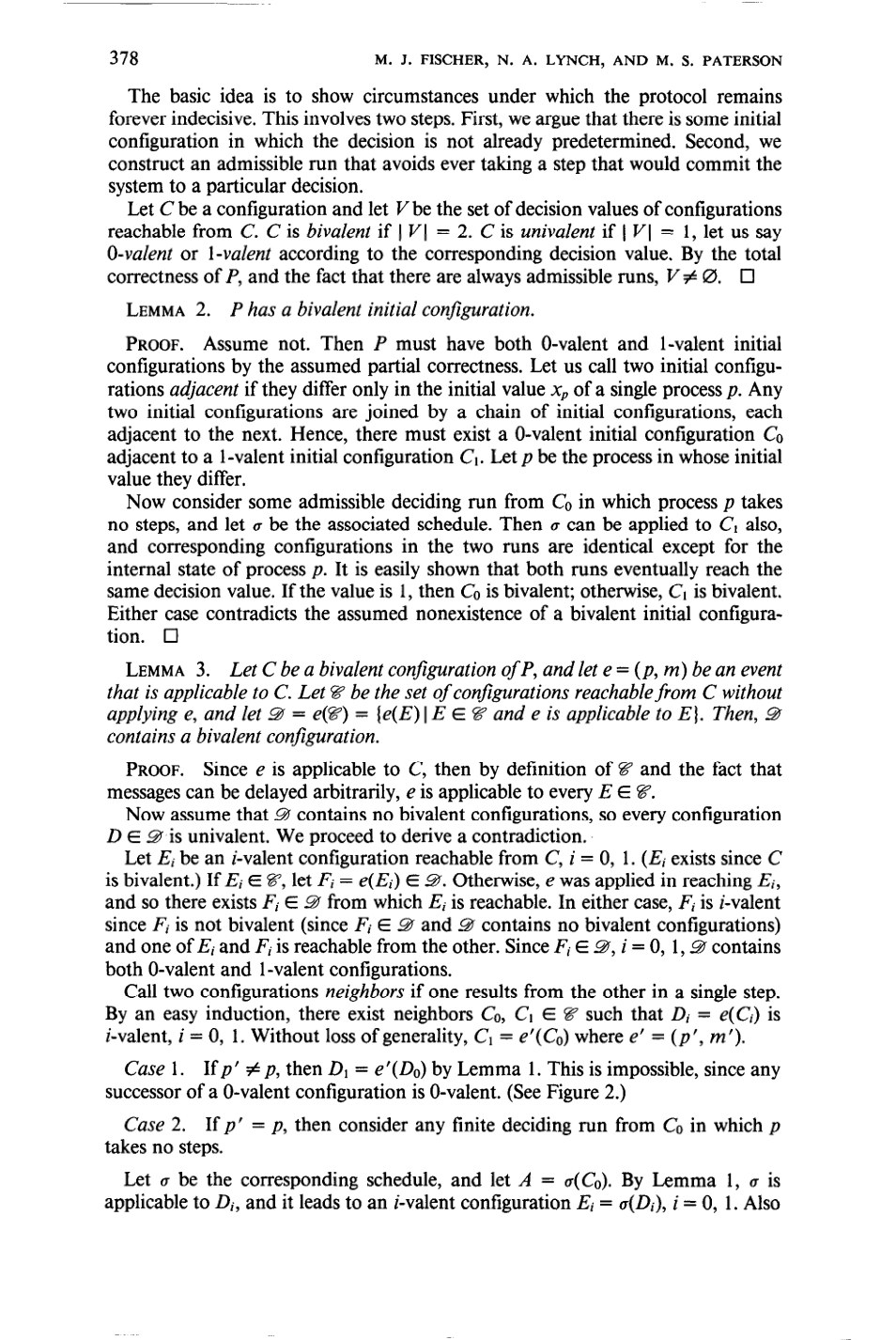
LEMMA 3. 令
C是P的一个 bivalent configuration,令e = (p, m)是一个可以应用于C的 event。令B为从C出发、但不应用e所能 reach 的 configurations 集合;令
D = e(B) = { e(E) | E ∈ B 且 e 可应用于 E }。则
D包含一个 bivalent configuration。
证明:因为 e 可以应用于 C,根据 B 的定义,以及 messages 可以 arbitrary delay 的事实,e 可以应用于每个 E ∈ B。
现在假设 D 不包含 bivalent configurations,于是 D 中的每个 configuration 都是 univalent。令 Eᵢ 是从 C reachable 的 i-valent configuration,其中 i = 0, 1。(因为 C bivalent,所以这样的 Eᵢ 存在。)
如果 Eᵢ ∈ B,令 Fᵢ = e(Eᵢ) ∈ D。否则,e 在 reach Eᵢ 的过程中已经被应用,因此存在 Fᵢ ∈ D,使得 Eᵢ 可以从 Fᵢ reach。
无论哪种情况,Fᵢ 都是 i-valent:因为 Fᵢ ∈ D 且 D 没有 bivalent configuration,所以 Fᵢ univalent;而 Eᵢ 和 Fᵢ 中一个可以从另一个 reach,因而它们必须具有相同的 valence。
所以 D 同时包含 0-valent 和 1-valent configurations。
称两个 configurations 是 neighbors,如果其中一个可以通过 single step 从另一个得到。通过简单 induction,可以找到 B 中相邻的 C₀、C₁,使得 Dᵢ = e(Cᵢ) 是 i-valent,i = 0, 1。
不失一般性,设 C₁ = e′(C₀),其中 e′ = (p′, m′)。
Case 1:p′ ≠ p。 由 Lemma 1,D₁ = e′(D₀)。这是不可能的,因为任何 0-valent configuration 的 successor 都是 0-valent。(见 Figure 2。)
Case 2:p′ = p。 考虑从 C₀ 出发、且 process p 不执行任何 steps 的任意 finite deciding run。令 u 为对应的 schedule,令 A = α(C₀)。
由 Lemma 1,u 可以从 Dᵢ 应用,并分别到达 i-valent configuration Eᵢ = α(Dᵢ),其中 i = 0, 1。同样由 Lemma 1,有 e(A) = E₀ 且 e(e′(A)) = E₁。(见 Figure 3。)因此,A 是 bivalent。
但这不可能,因为到达 A 的 run 是 deciding run(由假设保证),所以 A 必须是 univalent。
两种 cases 都导出了 contradiction,因此 D 必然包含 bivalent configuration。
第 6 页:构造 admissible nondeciding run
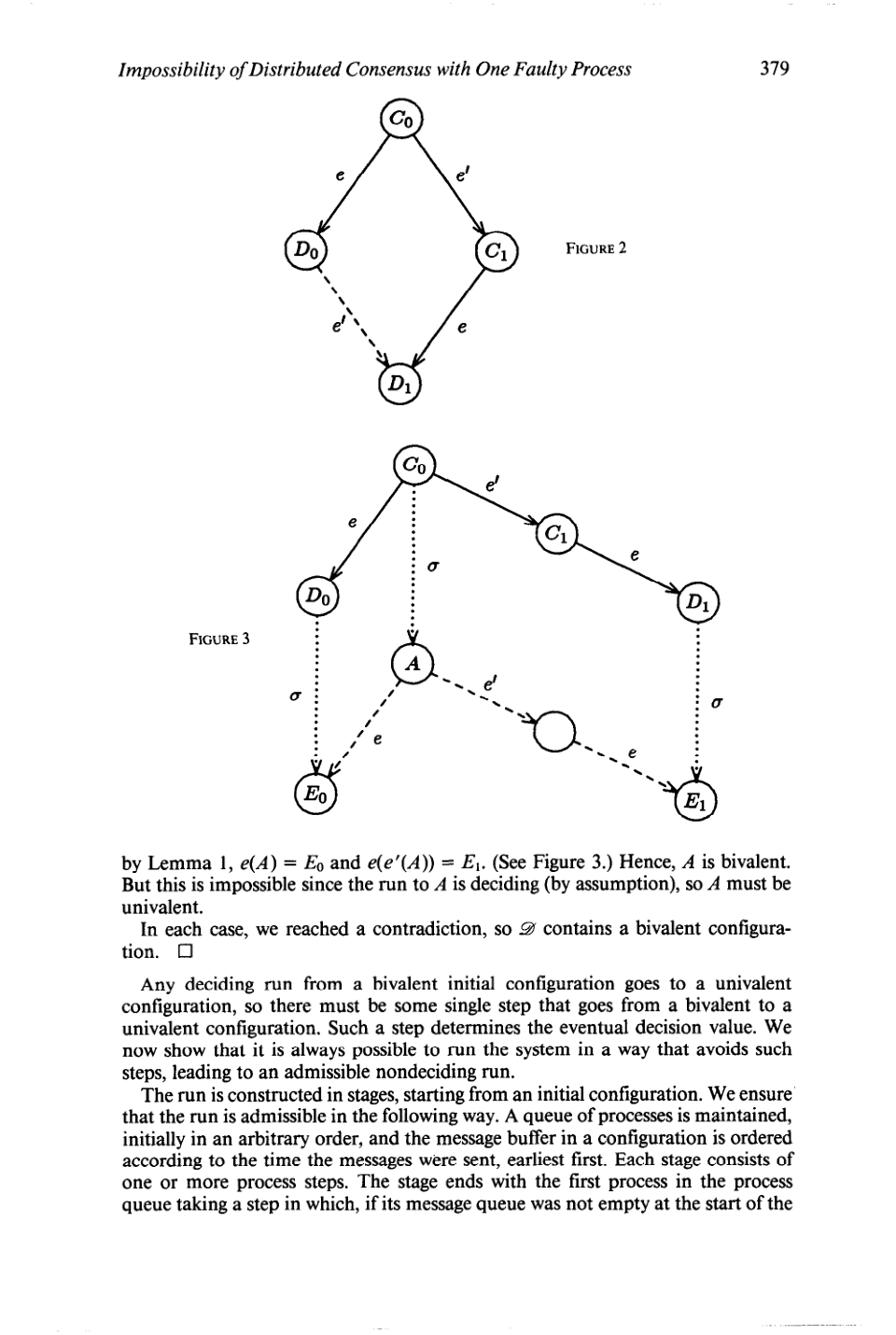
从 bivalent initial configuration 出发的任何 deciding run 都会到达 univalent configuration。因此,必然存在一个 single step,把 bivalent configuration 变成 univalent configuration。这个 step 决定了最终的 decision value。
下面说明:总能以一种避开这些 steps 的方式运行 system,从而得到一条 admissible、nondeciding 的 run。
run 分 stages 构造,从某个 initial configuration 开始。用下面方法保证 run 是 admissible 的:维护一个 process queue,初始顺序 arbitrary;在 configuration 中,message buffer 按 messages 的发送时间排序,最早发送的 message 在最前面。
每个 stage 包含一个或多个 process steps。stage 结束条件是:process queue 中排在最前面的 process 执行一个 step;如果 stage 开始时它的 message queue 非空,那么这个 step 必须接收其中最早的 message。执行后,把该 process 移到 process queue 的末尾。
在这种 stages 的任意 infinite sequence 中,每个 process 都会执行 infinitely many steps,并且它收到的每一条 message 都会被 delivery。因此,这条 run 是 admissible 的。
当然,我们还必须选择每个 stage 的 steps,使 system 永远不达到 decision。
令 C₀ 是 Lemma 2 保证存在的 bivalent initial configuration。execution 从 C₀ 开始,并保证每个 stage 都从 bivalent configuration 开始。
假设当前 configuration C 是 bivalent,且 process p 位于 priority queue 的 head。令 m 是 C 的 message buffer 中发给 p 的 earliest message(如果有),否则令 m = ∅。令 e = (p, m)。
由 Lemma 3,存在一个 configuration C′:它可以从 C 通过一个 schedule reach,且该 schedule 的最后 event 是 e,同时 C′ 仍为 bivalent。这个 schedule 对应的 steps sequence 就定义了当前 stage。
由于每个 stage 都以 bivalent configuration 结束,构造中的每个 stage 都能成功。由此得到的 infinite run 是 admissible 的,并且永远不会达到 decision。
因此,P 并不是 totally correct。证毕。
第 7 页:Initially Dead Processes
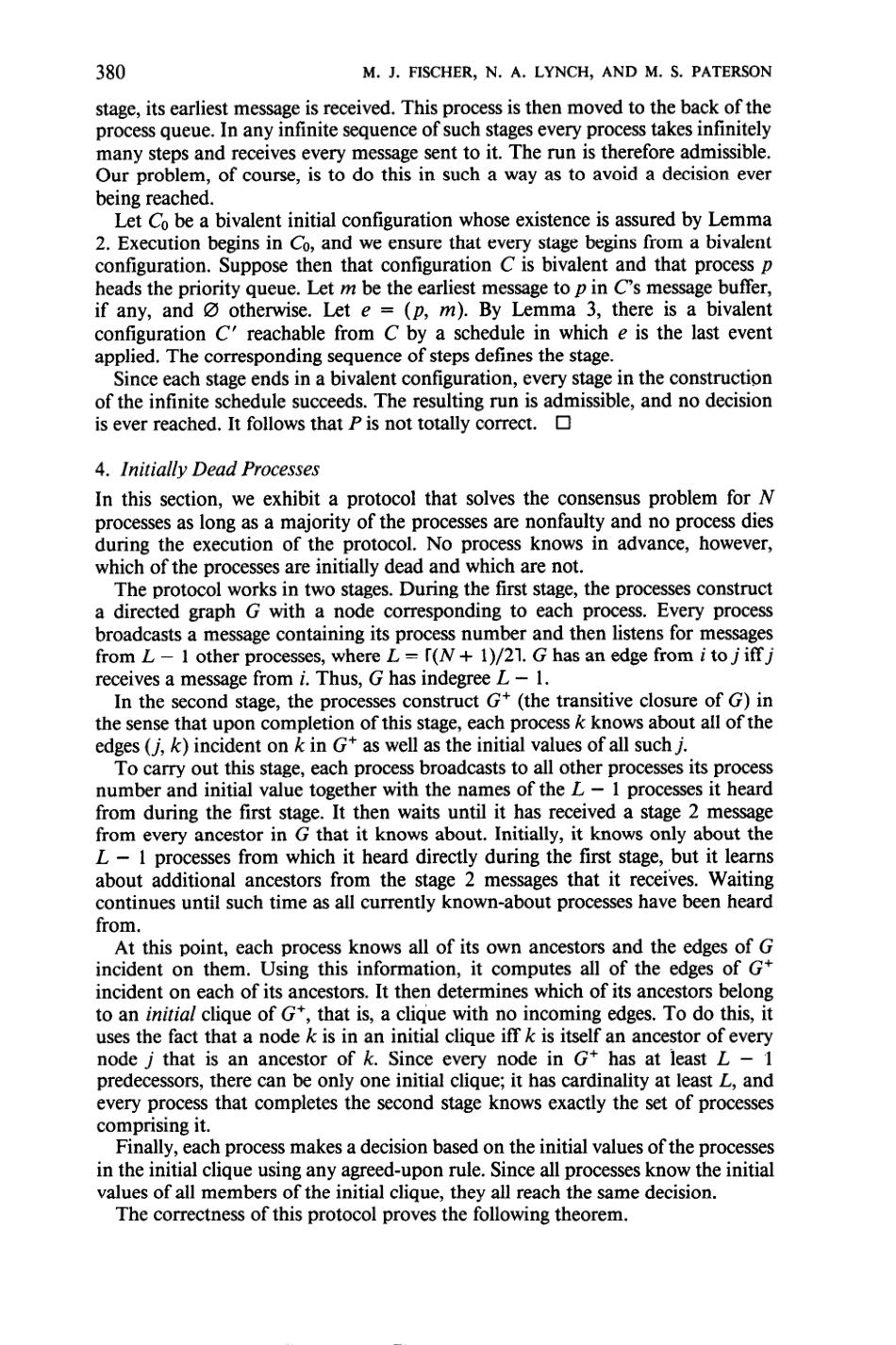
4. Initially Dead Processes
本节展示一个 protocol:只要大多数 processes 是 nonfaulty,并且 execution 期间没有 process death,它就能为 N 个 processes 解决 consensus problem。不过,没有 process 会预先知道哪些 processes 是 initially dead、哪些不是。
protocol 分两个 stages。
在第一 stage,processes 构造 directed graph G,其中每个 process 对应一个 node。每个 process broadcast 一条包含自己 process number 的 message,然后监听来自 L − 1 个其他 processes 的 messages,其中
L = ⌈(N + 1) / 2⌉。
如果 i 收到来自 j 的 message,就在 G 中加入从 j 到 i 的 edge。于是,G 的每个 node 都有 indegree L − 1。
在第二 stage,processes 构造 G⁺,即 G 的 transitive closure。这个 stage 完成后,每个 process k 都知道 G⁺ 中所有 incident on k 的 edges (j, k),以及这些 j 的 initial values。
为完成这个 stage,每个 process 向所有其他 processes broadcast:自己的 process number 和 initial value,以及 first stage 中它听到的 L − 1 个 processes 的 names。
然后,它等待从自己已经知道的 G ancestors 中每一个 ancestor 收到 stage-2 message。最初,它只知道 first stage 中直接听到的 L − 1 个 processes;随着收到 stage-2 messages,它会了解到更多 ancestors。等待会持续到:当前已经知道的所有 processes 都被听到。
此时,每个 process 都知道自己的全部 ancestors,以及这些 ancestors 上 incident 的 G edges。接着,它使用这些 information 计算 G⁺ 中每个 ancestor incident 的全部 edges。
然后,它判断哪些 ancestors 属于 G⁺ 的一个 initial clique,即没有 incoming edges 的 clique。判断依据是:node k 位于 initial clique 中,当且仅当 k 本身是每个 ancestor-of-k 的 node j 的 ancestor。
由于 G⁺ 中的每个 node 至少有 L − 1 个 predecessors,所以最多只能有一个 initial clique。该 initial clique 的 cardinality 至少为 L,并且每个完成第二 stage 的 process 都确切知道构成该 clique 的 processes 集合。
最后,每个 process 根据 initial clique 中 processes 的 initial values,使用任意 agreed-upon rule 作出 decision。由于所有 processes 都知道 initial clique 全体成员的 initial values,所以它们都会作出相同的 decision。
这个 protocol 的 correctness 证明了下面的 theorem。
第 8 页:Theorem 2、Conclusion 与 References 开始
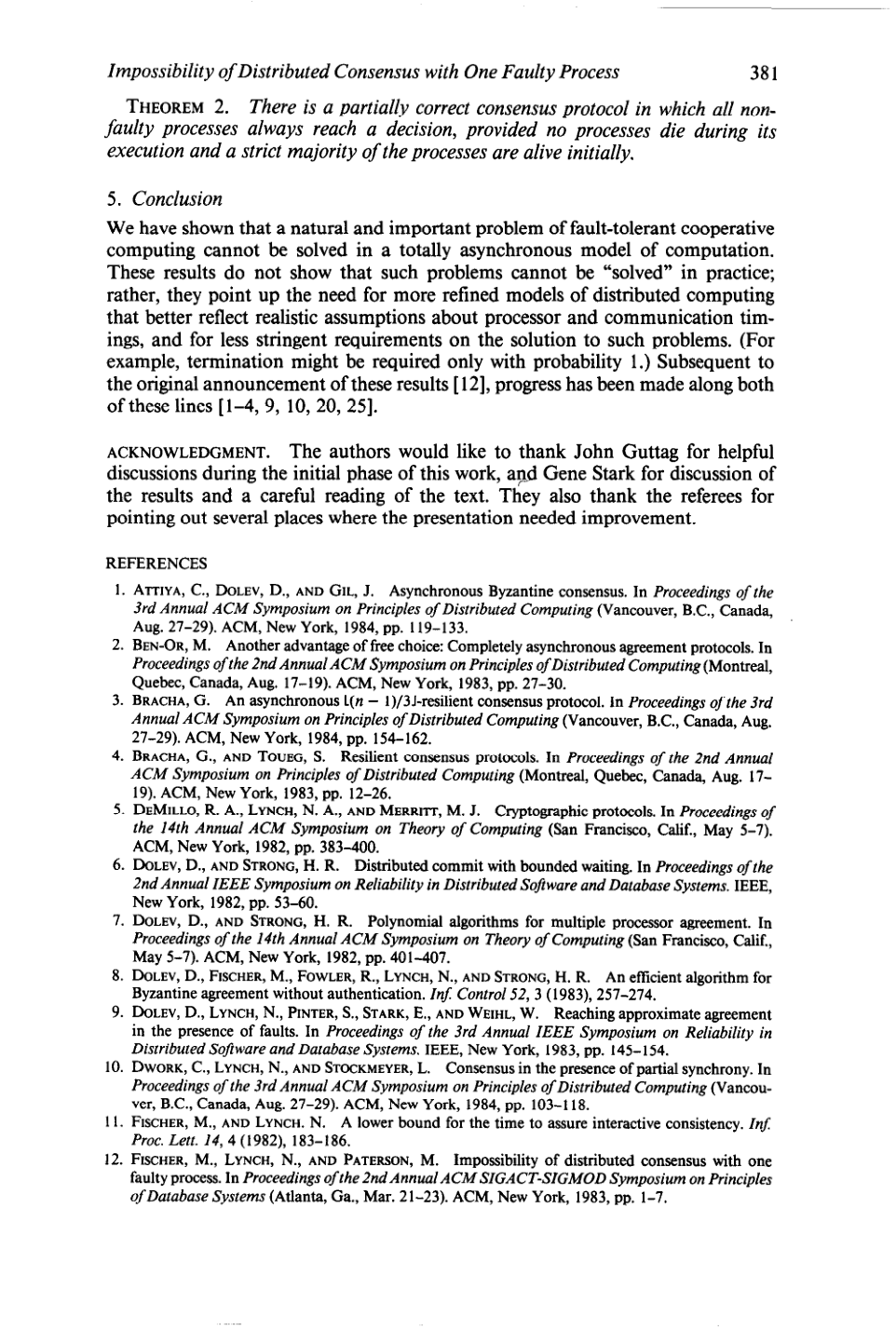
THEOREM 2. 存在一个 partially correct consensus protocol:只要 execution 期间没有 process death,且一开始 alive 的 processes 构成 strict majority,所有 nonfaulty processes 都总能作出 decision。
5. Conclusion
本文证明,一个 natural 且重要的 fault-tolerant cooperative computing problem,无法在 totally asynchronous computation model 中解决。
这些结果并不意味着这类问题在实践中不能被 “solve”;相反,它们指出:我们需要更 refined 的 distributed-computing models,使其更好地反映 realistic 的 processor 和 communication timings;同时也需要对这类问题使用 less stringent 的 solution requirements。(例如,可以只要求 termination 以 probability 1 发生。)
自这些结果最初公布以来 [12],在这两个方向都取得了进展 [1–4, 9, 10, 20, 25]。
ACKNOWLEDGMENT
作者感谢 John Guttag 在本工作 initial phase 中进行的 helpful discussions,也感谢 Gene Stark 对 results 的讨论以及对正文的 careful reading。作者还感谢 referees 指出多处需要改进 presentation 的地方。
REFERENCES(1–12)
- Attiya, C., Dolev, D., and Gil, J. “Asynchronous Byzantine Consensus.” Proceedings of the 3rd Annual ACM Symposium on Principles of Distributed Computing(Vancouver, B.C., Canada, Aug. 27–29, 1984),ACM, New York, pp. 119–133。
- Ben-Or, M. “Another Advantage of Free Choice: Completely Asynchronous Agreement Protocols.” Proceedings of the 2nd Annual ACM Symposium on Principles of Distributed Computing(Montreal, Quebec, Canada, Aug. 17–19, 1983),pp. 27–30。
- Bracha, G. “An Asynchronous
⌊(n − 1)/3⌋-Resilient Consensus Protocol.” Proceedings of the 3rd Annual ACM Symposium on Principles of Distributed Computing(Vancouver, 1984),pp. 154–162。 - Bracha, G., and Toueg, S. “Resilient Consensus Protocols.” Proceedings of the 2nd Annual ACM Symposium on Principles of Distributed Computing(Montreal, 1983),pp. 12–26。
- DeMillo, R. A., Lynch, N. A., and Merritt, M. J. “Cryptographic Protocols.” Proceedings of the 14th Annual ACM Symposium on Theory of Computing(San Francisco, Calif., May 5–7, 1982),pp. 383–400。
- Dolev, D., and Strong, H. R. “Distributed Commit with Bounded Waiting.” Proceedings of the 2nd Annual IEEE Symposium on Reliability in Distributed Software and Database Systems,IEEE, New York, 1982,pp. 53–60。
- Dolev, D., and Strong, H. R. “Polynomial Algorithms for Multiple Processor Agreement.” Proceedings of the 14th Annual ACM Symposium on Theory of Computing(San Francisco, 1982),pp. 401–407。
- Dolev, D., Fischer, M., Fowler, R., Lynch, N., and Strong, H. R. “An Efficient Algorithm for Byzantine Agreement without Authentication.” Information and Control 52(3), 1983, 257–274。
- Dolev, D., Lynch, N., Pinter, S., Stark, E., and Weihl, W. “Reaching Approximate Agreement in the Presence of Faults.” Proceedings of the 3rd Annual IEEE Symposium on Reliability in Distributed Software and Database Systems,IEEE, New York, 1983,pp. 145–154。
- Dwork, C., Lynch, N., and Stockmeyer, L. “Consensus in the Presence of Partial Synchrony.” Proceedings of the 3rd Annual ACM Symposium on Principles of Distributed Computing(Vancouver, 1984),pp. 103–118。
- Fischer, M., and Lynch, N. “A Lower Bound for the Time to Assure Interactive Consistency.” Information Processing Letters 14(4), 1982, 183–186。
- Fischer, M., Lynch, N., and Paterson, M. “Impossibility of Distributed Consensus with One Faulty Process.” Proceedings of the 2nd Annual ACM SIGACT-SIGMOD Symposium on Principles of Database Systems(Atlanta, Ga., Mar. 21–23, 1983),ACM, New York, pp. 1–7。
第 9 页:References(13–25)
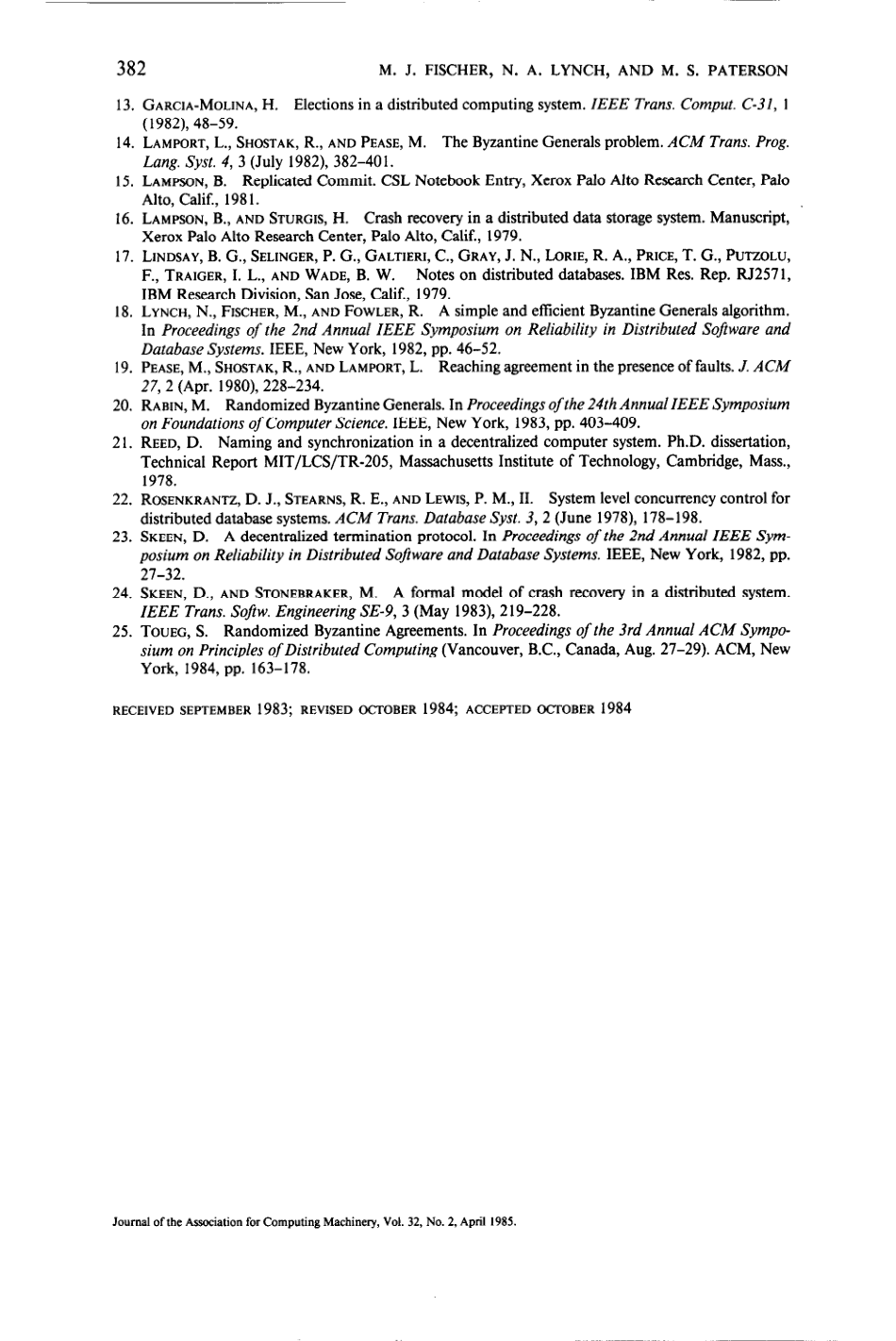
REFERENCES(13–25)
- Garcia-Molina, H. “Elections in a Distributed Computing System.” IEEE Transactions on Computers C-31(1), 1982, 48–59。
- Lamport, L., Shostak, R., and Pease, M. “The Byzantine Generals Problem.” ACM Transactions on Programming Languages and Systems 4(3), July 1982, 382–401。
- Lampson, B. “Replicated Commit.” CSL Notebook Entry, Xerox Palo Alto Research Center, Palo Alto, Calif., 1981。
- Lampson, B., and Sturgis, H. “Crash Recovery in a Distributed Data Storage System.” Manuscript, Xerox Palo Alto Research Center, Palo Alto, Calif., 1979。
- Lindsay, B. G., Selinger, P. G., Galtieri, C., Gray, J. N., Lorie, R. A., Price, T. G., Putzolu, F., Traiger, I. L., and Wade, B. W. “Notes on Distributed Databases.” IBM Research Report RJ2571, IBM Research Division, San Jose, Calif., 1979。
- Lynch, N., Fischer, M., and Fowler, R. “A Simple and Efficient Byzantine Generals Algorithm.” Proceedings of the 2nd Annual IEEE Symposium on Reliability in Distributed Software and Database Systems,IEEE, New York, 1982,pp. 46–52。
- Pease, M., Shostak, R., and Lamport, L. “Reaching Agreement in the Presence of Faults.” Journal of the ACM 27(2), Apr. 1980, 228–234。
- Rabin, M. “Randomized Byzantine Generals.” Proceedings of the 24th Annual IEEE Symposium on Foundations of Computer Science,IEEE, 1983,pp. 403–409。
- Reed, D. “Naming and Synchronization in a Decentralized Computer System.” Ph.D. dissertation, Technical Report MIT/LCS/TR-205, Massachusetts Institute of Technology, Cambridge, Mass., 1978。
- Rosenkrantz, D. J., Stearns, R. E., and Lewis, P. M., II. “System Level Concurrency Control for Distributed Database Systems.” ACM Transactions on Database Systems 3(2), June 1978, 178–198。
- Skeen, D. “A Decentralized Termination Protocol.” Proceedings of the 2nd Annual IEEE Symposium on Reliability in Distributed Software and Database Systems,IEEE, New York, 1982,pp. 27–32。
- Skeen, D., and Stonebraker, M. “A Formal Model of Crash Recovery in a Distributed System.” IEEE Transactions on Software Engineering SE-9(3), May 1983, 219–228。
- Toueg, S. “Randomized Byzantine Agreements.” Proceedings of the 3rd Annual ACM Symposium on Principles of Distributed Computing(Vancouver, 1984),pp. 163–178。
Received September 1983; revised October 1984; accepted October 1984。
机制索引
| 机制 | 本文位置 | 核心含义 |
|---|---|---|
| Asynchronous model | Introduction | 不假设 process speed、message delay、shared clock 或 failure detection |
| Partially correct | Consensus Protocols | 不产生 conflicting decisions,且 0/1 都可在某些 configurations 中决定 |
| Admissible run | Consensus Protocols | 最多一个 faulty process,且 nonfaulty recipients 最终收齐 messages |
| Commutativity | Lemma 1 | 不同 processes 的 independent schedules 可以交换 |
| Bivalent configuration | Lemma 2 | 仍可到达 0 或 1 两种 decision values |
| Lemma 3 | Main Result | 任意可应用 event 后仍能找到 bivalent successor |
| Fair stage construction | Theorem 1 proof | 轮转 process queue,保证每个 process 无限 steps 且每条 message 最终 delivery |
| FLP impossibility | Theorem 1 | 一个 crash fault 足以让某条 admissible run 永不 decision |
| Initially dead protocol | Section 4 | 在没有 execution-time death 且初始 alive strict majority 时,可以达成 consensus |
与本专栏其他内容的关系
- 与 Paxos / Raft 的关系:FLP 说明完全 asynchronous 模型下 deterministic termination 不可保证;Paxos、Raft 因而把 liveness 建立在更现实的 timing、leader、election 或 partial-synchrony 假设上。
- 与 Byzantine Generals 的关系:Byzantine Generals 研究 faulty participants 下的 agreement;FLP 研究即使只有 crash failure、messages reliable,完全 asynchronous system 仍无法保证 termination。
- 与 Time, Clocks 的关系:本文明确排除 synchronized clocks 与 timeout;Time, Clocks 解释为什么 physical time、logical ordering 和 failure observation 必须分开看待。
- 与 practical systems 的关系:工程上通常通过 partial synchrony、failure detector、randomized consensus、租约/timeout 或弱化 termination 要求绕开 FLP 的模型边界,而不是“证明 FLP 错误”。
本篇验收
- [x] MIT DSpace 记录已核对,论文作者、technical report、1982 年记录与 JACM 1985 版本边界已记录。
- [x] 9 个 PDF 页面均已按原始 page rectangle 渲染为 PNG,并保存到
assets/49 FLP Impossibility/。 - [x] 9 个页面图片均在对应译文前按原页顺序嵌入,并保留 Figure 1–3 与 proof diagrams。
- [x] Abstract、Introduction、asynchronous assumptions、consensus protocol model、Lemma 1–3、Theorem 1、bivalence proof、admissible nondeciding run、Initially Dead Processes、Theorem 2、Conclusion、Acknowledgment 和 25 条 References 均已覆盖。
- [x] consensus、configuration、schedule、run、admissible、bivalent、univalent、faulty、nontermination 等术语按本系列约定保留 English 或中英并列。
- [x] 本地源文件 SHA-256:
80e1c33be45362d6ce0eeaba0259939df16eaff592cd612d42d783e4686c82b7。
参考资料
评论 (0)