Superclasses:super lookup 与继承调用
Crafting Interpreters:Superclasses
本章把 inheritance 完整接入 clox:class 继承 superclass、method lookup 沿层次结构工作,并通过 super call 调用被覆盖的方法。
TL;DR
- subclass declaration 编译并执行 inheritance,子类的 method table 仍只保存自身声明的方法。
- method lookup 失败时沿 superclass 链搜索;super call 则从指定 superclass 开始搜索。
- superclass 在运行时暂存在 stack/local slot 中,保证编译和执行期间对象可达。
- OP_GET_SUPER 与 OP_SUPER_INVOKE 处理 super property access 和直接调用。
- 完成后,clox VM 支持 Lox 的完整面向对象模型:fields、methods、this、initializers 和 inheritance。
目录
| 章节 | 内容 |
|---|---|
| Inheriting methods | 继承执行 |
| Storing superclasses | superclass local |
| Super calls | super lookup 与调用 |
| A complete VM | 语言能力汇总 |
| Challenges | 扩展练习 |
Inheriting methods
LoxClass 保存 superclass pointer。查找 method 时先查当前 class 的 methods table,找不到再递归查 superclass:
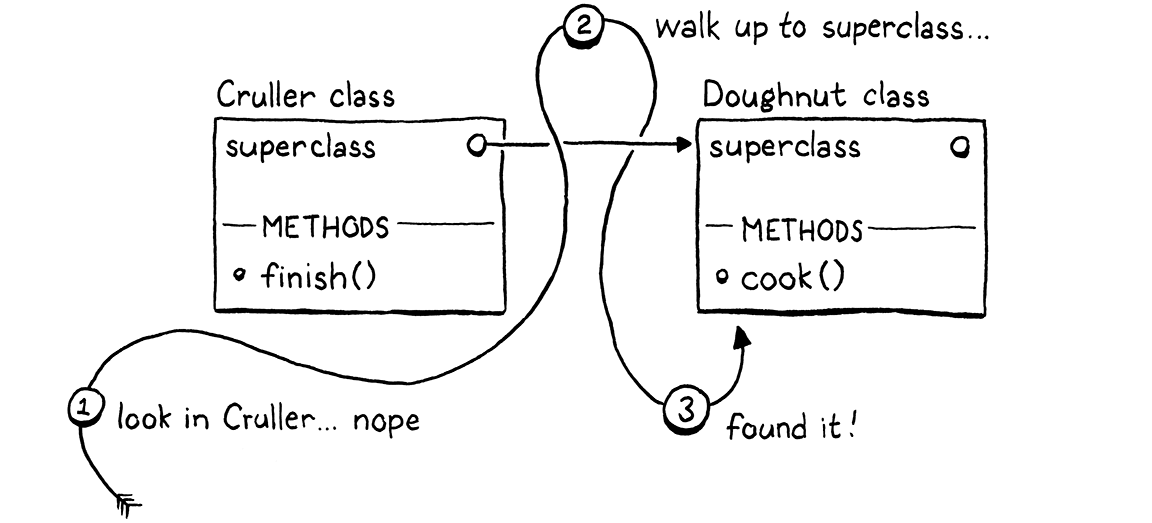
clox 也使用相同语义,但把查找和调用编译为 bytecode。class declaration 运行时把 subclass 与 superclass 连接起来:
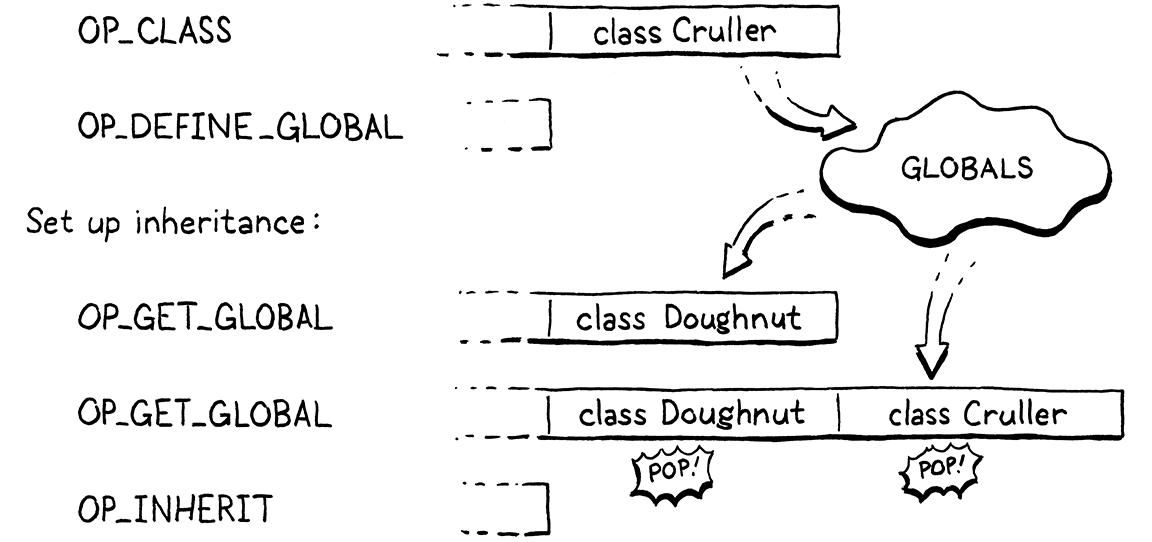
Executing inheritance
compiler 编译 class name、superclass expression 和 method declarations。执行 OP_INHERIT 时,VM 从 stack 取得 subclass 和 superclass,把 superclass methods 复制或链接到正确的 class representation。
clox 通常让 subclass 持有 superclass pointer,而不是复制所有 method。这样 method 更新和内存占用更可控,lookup 也能沿链进行。
Invalid superclasses
继承目标必须是 class object。对 number、string、instance 或其他非-class value 使用 <,应在 runtime 报错。class 不能继承自身,否则 method lookup 会形成循环。
Storing superclasses
编译 subclass body 时,superclass 需要在当前 stack 上保持可达。compiler 可以把它作为隐含 local 保存,并创建一个专门的 scope:

A superclass local variable
super expression 的 resolver distance 指向这个 local。class method 的 closure 同时能访问 this 和 super;执行时 super local 指向 superclass,this local 指向当前 receiver。
这种布局使 nested method 和 closure 能正确捕获 class context,也让 GC 能从 stack/frame 找到 class hierarchy 中仍在使用的 object。
Super calls
super call 使用 super.method() 语法。compiler 发出 method name 和 super reference,VM 先取得 superclass,再查找 method,并绑定当前 this。
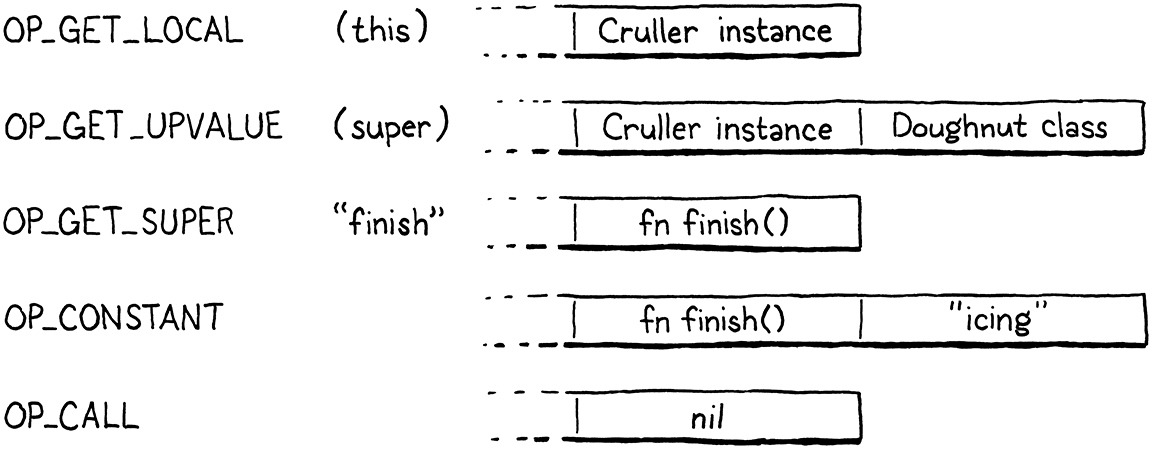
Executing super accesses
OP_GET_SUPER 读取 superclass 与 method name,从 superclass method table 中查找 function,然后用 this 创建 bound method。它不会从当前 instance 的 fields 中查找,因为 super 明确指定了查找起点。
Faster super calls
如果 super property 之后立刻调用,可以发出 OP_SUPER_INVOKE,避免先创建 bound-method object:
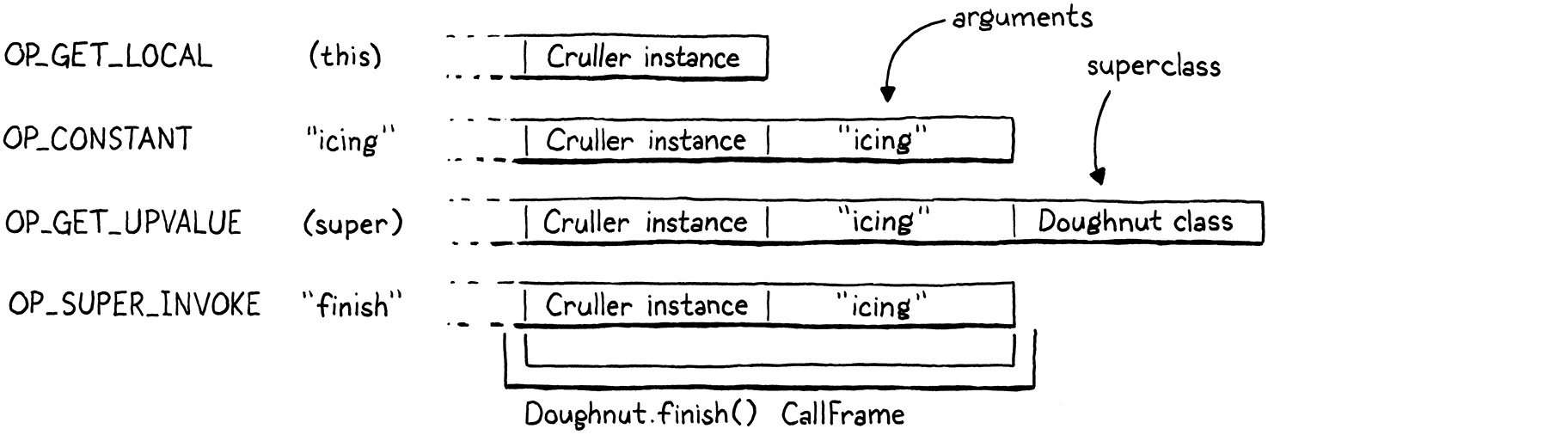
该 opcode 直接完成 superclass lookup、receiver binding 和 call frame 创建,同时保持 method 的 arity 与 runtime error 检查。
A complete VM
完成本章后,clox 已覆盖:
- scanner 与 Pratt compiler;
- constants、global/local variables;
- if、while、for 和 jump;
- functions、call frames、closures 和 upvalues;
- classes、instances、fields、methods、this、initializers;
- superclass、inheritance 和 super calls;
- mark-sweep garbage collection。
这套实现仍有可优化之处,但语言语义已经闭合。接下来进入 optimization:在保持行为不变的前提下减少 instruction、内存和执行时间。
Challenges
1. Multiple inheritance
实现多个 superclass,并比较 linearization、method conflict 和 super semantics。
2. Sealed classes
加入 sealed class,使 compiler 可以检查继承关系是否封闭。
3. Method cache
为 superclass lookup 添加缓存,并处理 hierarchy 或 method table 变化时的失效。
原文代码片段
本节按官方页面顺序保留本章所有 grammar、C 和测试代码片段,便于与上文译文逐段对照。
Design Note:Classical Inheritance
inheritance 可以表达稳定的“is-a”关系,但不是所有 code reuse 都适合用 subclass。若行为只需要组合或委托,composition 往往能避免深层 hierarchy 和脆弱的 base-class 依赖。
参考资料
Code block 1
class Doughnut {
  cook() {
    print "Dunk in the fryer.";
  }
}

class Cruller < Doughnut {
  finish() {
    print "Glaze with icing.";
  }
}
Code block 2
currentClass = &classCompiler;
Code block 3
  if (match(TOKEN_LESS)) {
    consume(TOKEN_IDENTIFIER, "Expect superclass name.");
    variable(false);
    namedVariable(className, false);
    emitByte(OP_INHERIT);
  }
Code block 4
namedVariable(className, false);
Code block 5
class Cruller < Doughnut {
Code block 6
variable(false);
Code block 7
    if (identifiersEqual(&className, &parser.previous)) {
      error("A class can't inherit from itself.");
    }
Code block 8
namedVariable(className, false);
Code block 9
OP_CLASS,
Code block 10
OP_INHERIT,
Code block 11
OP_METHOD
Code block 12
return constantInstruction("OP_CLASS", chunk, offset);
Code block 13
    case OP_INHERIT:
      return simpleInstruction("OP_INHERIT", offset);
Code block 14
case OP_METHOD:
Code block 15
break;
Code block 16
      case OP_INHERIT: {
        Value superclass = peek(1);
        ObjClass* subclass = AS_CLASS(peek(0));
        tableAddAll(&AS_CLASS(superclass)->methods,
                    &subclass->methods);
        pop(); // Subclass.
        break;
      }
Code block 17
case OP_METHOD:
Code block 18
var NotClass = "So not a class";
class OhNo < NotClass {}
Code block 19
Value superclass = peek(1);
Code block 20
        if (!IS_CLASS(superclass)) {
          runtimeError("Superclass must be a class.");
          return INTERPRET_RUNTIME_ERROR;
        }
Code block 21
ObjClass* subclass = AS_CLASS(peek(0));
Code block 22
class A {
  method() {
    print "A method";
  }
}

class B < A {
  method() {
    print "B method";
  }

  test() {
    super.method();
  }
}

class C < B {}

C().test();
Code block 23
class A {
  method() {
    print "A method";
  }
}

var Bs_super = A;
class B < A {
  method() {
    print "B method";
  }

  test() {
    runtimeSuperCall(Bs_super, "method");
  }
}

var Cs_super = B;
class C < B {}

C().test();
Code block 24
}
Code block 25
    beginScope();
    addLocal(syntheticToken("super"));
    defineVariable(0);
Code block 26
    namedVariable(className, false);
    emitByte(OP_INHERIT);
Code block 27
static Token syntheticToken(const char* text) {
  Token token;
  token.start = text;
  token.length = (int)strlen(text);
  return token;
}
Code block 28
emitByte(OP_POP);
Code block 29
  if (classCompiler.hasSuperclass) {
    endScope();
  }
Code block 30
currentClass = currentClass->enclosing;
Code block 31
typedef struct ClassCompiler {
  struct ClassCompiler* enclosing;
Code block 32
bool hasSuperclass;
Code block 33
} ClassCompiler;
Code block 34
ClassCompiler classCompiler;
Code block 35
classCompiler.hasSuperclass = false;
Code block 36
classCompiler.enclosing = currentClass;
Code block 37
emitByte(OP_INHERIT);
Code block 38
classCompiler.hasSuperclass = true;
Code block 39
}
Code block 40
[TOKEN_RETURN] = {NULL, NULL, PREC_NONE},
Code block 41
[TOKEN_SUPER] = {super_, NULL, PREC_NONE},
Code block 42
[TOKEN_THIS] = {this_, NULL, PREC_NONE},
Code block 43
static void super_(bool canAssign) {
  consume(TOKEN_DOT, "Expect '.' after 'super'.");
  consume(TOKEN_IDENTIFIER, "Expect superclass method name.");
  uint8_t name = identifierConstant(&parser.previous);
}
Code block 44
class A {
  method() {
    print "A";
  }
}

class B < A {
  method() {
    var closure = super.method;
    closure(); // Prints "A".
  }
}
Code block 45
uint8_t name = identifierConstant(&parser.previous);
Code block 46
  namedVariable(syntheticToken("this"), false);
  namedVariable(syntheticToken("super"), false);
  emitBytes(OP_GET_SUPER, name);
Code block 47
}
Code block 48
class Doughnut {
  cook() {
    print "Dunk in the fryer.";
    this.finish("sprinkles");
  }

  finish(ingredient) {
    print "Finish with " + ingredient;
  }
}

class Cruller < Doughnut {
  finish(ingredient) {
    // No sprinkles, always icing.
    super.finish("icing");
  }
}
Code block 49
static void super_(bool canAssign) {
Code block 50
  if (currentClass == NULL) {
    error("Can't use 'super' outside of a class.");
  } else if (!currentClass->hasSuperclass) {
    error("Can't use 'super' in a class with no superclass.");
  }
Code block 51
consume(TOKEN_DOT, "Expect '.' after 'super'.");
Code block 52
OP_SET_PROPERTY,
Code block 53
OP_GET_SUPER,
Code block 54
OP_EQUAL,
Code block 55
return constantInstruction("OP_SET_PROPERTY", chunk, offset);
Code block 56
    case OP_GET_SUPER:
      return constantInstruction("OP_GET_SUPER", chunk, offset);
Code block 57
case OP_EQUAL:
Code block 58
}
Code block 59
      case OP_GET_SUPER: {
        ObjString* name = READ_STRING();
        ObjClass* superclass = AS_CLASS(pop());

        if (!bindMethod(superclass, name)) {
          return INTERPRET_RUNTIME_ERROR;
        }
        break;
      }
Code block 60
case OP_EQUAL: {
Code block 61
namedVariable(syntheticToken("this"), false);
Code block 62
  if (match(TOKEN_LEFT_PAREN)) {
    uint8_t argCount = argumentList();
    namedVariable(syntheticToken("super"), false);
    emitBytes(OP_SUPER_INVOKE, name);
    emitByte(argCount);
  } else {
    namedVariable(syntheticToken("super"), false);
    emitBytes(OP_GET_SUPER, name);
  }
Code block 63
}
Code block 64
OP_INVOKE,
Code block 65
OP_SUPER_INVOKE,
Code block 66
OP_CLOSURE,
Code block 67
return invokeInstruction("OP_INVOKE", chunk, offset);
Code block 68
    case OP_SUPER_INVOKE:
      return invokeInstruction("OP_SUPER_INVOKE", chunk, offset);
Code block 69
case OP_CLOSURE: {
Code block 70
        break;
      }
Code block 71
      case OP_SUPER_INVOKE: {
        ObjString* method = READ_STRING();
        int argCount = READ_BYTE();
        ObjClass* superclass = AS_CLASS(pop());
        if (!invokeFromClass(superclass, method, argCount)) {
          return INTERPRET_RUNTIME_ERROR;
        }
        frame = &vm.frames[vm.frameCount - 1];
        break;
      }
Code block 72
case OP_CLOSURE: {
Code block 73
class Doughnut {
  cook() {
    print "Fry until golden brown.";
    inner();
    print "Place in a nice box.";
  }
}

class BostonCream < Doughnut {
  cook() {
    print "Pipe full of custard and coat with chocolate.";
  }
}

BostonCream().cook();
Code block 74
Fry until golden brown.
Pipe full of custard and coat with chocolate.
Place in a nice box.
参考资料
- 原文:Superclasses
- 系列索引
- Robert Nystrom, Crafting Interpreters,© 2015–2021
评论 (0)