Kaleidoscope:控制流与 LLVM PHI 节点
Kaleidoscope:控制流
本章为 Kaleidoscope 加入
if/then/elseexpression 和forloop,并说明 LLVM IR 中 basic block、branch 和 PHI node 的协作方式。
TL;DR
- Kaleidoscope 中所有 constructs 都是 expressions,因此
if/then/else必须返回一个 value。 - 条件表达式通过 basic blocks 和 conditional branch 实现,两个分支在 merge block 中通过
PHI汇合。 - 前端不需要自行实现完整的 SSA construction algorithm;本章的隐式控制流 value 可以直接创建 PHI node。
forexpression 使用 PHI node 表示 loop induction variable,并在 loop body 中临时加入 symbol table。- 本章同时展示了 LLVM IR 的硬规则:每个 basic block 都必须以 branch 或 return 等 control-flow instruction 结束。
目录
| 章节 | 说明 |
|---|---|
| 本章简介 | 为什么需要控制流 |
| If/Then/Else | 条件表达式的 lexer、AST、parser 和 IR |
| For Loop Expression | for/in expression 的完整实现 |
| 完整代码清单 | 加入两种控制流后的完整示例 |
本章简介
欢迎来到“使用 LLVM 实现一门语言”教程的第 5 章。第 1~4 章描述了简单 Kaleidoscope language 的实现,加入了 LLVM IR 生成、optimizations 和 JIT compiler。遗憾的是,按照目前的实现,Kaleidoscope 基本没有什么用:除了 call 和 return 之外,它没有其他 control flow。这意味着 code 中不能出现 conditional branches,语言能力受到了很大限制。
在本期“构建那门 compiler”中,我们会扩展 Kaleidoscope,加入 if/then/else expression 和一个简单的 for loop。
If/Then/Else
让 Kaleidoscope 支持 if/then/else 相当直接。基本上,需要在 lexer、parser、AST 和 LLVM code emitter 中分别加入对这个“新”概念的 support。这个例子很好地展示了如何随着新想法出现,逐步扩展一门 language。
在讨论如何添加扩展之前,先看我们希望得到什么。目标是能够写出这样的 code:
def fib(x)
  if x < 3 then
    1
  else
    fib(x-1)+fib(x-2);
在 Kaleidoscope 中,每个 construct 都是一个 expression,不存在 statements。因此,if/then/else expression 和其他 expressions 一样,需要返回一个 value。由于 Kaleidoscope 采用了基本的 functional form,它会先计算 condition,然后根据 condition 的结果返回 then 或 else value。这与 C 的 ?: expression 非常相似。
if/then/else expression 的语义是:将 condition 计算为一个 boolean equality value;0.0 被视为 false,其他所有值都视为 true。如果 condition 为 true,则计算并返回第一个 subexpression;如果 condition 为 false,则计算并返回第二个 subexpression。由于 Kaleidoscope 允许 side-effects,因此必须明确这一行为。
现在知道了目标,下面将它拆分成组成部分。
Lexer Extensions for If/Then/Else
lexer 的扩展很直接。首先为相关 tokens 添加新的 enum values:
// control
tok_if = -6,
tok_then = -7,
tok_else = -8,
然后在 lexer 中识别新的 keywords:
...
if (IdentifierStr == "def")
  return tok_def;
if (IdentifierStr == "extern")
  return tok_extern;
if (IdentifierStr == "if")
  return tok_if;
if (IdentifierStr == "then")
  return tok_then;
if (IdentifierStr == "else")
  return tok_else;
return tok_identifier;
AST Extensions for If/Then/Else
为了表示这个新的 expression,添加一个新的 AST node:
/// IfExprAST - Expression class for if/then/else.
class IfExprAST : public ExprAST {
  std::unique_ptr<ExprAST> Cond, Then, Else;

public:
  IfExprAST(std::unique_ptr<ExprAST> Cond, std::unique_ptr<ExprAST> Then,
            std::unique_ptr<ExprAST> Else)
    : Cond(std::move(Cond)), Then(std::move(Then)), Else(std::move(Else)) {}

  Value *codegen() override;
};
这个 AST node 只保存指向各个 subexpressions 的 pointers。
Parser Extensions for If/Then/Else
现在 lexer 能够返回相关 tokens,也有了需要构建的 AST node,parser logic 就相对直接了。首先定义新的 parsing function:
/// ifexpr ::= 'if' expression 'then' expression 'else' expression
static std::unique_ptr<ExprAST> ParseIfExpr() {
  getNextToken();  // eat the if.

  // condition.
  auto Cond = ParseExpression();
  if (!Cond)
    return nullptr;

  if (CurTok != tok_then)
    return LogError("expected then");
  getNextToken();  // eat the then

  auto Then = ParseExpression();
  if (!Then)
    return nullptr;

  if (CurTok != tok_else)
    return LogError("expected else");

  getNextToken();

  auto Else = ParseExpression();
  if (!Else)
    return nullptr;

  return std::make_unique<IfExprAST>(std::move(Cond), std::move(Then),
                                      std::move(Else));
}
然后把它接入 primary expression:
static std::unique_ptr<ExprAST> ParsePrimary() {
  switch (CurTok) {
  default:
    return LogError("unknown token when expecting an expression");
  case tok_identifier:
    return ParseIdentifierExpr();
  case tok_number:
    return ParseNumberExpr();
  case '(':
    return ParseParenExpr();
  case tok_if:
    return ParseIfExpr();
  }
}
LLVM IR for If/Then/Else
现在已经可以 parsing 并构建 AST,最后一步是加入 LLVM code generation support。这是 if/then/else 示例中最有趣的部分,因为它开始引入新的 concepts。前面的 code 在之前章节中都已经详细介绍过。
先看希望生成的 code。考虑下面的例子:
extern foo();
extern bar();
def baz(x) if x then foo() else bar();
如果关闭 optimizations,Kaleidoscope 很快就会生成这样的 code:
declare double @foo()

declare double @bar()

define double @baz(double %x) {
entry:
  %ifcond = fcmp one double %x, 0.000000e+00
  br i1 %ifcond, label %then, label %else

then:       ; preds = %entry
  %calltmp = call double @foo()
  br label %ifcont

else:       ; preds = %entry
  %calltmp1 = call double @bar()
  br label %ifcont

ifcont:     ; preds = %else, %then
  %iftmp = phi double [ %calltmp, %then ], [ %calltmp1, %else ]
  ret double %iftmp
}
要可视化 control flow graph,可以使用 LLVM opt tool 的一个方便功能。将上面的 LLVM IR 放入 t.ll,然后运行 llvm-as < t.ll | opt -passes=view-cfg,就会弹出一个窗口,显示下面的 graph:
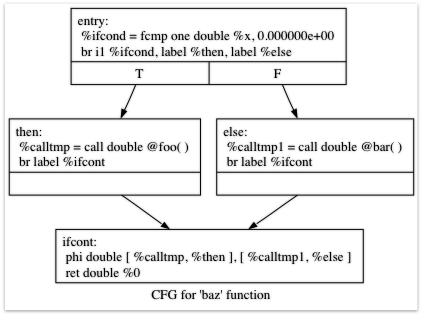
另一种获取该 graph 的方式,是调用 F->viewCFG() 或 F->viewCFGOnly()(其中 F 是一个 Function*),可以将调用直接插入 code 后重新编译,也可以在 debugger 中调用。LLVM 还提供了许多用于可视化不同 graphs 的功能。
回到生成的 code,它其实很简单:entry block 计算 conditional expression(这里是 x),使用 fcmp one instruction 将结果与 0.0 比较(one 表示 “Ordered and Not Equal”)。根据 expression 的结果,code 跳转到 then 或 else block,这两个 blocks 分别包含 true 和 false 情况下的 expressions。
then 和 else blocks 执行完成后,都会跳回 ifcont block,执行 if/then/else 后面的 code。当前示例中,剩下的唯一工作就是向 function caller 返回 value。那么,code 如何知道应该返回哪个 expression 的 value 呢?
答案涉及一个重要的 SSA operation:Phi operation。如果你不熟悉 SSA,可以参考 Wikipedia article 以及其他资料。简而言之,执行 Phi operation 时,需要记住 control 是从哪个 block 进入的。Phi operation 会取得与输入 control block 对应的 value。这里,如果 control 从 then block 进入,就取得 calltmp;如果从 else block 进入,就取得 calltmp1。
此时你可能会想:“糟了!这意味着为了使用 LLVM,我的简单而优雅的 front-end 也必须开始生成 SSA form!”幸运的是,事实并非如此。除非有非常充分的理由,我们强烈建议不要在 front-end 中实现 SSA construction algorithm。
实践中,普通 imperative language 的 code 中可能需要 Phi nodes 的 values 大致有两类:
- 涉及 user variables 的 code,例如
x = 1; x = x + 1;。 - AST structure 中隐含的 values,例如当前例子中的 Phi node。
本教程第 7 章(“mutable variables”)会深入讨论第 1 类。现在只需要相信:处理这种情况不需要 SSA construction。对于第 2 类,可以使用第 1 类将介绍的技术,也可以在方便时直接插入 Phi nodes。当前例子中,直接生成 Phi node 非常容易,因此我们选择直接生成。
好了,动机和概览已经足够,开始生成 code。
Code Generation for If/Then/Else
为此,实现 IfExprAST 的 codegen method:
Value *IfExprAST::codegen() {
  Value *CondV = Cond->codegen();
  if (!CondV)
    return nullptr;

  // Convert condition to a bool by comparing non-equal to 0.0.
  CondV = Builder->CreateFCmpONE(
      CondV, ConstantFP::get(*TheContext, APFloat(0.0)), "ifcond");
这段 code 与之前看到的内容类似。先为 condition expression 发出 code,然后将 value 与 zero 比较,得到一个 1-bit(bool)value。
Function *TheFunction = Builder->GetInsertBlock()->getParent();

// Create blocks for the then and else cases.  Insert the 'then' block at the
// end of the function.
BasicBlock *ThenBB =
    BasicBlock::Create(*TheContext, "then", TheFunction);
BasicBlock *ElseBB = BasicBlock::Create(*TheContext, "else");
BasicBlock *MergeBB = BasicBlock::Create(*TheContext, "ifcont");

Builder->CreateCondBr(CondV, ThenBB, ElseBB);
这段 code 创建与 if/then/else 相关的 basic blocks,它们与上面示例中的 blocks 直接对应。第一行取得正在构建的 Function object:向 builder 请求当前 BasicBlock,再向该 block 请求它的 “parent”(也就是它当前嵌入的 function)。
得到 function 后,创建三个 blocks。注意,创建 then block 时将 TheFunction 传给 constructor,这会使 constructor 自动把新 block 插入指定 function 的末尾。其他两个 blocks 虽然已经创建,但尚未插入 function。
blocks 创建完成后,就可以发出选择它们的 conditional branch。创建新 blocks 不会隐式改变 IRBuilder,因此它仍然向 condition 所在的 block 插入 code。这里即使 else block 还未插入 function,也可以创建跳转到它的 branch;这是 LLVM 支持 forward references 的标准方式。
// Emit then value.
Builder->SetInsertPoint(ThenBB);

Value *ThenV = Then->codegen();
if (!ThenV)
  return nullptr;

Builder->CreateBr(MergeBB);
// Codegen of 'Then' can change the current block, update ThenBB for the PHI.
ThenBB = Builder->GetInsertBlock();
插入 conditional branch 后,将 builder 移到 then block,开始向其中插入 code。严格来说,这次调用把 insertion point 移到指定 block 的末尾。不过由于 then block 还是空的,因此它实际上也会从 block 开头开始插入 :)。
设置 insertion point 后,从 AST 递归地为 then expression 生成 code。为了完成 then block,创建一个无条件 branch,跳到 merge block。
LLVM IR 有一个很重要的规则:所有 basic blocks 都必须以 return、branch 等 control-flow instruction “terminated”。也就是说,所有 control flow(包括 fall through)都必须在 LLVM IR 中显式表示。如果违反这个规则,verifier 会报错。
最后一行很微妙,但非常重要。在 merge block 中创建 Phi node 时,需要设置表示 Phi 工作方式的 block/value pairs。Phi node 需要为 CFG 中 block 的每个 predecessor 都准备一项。既然 5 行之前刚把当前 block 设置为 ThenBB,为什么还要重新获取 current block?问题在于 Then expression 自身可能改变 Builder 当前输出的 block,例如它包含嵌套的 if/then/else expression。由于递归调用 codegen() 可能任意改变 current block,因此必须获取最新的 block,才能正确设置 Phi node。
// Emit else block.
TheFunction->insert(TheFunction->end(), ElseBB);
Builder->SetInsertPoint(ElseBB);

Value *ElseV = Else->codegen();
if (!ElseV)
  return nullptr;

Builder->CreateBr(MergeBB);
// codegen of 'Else' can change the current block, update ElseBB for the PHI.
ElseBB = Builder->GetInsertBlock();
else block 的 code generation 基本与 then block 相同。唯一重要的区别是第一行:它把 else block 添加到 function 中。还记得吗,之前 else block 已经创建,但尚未加入 function。现在 then 和 else blocks 都已经发出 code,可以完成 merge code:
// Emit merge block.
TheFunction->insert(TheFunction->end(), MergeBB);
Builder->SetInsertPoint(MergeBB);
PHINode *PN =
    Builder->CreatePHI(Type::getDoubleTy(*TheContext), 2, "iftmp");

PN->addIncoming(ThenV, ThenBB);
PN->addIncoming(ElseV, ElseBB);
return PN;
}
前两行现在已经很熟悉了:第一行将此前 floating 的 merge block 添加到 Function object;第二行修改 insertion point,使新 code 插入 merge block。完成后,创建 PHI node,并设置 Phi 所需的 block/value pairs。
最后,CodeGen function 将 phi node 作为 if/then/else expression 计算出的 value 返回。在上面的例子中,这个返回 value 会传给 top-level function 的 code,后者再创建 return instruction。
总体来说,现在 Kaleidoscope 已经可以执行 conditional code。有了这个扩展,Kaleidoscope 已经是一门相当完整的 language,能够计算各种 numeric functions。接下来加入一个在非 functional languages 中很常见的 expression……
For Loop Expression
既然已经知道如何为 language 添加基础 control flow constructs,就可以使用这些工具加入更强大的能力。现在添加一个更激进的 for expression:
extern putchard(char);
def printstar(n)
  for i = 1, i < n, 1.0 in
    putchard(42);  # ascii 42 = '*'

# print 100 '*' characters
printstar(100);
这个 expression 定义了一个新 variable(这里是 i),从一个 starting value 开始迭代;只要 condition(这里是 i < n)为 true,就执行 loop,并按照 optional step value(这里是 1.0)递增。如果省略 step value,它默认为 1.0。loop 为 true 时,会执行 body expression。由于没有更好的返回值,我们把 loop 定义为始终返回 0.0。将来加入 mutable variables 后,它会变得更有用。
接下来讨论让 Kaleidoscope 支持它需要哪些修改。
Lexer Extensions for the for Loop
lexer 的扩展与 if/then/else 类似:
... in enum Token ...
// control
tok_if = -6, tok_then = -7, tok_else = -8,
tok_for = -9, tok_in = -10

... in gettok ...
if (IdentifierStr == "def")
  return tok_def;
if (IdentifierStr == "extern")
  return tok_extern;
if (IdentifierStr == "if")
  return tok_if;
if (IdentifierStr == "then")
  return tok_then;
if (IdentifierStr == "else")
  return tok_else;
if (IdentifierStr == "for")
  return tok_for;
if (IdentifierStr == "in")
  return tok_in;
return tok_identifier;
AST Extensions for the for Loop
AST node 同样很简单,本质上就是保存 variable name 和组成该 node 的 expressions:
/// ForExprAST - Expression class for for/in.
class ForExprAST : public ExprAST {
  std::string VarName;
  std::unique_ptr<ExprAST> Start, End, Step, Body;

public:
  ForExprAST(const std::string &VarName, std::unique_ptr<ExprAST> Start,
             std::unique_ptr<ExprAST> End, std::unique_ptr<ExprAST> Step,
             std::unique_ptr<ExprAST> Body)
    : VarName(VarName), Start(std::move(Start)), End(std::move(End)),
      Step(std::move(Step)), Body(std::move(Body)) {}

  Value *codegen() override;
};
Parser Extensions for the for Loop
parser code 也很标准。这里唯一有趣的地方是处理 optional step value。parser 通过检查第二个 comma 是否存在来处理它;如果不存在,就在 AST node 中将 step value 设置为 null:
/// forexpr ::= 'for' identifier '=' expr ',' expr (',' expr)? 'in' expression
static std::unique_ptr<ExprAST> ParseForExpr() {
  getNextToken();  // eat the for.

  if (CurTok != tok_identifier)
    return LogError("expected identifier after for");

  std::string IdName = IdentifierStr;
  getNextToken();  // eat identifier.

  if (CurTok != '=')
    return LogError("expected '=' after for");
  getNextToken();  // eat '='.

  auto Start = ParseExpression();
  if (!Start)
    return nullptr;
  if (CurTok != ',')
    return LogError("expected ',' after for start value");
  getNextToken();

  auto End = ParseExpression();
  if (!End)
    return nullptr;

  // The step value is optional.
  std::unique_ptr<ExprAST> Step;
  if (CurTok == ',') {
    getNextToken();
    Step = ParseExpression();
    if (!Step)
      return nullptr;
  }

  if (CurTok != tok_in)
    return LogError("expected 'in' after for");
  getNextToken();  // eat 'in'.

  auto Body = ParseExpression();
  if (!Body)
    return nullptr;

  return std::make_unique<ForExprAST>(IdName, std::move(Start),
                                       std::move(End), std::move(Step),
                                       std::move(Body));
}
同样,把它接入 primary expression:
static std::unique_ptr<ExprAST> ParsePrimary() {
  switch (CurTok) {
  default:
    return LogError("unknown token when expecting an expression");
  case tok_identifier:
    return ParseIdentifierExpr();
  case tok_number:
    return ParseNumberExpr();
  case '(':
    return ParseParenExpr();
  case tok_if:
    return ParseIfExpr();
  case tok_for:
    return ParseForExpr();
  }
}
LLVM IR for the for Loop
现在到了有趣的部分:为这个 construct 生成 LLVM IR。对于上面的简单示例,会得到如下 LLVM IR(注意,为了清晰起见,此 dump 关闭了 optimizations):
declare double @putchard(double)

define double @printstar(double %n) {
entry:
  ; initial value = 1.0 (inlined into phi)
  br label %loop

loop:       ; preds = %loop, %entry
  %i = phi double [ 1.000000e+00, %entry ], [ %nextvar, %loop ]
  ; body
  %calltmp = call double @putchard(double 4.200000e+01)
  ; increment
  %nextvar = fadd double %i, 1.000000e+00

  ; termination test
  %cmptmp = fcmp ult double %i, %n
  %booltmp = uitofp i1 %cmptmp to double
  %loopcond = fcmp one double %booltmp, 0.000000e+00
  br i1 %loopcond, label %loop, label %afterloop

afterloop:      ; preds = %loop
  ; loop always returns 0.0
  ret double 0.000000e+00
}
这个 loop 包含之前见过的全部 constructs:一个 Phi node、若干 expressions 以及一些 basic blocks。下面看看它们如何组合在一起。
Code Generation for the for Loop
codegen 的第一部分很简单:先输出 loop value 的 start expression:
Value *ForExprAST::codegen() {
  // Emit the start code first, without 'variable' in scope.
  Value *StartVal = Start->codegen();
  if (!StartVal)
    return nullptr;
接下来设置 loop body 开始位置的 LLVM basic block。上面的例子中,整个 loop body 只有一个 block;但需要记住,body code 自身可能包含多个 blocks,例如其中有 if/then/else 或 for/in expression。
// Make the new basic block for the loop header, inserting after current
// block.
Function *TheFunction = Builder->GetInsertBlock()->getParent();
BasicBlock *PreheaderBB = Builder->GetInsertBlock();
BasicBlock *LoopBB =
    BasicBlock::Create(*TheContext, "loop", TheFunction);

// Insert an explicit fall through from the current block to the LoopBB.
Builder->CreateBr(LoopBB);
这段 code 与 if/then/else 的 code 类似。因为之后创建 Phi node 时需要它,我们记住 fall through 进入 loop 的 block。然后创建真正开始 loop 的 block,并在两个 blocks 之间创建 unconditional branch。
// Start insertion in LoopBB.
Builder->SetInsertPoint(LoopBB);

// Start the PHI node with an entry for Start.
PHINode *Variable = Builder->CreatePHI(Type::getDoubleTy(*TheContext),
                                       2, VarName);
Variable->addIncoming(StartVal, PreheaderBB);
设置好 loop 的 “preheader” 后,开始向 loop body 发出 code。首先移动 insertion point,并为 loop induction variable 创建 Phi node。由于已经知道 start value 的 incoming value,就将它添加到 Phi node。注意,Phi 最终还会得到一个 backedge value,但现在还不能设置,因为 backedge 尚不存在。
// Within the loop, the variable is defined equal to the PHI node.  If it
// shadows an existing variable, we have to restore it, so save it now.
Value *OldVal = NamedValues[VarName];
NamedValues[VarName] = Variable;

// Emit the body of the loop.  This, like any other expr, can change the
// current BB.  Note that we ignore the value computed by the body, but don't
// allow an error.
if (!Body->codegen())
  return nullptr;
这里开始变得更有意思。for loop 引入了一个新 variable,因此 symbol table 现在既可能包含 function arguments,也可能包含 loop variables。为此,在 body codegen 之前,把 loop variable 作为该 name 的当前 value 加入 symbol table。
外层 scope 中可能已经存在同名 variable。也可以将此视为 error(如果 VarName 已有 entry,就报告 error 并返回 null),但我们选择允许 variable shadowing。为了正确处理它,需要把可能被 shadow 的 Value 保存到 OldVal 中;如果没有被 shadow 的 variable,OldVal 就是 null。
loop variable 放入 symbol table 后,递归地为 body 生成 code。这样 body 就可以使用 loop variable,对它的任何 references 都会自然地从 symbol table 找到该 variable。
// Emit the step value.
Value *StepVal = nullptr;
if (Step) {
  StepVal = Step->codegen();
  if (!StepVal)
    return nullptr;
} else {
  // If not specified, use 1.0.
  StepVal = ConstantFP::get(*TheContext, APFloat(1.0));
}

Value *NextVar = Builder->CreateFAdd(Variable, StepVal, "nextvar");
body 发出后,通过加上 step value(如果没有指定则加上 1.0)计算 iteration variable 的下一个 value。NextVar 就是 loop 下一次迭代中 loop variable 的 value。
// Compute the end condition.
Value *EndCond = End->codegen();
if (!EndCond)
  return nullptr;

// Convert condition to a bool by comparing non-equal to 0.0.
EndCond = Builder->CreateFCmpONE(
    EndCond, ConstantFP::get(*TheContext, APFloat(0.0)), "loopcond");
最后,计算 loop 的 exit value,决定 loop 是否退出。这与 if/then/else 对 condition 的计算方式相同。
// Create the "after loop" block and insert it.
BasicBlock *LoopEndBB = Builder->GetInsertBlock();
BasicBlock *AfterBB =
    BasicBlock::Create(*TheContext, "afterloop", TheFunction);

// Insert the conditional branch into the end of LoopEndBB.
Builder->CreateCondBr(EndCond, LoopBB, AfterBB);

// Any new code will be inserted in AfterBB.
Builder->SetInsertPoint(AfterBB);
loop body 的 code 完成后,只需收尾 control flow。代码先记住 end block(Phi node 需要它),再创建 loop exit(afterloop)block。根据 exit condition 的值,创建 conditional branch,决定再次执行 loop 还是退出。之后的 code 都会发出到 afterloop block,因此将 insertion position 设置到这里。
// Add a new entry to the PHI node for the backedge.
Variable->addIncoming(NextVar, LoopEndBB);

// Restore the unshadowed variable.
if (OldVal)
  NamedValues[VarName] = OldVal;
else
  NamedValues.erase(VarName);

// for expr always returns 0.0.
return Constant::getNullValue(Type::getDoubleTy(*TheContext));
}
最后一段 code 处理各种 cleanups:现在已经有了 NextVar value,可以将 incoming value 加到 loop PHI node。接着从 symbol table 中移除 loop variable,使它不会在 for loop 之后继续处于 scope 中。最后,for expression 总是返回 0.0,因此 ForExprAST::codegen() 也返回该 value。
至此,“为 Kaleidoscope 添加 control flow”章节结束。本章加入了两种 control flow constructs,并以它们为例说明 front-end implementors 需要了解的几个重要 LLVM IR aspects。下一章会更进一步,为这门无辜的 language 加入 user-defined operators。
完整代码清单
下面是加入 if/then/else 和 for expressions 后的完整代码。构建示例时使用:
# Compile
clang++ -g toy.cpp `llvm-config --cxxflags --ldflags --system-libs --libs core orcjit native` -O3 -o toy
# Run
./toy
下面是代码:
#include "../include/KaleidoscopeJIT.h"
#include "llvm/ADT/APFloat.h"
#include "llvm/ADT/STLExtras.h"
#include "llvm/IR/BasicBlock.h"
#include "llvm/IR/Constants.h"
#include "llvm/IR/DerivedTypes.h"
#include "llvm/IR/Function.h"
#include "llvm/IR/IRBuilder.h"
#include "llvm/IR/Instructions.h"
#include "llvm/IR/LLVMContext.h"
#include "llvm/IR/Module.h"
#include "llvm/IR/PassManager.h"
#include "llvm/IR/Type.h"
#include "llvm/IR/Verifier.h"
#include "llvm/Passes/PassBuilder.h"
#include "llvm/Passes/StandardInstrumentations.h"
#include "llvm/Support/TargetSelect.h"
#include "llvm/Target/TargetMachine.h"
#include "llvm/Transforms/InstCombine/InstCombine.h"
#include "llvm/Transforms/Scalar.h"
#include "llvm/Transforms/Scalar/GVN.h"
#include "llvm/Transforms/Scalar/Reassociate.h"
#include "llvm/Transforms/Scalar/SimplifyCFG.h"
#include <algorithm>
#include <cassert>
#include <cctype>
#include <cstdint>
#include <cstdio>
#include <cstdlib>
#include <map>
#include <memory>
#include <string>
#include <vector>

using namespace llvm;
using namespace llvm::orc;

//===----------------------------------------------------------------------===//
// Lexer
//===----------------------------------------------------------------------===//

// The lexer returns tokens [0-255] if it is an unknown character, otherwise one
// of these for known things.
enum Token {
  tok_eof = -1,

  // commands
  tok_def = -2,
  tok_extern = -3,

  // primary
  tok_identifier = -4,
  tok_number = -5,

  // control
  tok_if = -6,
  tok_then = -7,
  tok_else = -8,
  tok_for = -9,
  tok_in = -10
};

static std::string IdentifierStr; // Filled in if tok_identifier
static double NumVal;             // Filled in if tok_number

/// gettok - Return the next token from standard input.
static int gettok() {
  static int LastChar = ' ';

  // Skip any whitespace.
  while (isspace(LastChar))
    LastChar = getchar();

  if (isalpha(LastChar)) { // identifier: [a-zA-Z][a-zA-Z0-9]*
    IdentifierStr = LastChar;
    while (isalnum((LastChar = getchar())))
      IdentifierStr += LastChar;

    if (IdentifierStr == "def")
      return tok_def;
    if (IdentifierStr == "extern")
      return tok_extern;
    if (IdentifierStr == "if")
      return tok_if;
    if (IdentifierStr == "then")
      return tok_then;
    if (IdentifierStr == "else")
      return tok_else;
    if (IdentifierStr == "for")
      return tok_for;
    if (IdentifierStr == "in")
      return tok_in;
    return tok_identifier;
  }

  if (isdigit(LastChar) || LastChar == '.') { // Number: [0-9.]+
    std::string NumStr;
    do {
      NumStr += LastChar;
      LastChar = getchar();
    } while (isdigit(LastChar) || LastChar == '.');

    NumVal = strtod(NumStr.c_str(), nullptr);
    return tok_number;
  }

  if (LastChar == '#') {
    // Comment until end of line.
    do
      LastChar = getchar();
    while (LastChar != EOF && LastChar != '\n' && LastChar != '\r');

    if (LastChar != EOF)
      return gettok();
  }

  // Check for end of file.  Don't eat the EOF.
  if (LastChar == EOF)
    return tok_eof;

  // Otherwise, just return the character as its ascii value.
  int ThisChar = LastChar;
  LastChar = getchar();
  return ThisChar;
}

//===----------------------------------------------------------------------===//
// Abstract Syntax Tree (aka Parse Tree)
//===----------------------------------------------------------------------===//

namespace {

/// ExprAST - Base class for all expression nodes.
class ExprAST {
public:
  virtual ~ExprAST() = default;

  virtual Value *codegen() = 0;
};

/// NumberExprAST - Expression class for numeric literals like "1.0".
class NumberExprAST : public ExprAST {
  double Val;

public:
  NumberExprAST(double Val) : Val(Val) {}

  Value *codegen() override;
};

/// VariableExprAST - Expression class for referencing a variable, like "a".
class VariableExprAST : public ExprAST {
  std::string Name;

public:
  VariableExprAST(const std::string &Name) : Name(Name) {}

  Value *codegen() override;
};

/// BinaryExprAST - Expression class for a binary operator.
class BinaryExprAST : public ExprAST {
  char Op;
  std::unique_ptr<ExprAST> LHS, RHS;

public:
  BinaryExprAST(char Op, std::unique_ptr<ExprAST> LHS,
                std::unique_ptr<ExprAST> RHS)
      : Op(Op), LHS(std::move(LHS)), RHS(std::move(RHS)) {}

  Value *codegen() override;
};

/// CallExprAST - Expression class for function calls.
class CallExprAST : public ExprAST {
  std::string Callee;
  std::vector<std::unique_ptr<ExprAST>> Args;

public:
  CallExprAST(const std::string &Callee,
              std::vector<std::unique_ptr<ExprAST>> Args)
      : Callee(Callee), Args(std::move(Args)) {}

  Value *codegen() override;
};

/// IfExprAST - Expression class for if/then/else.
class IfExprAST : public ExprAST {
  std::unique_ptr<ExprAST> Cond, Then, Else;

public:
  IfExprAST(std::unique_ptr<ExprAST> Cond, std::unique_ptr<ExprAST> Then,
            std::unique_ptr<ExprAST> Else)
      : Cond(std::move(Cond)), Then(std::move(Then)), Else(std::move(Else)) {}

  Value *codegen() override;
};

/// ForExprAST - Expression class for for/in.
class ForExprAST : public ExprAST {
  std::string VarName;
  std::unique_ptr<ExprAST> Start, End, Step, Body;

public:
  ForExprAST(const std::string &VarName, std::unique_ptr<ExprAST> Start,
             std::unique_ptr<ExprAST> End, std::unique_ptr<ExprAST> Step,
             std::unique_ptr<ExprAST> Body)
      : VarName(VarName), Start(std::move(Start)), End(std::move(End)),
        Step(std::move(Step)), Body(std::move(Body)) {}

  Value *codegen() override;
};

/// PrototypeAST - This class represents the "prototype" for a function,
/// which captures its name, and its argument names (thus implicitly the number
/// of arguments the function takes).
class PrototypeAST {
  std::string Name;
  std::vector<std::string> Args;

public:
  PrototypeAST(const std::string &Name, std::vector<std::string> Args)
      : Name(Name), Args(std::move(Args)) {}

  Function *codegen();
  const std::string &getName() const { return Name; }
};

/// FunctionAST - This class represents a function definition itself.
class FunctionAST {
  std::unique_ptr<PrototypeAST> Proto;
  std::unique_ptr<ExprAST> Body;

public:
  FunctionAST(std::unique_ptr<PrototypeAST> Proto,
              std::unique_ptr<ExprAST> Body)
      : Proto(std::move(Proto)), Body(std::move(Body)) {}

  Function *codegen();
};

} // end anonymous namespace

//===----------------------------------------------------------------------===//
// Parser
//===----------------------------------------------------------------------===//

/// CurTok/getNextToken - Provide a simple token buffer.  CurTok is the current
/// token the parser is looking at.  getNextToken reads another token from the
/// lexer and updates CurTok with its results.
static int CurTok;
static int getNextToken() { return CurTok = gettok(); }

/// BinopPrecedence - This holds the precedence for each binary operator that is
/// defined.
static std::map<char, int> BinopPrecedence;

/// GetTokPrecedence - Get the precedence of the pending binary operator token.
static int GetTokPrecedence() {
  if (!isascii(CurTok))
    return -1;

  // Make sure it's a declared binop.
  int TokPrec = BinopPrecedence[CurTok];
  if (TokPrec <= 0)
    return -1;
  return TokPrec;
}

/// LogError* - These are little helper functions for error handling.
std::unique_ptr<ExprAST> LogError(const char *Str) {
  fprintf(stderr, "Error: %s\n", Str);
  return nullptr;
}

std::unique_ptr<PrototypeAST> LogErrorP(const char *Str) {
  LogError(Str);
  return nullptr;
}

static std::unique_ptr<ExprAST> ParseExpression();

/// numberexpr ::= number
static std::unique_ptr<ExprAST> ParseNumberExpr() {
  auto Result = std::make_unique<NumberExprAST>(NumVal);
  getNextToken(); // consume the number
  return std::move(Result);
}

/// parenexpr ::= '(' expression ')'
static std::unique_ptr<ExprAST> ParseParenExpr() {
  getNextToken(); // eat (.
  auto V = ParseExpression();
  if (!V)
    return nullptr;

  if (CurTok != ')')
    return LogError("expected ')'");
  getNextToken(); // eat ).
  return V;
}

/// identifierexpr
///   ::= identifier
///   ::= identifier '(' expression* ')'
static std::unique_ptr<ExprAST> ParseIdentifierExpr() {
  std::string IdName = IdentifierStr;

  getNextToken(); // eat identifier.

  if (CurTok != '(') // Simple variable ref.
    return std::make_unique<VariableExprAST>(IdName);

  // Call.
  getNextToken(); // eat (
  std::vector<std::unique_ptr<ExprAST>> Args;
  if (CurTok != ')') {
    while (true) {
      if (auto Arg = ParseExpression())
        Args.push_back(std::move(Arg));
      else
        return nullptr;

      if (CurTok == ')')
        break;

      if (CurTok != ',')
        return LogError("Expected ')' or ',' in argument list");
      getNextToken();
    }
  }

  // Eat the ')'.
  getNextToken();

  return std::make_unique<CallExprAST>(IdName, std::move(Args));
}

/// ifexpr ::= 'if' expression 'then' expression 'else' expression
static std::unique_ptr<ExprAST> ParseIfExpr() {
  getNextToken(); // eat the if.

  // condition.
  auto Cond = ParseExpression();
  if (!Cond)
    return nullptr;

  if (CurTok != tok_then)
    return LogError("expected then");
  getNextToken(); // eat the then

  auto Then = ParseExpression();
  if (!Then)
    return nullptr;

  if (CurTok != tok_else)
    return LogError("expected else");

  getNextToken();

  auto Else = ParseExpression();
  if (!Else)
    return nullptr;

  return std::make_unique<IfExprAST>(std::move(Cond), std::move(Then),
                                      std::move(Else));
}

/// forexpr ::= 'for' identifier '=' expr ',' expr (',' expr)? 'in' expression
static std::unique_ptr<ExprAST> ParseForExpr() {
  getNextToken(); // eat the for.

  if (CurTok != tok_identifier)
    return LogError("expected identifier after for");

  std::string IdName = IdentifierStr;
  getNextToken(); // eat identifier.

  if (CurTok != '=')
    return LogError("expected '=' after for");
  getNextToken(); // eat '='.

  auto Start = ParseExpression();
  if (!Start)
    return nullptr;
  if (CurTok != ',')
    return LogError("expected ',' after for start value");
  getNextToken();

  auto End = ParseExpression();
  if (!End)
    return nullptr;

  // The step value is optional.
  std::unique_ptr<ExprAST> Step;
  if (CurTok == ',') {
    getNextToken();
    Step = ParseExpression();
    if (!Step)
      return nullptr;
  }

  if (CurTok != tok_in)
    return LogError("expected 'in' after for");
  getNextToken(); // eat 'in'.

  auto Body = ParseExpression();
  if (!Body)
    return nullptr;

  return std::make_unique<ForExprAST>(IdName, std::move(Start), std::move(End),
                                       std::move(Step), std::move(Body));
}

/// primary
///   ::= identifierexpr
///   ::= numberexpr
///   ::= parenexpr
///   ::= ifexpr
///   ::= forexpr
static std::unique_ptr<ExprAST> ParsePrimary() {
  switch (CurTok) {
  default:
    return LogError("unknown token when expecting an expression");
  case tok_identifier:
    return ParseIdentifierExpr();
  case tok_number:
    return ParseNumberExpr();
  case '(':
    return ParseParenExpr();
  case tok_if:
    return ParseIfExpr();
  case tok_for:
    return ParseForExpr();
  }
}

/// binoprhs
///   ::= ('+' primary)*
static std::unique_ptr<ExprAST> ParseBinOpRHS(int ExprPrec,
                                              std::unique_ptr<ExprAST> LHS) {
  // If this is a binop, find its precedence.
  while (true) {
    int TokPrec = GetTokPrecedence();

    // If this is a binop that binds at least as tightly as the current binop,
    // consume it, otherwise we are done.
    if (TokPrec < ExprPrec)
      return LHS;

    // Okay, we know this is a binop.
    int BinOp = CurTok;
    getNextToken(); // eat binop

    // Parse the primary expression after the binary operator.
    auto RHS = ParsePrimary();
    if (!RHS)
      return nullptr;

    // If BinOp binds less tightly with RHS than the operator after RHS, let
    // the pending operator take RHS as its LHS.
    int NextPrec = GetTokPrecedence();
    if (TokPrec < NextPrec) {
      RHS = ParseBinOpRHS(TokPrec + 1, std::move(RHS));
      if (!RHS)
        return nullptr;
    }

    // Merge LHS/RHS.
    LHS =
        std::make_unique<BinaryExprAST>(BinOp, std::move(LHS), std::move(RHS));
  }
}

/// expression
///   ::= primary binoprhs
///
static std::unique_ptr<ExprAST> ParseExpression() {
  auto LHS = ParsePrimary();
  if (!LHS)
    return nullptr;

  return ParseBinOpRHS(0, std::move(LHS));
}

/// prototype
///   ::= id '(' id* ')'
static std::unique_ptr<PrototypeAST> ParsePrototype() {
  if (CurTok != tok_identifier)
    return LogErrorP("Expected function name in prototype");

  std::string FnName = IdentifierStr;
  getNextToken();

  if (CurTok != '(')
    return LogErrorP("Expected '(' in prototype");

  std::vector<std::string> ArgNames;
  while (getNextToken() == tok_identifier)
    ArgNames.push_back(IdentifierStr);
  if (CurTok != ')')
    return LogErrorP("Expected ')' in prototype");

  // success.
  getNextToken(); // eat ')'.

  return std::make_unique<PrototypeAST>(FnName, std::move(ArgNames));
}

/// definition ::= 'def' prototype expression
static std::unique_ptr<FunctionAST> ParseDefinition() {
  getNextToken(); // eat def.
  auto Proto = ParsePrototype();
  if (!Proto)
    return nullptr;

  if (auto E = ParseExpression())
    return std::make_unique<FunctionAST>(std::move(Proto), std::move(E));
  return nullptr;
}

/// toplevelexpr ::= expression
static std::unique_ptr<FunctionAST> ParseTopLevelExpr() {
  if (auto E = ParseExpression()) {
    // Make an anonymous proto.
    auto Proto = std::make_unique<PrototypeAST>("__anon_expr",
                                                 std::vector<std::string>());
    return std::make_unique<FunctionAST>(std::move(Proto), std::move(E));
  }
  return nullptr;
}

/// external ::= 'extern' prototype
static std::unique_ptr<PrototypeAST> ParseExtern() {
  getNextToken(); // eat extern.
  return ParsePrototype();
}

//===----------------------------------------------------------------------===//
// Code Generation
//===----------------------------------------------------------------------===//

static std::unique_ptr<LLVMContext> TheContext;
static std::unique_ptr<Module> TheModule;
static std::unique_ptr<IRBuilder<>> Builder;
static std::map<std::string, Value *> NamedValues;
static std::unique_ptr<KaleidoscopeJIT> TheJIT;
static std::unique_ptr<FunctionPassManager> TheFPM;
static std::unique_ptr<LoopAnalysisManager> TheLAM;
static std::unique_ptr<FunctionAnalysisManager> TheFAM;
static std::unique_ptr<CGSCCAnalysisManager> TheCGAM;
static std::unique_ptr<ModuleAnalysisManager> TheMAM;
static std::unique_ptr<PassInstrumentationCallbacks> ThePIC;
static std::unique_ptr<StandardInstrumentations> TheSI;
static std::map<std::string, std::unique_ptr<PrototypeAST>> FunctionProtos;
static ExitOnError ExitOnErr;

Value *LogErrorV(const char *Str) {
  LogError(Str);
  return nullptr;
}

Function *getFunction(std::string Name) {
  // First, see if the function has already been added to the current module.
  if (auto *F = TheModule->getFunction(Name))
    return F;

  // If not, check whether we can codegen the declaration from some existing
  // prototype.
  auto FI = FunctionProtos.find(Name);
  if (FI != FunctionProtos.end())
    return FI->second->codegen();

  // If no existing prototype exists, return null.
  return nullptr;
}

Value *NumberExprAST::codegen() {
  return ConstantFP::get(*TheContext, APFloat(Val));
}

Value *VariableExprAST::codegen() {
  // Look this variable up in the function.
  Value *V = NamedValues[Name];
  if (!V)
    return LogErrorV("Unknown variable name");
  return V;
}

Value *BinaryExprAST::codegen() {
  Value *L = LHS->codegen();
  Value *R = RHS->codegen();
  if (!L || !R)
    return nullptr;

  switch (Op) {
  case '+':
    return Builder->CreateFAdd(L, R, "addtmp");
  case '-':
    return Builder->CreateFSub(L, R, "subtmp");
  case '*':
    return Builder->CreateFMul(L, R, "multmp");
  case '<':
    L = Builder->CreateFCmpULT(L, R, "cmptmp");
    // Convert bool 0/1 to double 0.0 or 1.0
    return Builder->CreateUIToFP(L, Type::getDoubleTy(*TheContext), "booltmp");
  default:
    return LogErrorV("invalid binary operator");
  }
}

Value *CallExprAST::codegen() {
  // Look up the name in the global module table.
  Function *CalleeF = getFunction(Callee);
  if (!CalleeF)
    return LogErrorV("Unknown function referenced");

  // If argument mismatch error.
  if (CalleeF->arg_size() != Args.size())
    return LogErrorV("Incorrect # arguments passed");

  std::vector<Value *> ArgsV;
  for (unsigned i = 0, e = Args.size(); i != e; ++i) {
    ArgsV.push_back(Args[i]->codegen());
    if (!ArgsV.back())
      return nullptr;
  }

  return Builder->CreateCall(CalleeF, ArgsV, "calltmp");
}

Value *IfExprAST::codegen() {
  Value *CondV = Cond->codegen();
  if (!CondV)
    return nullptr;

  // Convert condition to a bool by comparing non-equal to 0.0.
  CondV = Builder->CreateFCmpONE(
      CondV, ConstantFP::get(*TheContext, APFloat(0.0)), "ifcond");

  Function *TheFunction = Builder->GetInsertBlock()->getParent();

  // Create blocks for the then and else cases.  Insert the 'then' block at the
  // end of the function.
  BasicBlock *ThenBB = BasicBlock::Create(*TheContext, "then", TheFunction);
  BasicBlock *ElseBB = BasicBlock::Create(*TheContext, "else");
  BasicBlock *MergeBB = BasicBlock::Create(*TheContext, "ifcont");

  Builder->CreateCondBr(CondV, ThenBB, ElseBB);

  // Emit then value.
  Builder->SetInsertPoint(ThenBB);

  Value *ThenV = Then->codegen();
  if (!ThenV)
    return nullptr;

  Builder->CreateBr(MergeBB);
  // Codegen of 'Then' can change the current block, update ThenBB for the PHI.
  ThenBB = Builder->GetInsertBlock();

  // Emit else block.
  TheFunction->insert(TheFunction->end(), ElseBB);
  Builder->SetInsertPoint(ElseBB);

  Value *ElseV = Else->codegen();
  if (!ElseV)
    return nullptr;

  Builder->CreateBr(MergeBB);
  // Codegen of 'Else' can change the current block, update ElseBB for the PHI.
  ElseBB = Builder->GetInsertBlock();

  // Emit merge block.
  TheFunction->insert(TheFunction->end(), MergeBB);
  Builder->SetInsertPoint(MergeBB);
  PHINode *PN = Builder->CreatePHI(Type::getDoubleTy(*TheContext), 2, "iftmp");

  PN->addIncoming(ThenV, ThenBB);
  PN->addIncoming(ElseV, ElseBB);
  return PN;
}

// Output for-loop as:
//   ...
//   start = startexpr
//   goto loop
// loop:
//   variable = phi [start, loopheader], [nextvariable, loopend]
//   ...
//   bodyexpr
//   ...
// loopend:
//   step = stepexpr
//   nextvariable = variable + step
//   endcond = endexpr
//   br endcond, loop, endloop
// outloop:
Value *ForExprAST::codegen() {
  // Emit the start code first, without 'variable' in scope.
  Value *StartVal = Start->codegen();
  if (!StartVal)
    return nullptr;

  // Make the new basic block for the loop header, inserting after current
  // block.
  Function *TheFunction = Builder->GetInsertBlock()->getParent();
  BasicBlock *PreheaderBB = Builder->GetInsertBlock();
  BasicBlock *LoopBB = BasicBlock::Create(*TheContext, "loop", TheFunction);

  // Insert an explicit fall through from the current block to the LoopBB.
  Builder->CreateBr(LoopBB);

  // Start insertion in LoopBB.
  Builder->SetInsertPoint(LoopBB);

  // Start the PHI node with an entry for Start.
  PHINode *Variable =
      Builder->CreatePHI(Type::getDoubleTy(*TheContext), 2, VarName);
  Variable->addIncoming(StartVal, PreheaderBB);

  // Within the loop, the variable is defined equal to the PHI node.  If it
  // shadows an existing variable, we have to restore it, so save it now.
  Value *OldVal = NamedValues[VarName];
  NamedValues[VarName] = Variable;

  // Emit the body of the loop.  This, like any other expr, can change the
  // current BB.  Note that we ignore the value computed by the body, but don't
  // allow an error.
  if (!Body->codegen())
    return nullptr;

  // Emit the step value.
  Value *StepVal = nullptr;
  if (Step) {
    StepVal = Step->codegen();
    if (!StepVal)
      return nullptr;
  } else {
    // If not specified, use 1.0.
    StepVal = ConstantFP::get(*TheContext, APFloat(1.0));
  }

  Value *NextVar = Builder->CreateFAdd(Variable, StepVal, "nextvar");

  // Compute the end condition.
  Value *EndCond = End->codegen();
  if (!EndCond)
    return nullptr;

  // Convert condition to a bool by comparing non-equal to 0.0.
  EndCond = Builder->CreateFCmpONE(
      EndCond, ConstantFP::get(*TheContext, APFloat(0.0)), "loopcond");

  // Create the "after loop" block and insert it.
  BasicBlock *LoopEndBB = Builder->GetInsertBlock();
  BasicBlock *AfterBB =
      BasicBlock::Create(*TheContext, "afterloop", TheFunction);

  // Insert the conditional branch into the end of LoopEndBB.
  Builder->CreateCondBr(EndCond, LoopBB, AfterBB);

  // Any new code will be inserted in AfterBB.
  Builder->SetInsertPoint(AfterBB);

  // Add a new entry to the PHI node for the backedge.
  Variable->addIncoming(NextVar, LoopEndBB);

  // Restore the unshadowed variable.
  if (OldVal)
    NamedValues[VarName] = OldVal;
  else
    NamedValues.erase(VarName);

  // for expr always returns 0.0.
  return Constant::getNullValue(Type::getDoubleTy(*TheContext));
}

Function *PrototypeAST::codegen() {
  // Make the function type:  double(double,double) etc.
  std::vector<Type *> Doubles(Args.size(), Type::getDoubleTy(*TheContext));
  FunctionType *FT =
      FunctionType::get(Type::getDoubleTy(*TheContext), Doubles, false);

  Function *F =
      Function::Create(FT, Function::ExternalLinkage, Name, TheModule.get());

  // Set names for all arguments.
  unsigned Idx = 0;
  for (auto &Arg : F->args())
    Arg.setName(Args[Idx++]);

  return F;
}

Function *FunctionAST::codegen() {
  // Transfer ownership of the prototype to the FunctionProtos map, but keep a
  // reference to it for use below.
  auto &P = *Proto;
  FunctionProtos[Proto->getName()] = std::move(Proto);
  Function *TheFunction = getFunction(P.getName());
  if (!TheFunction)
    return nullptr;

  // Create a new basic block to start insertion into.
  BasicBlock *BB = BasicBlock::Create(*TheContext, "entry", TheFunction);
  Builder->SetInsertPoint(BB);

  // Record the function arguments in the NamedValues map.
  NamedValues.clear();
  for (auto &Arg : TheFunction->args())
    NamedValues[std::string(Arg.getName())] = &Arg;

  if (Value *RetVal = Body->codegen()) {
    // Finish off the function.
    Builder->CreateRet(RetVal);

    // Validate the generated code, checking for consistency.
    verifyFunction(*TheFunction);

    // Run the optimizer on the function.
    TheFPM->run(*TheFunction, *TheFAM);

    return TheFunction;
  }

  // Error reading body, remove function.
  TheFunction->eraseFromParent();
  return nullptr;
}

//===----------------------------------------------------------------------===//
// Top-Level parsing and JIT Driver
//===----------------------------------------------------------------------===//

static void InitializeModuleAndManagers() {
  // Open a new context and module.
  TheContext = std::make_unique<LLVMContext>();
  TheModule = std::make_unique<Module>("KaleidoscopeJIT", *TheContext);
  TheModule->setDataLayout(TheJIT->getDataLayout());

  // Create a new builder for the module.
  Builder = std::make_unique<IRBuilder<>>(*TheContext);

  // Create new pass and analysis managers.
  TheFPM = std::make_unique<FunctionPassManager>();
  TheLAM = std::make_unique<LoopAnalysisManager>();
  TheFAM = std::make_unique<FunctionAnalysisManager>();
  TheCGAM = std::make_unique<CGSCCAnalysisManager>();
  TheMAM = std::make_unique<ModuleAnalysisManager>();
  ThePIC = std::make_unique<PassInstrumentationCallbacks>();
  TheSI = std::make_unique<StandardInstrumentations>(*TheContext,
                                                     /*DebugLogging*/ true);
  TheSI->registerCallbacks(*ThePIC, TheMAM.get());

  // Add transform passes.
  // Do simple "peephole" optimizations and bit-twiddling optzns.
  TheFPM->addPass(InstCombinePass());
  // Reassociate expressions.
  TheFPM->addPass(ReassociatePass());
  // Eliminate Common SubExpressions.
  TheFPM->addPass(GVNPass());
  // Simplify the control flow graph (deleting unreachable blocks, etc).
  TheFPM->addPass(SimplifyCFGPass());

  // Register analysis passes used in these transform passes.
  PassBuilder PB;
  PB.registerModuleAnalyses(*TheMAM);
  PB.registerFunctionAnalyses(*TheFAM);
  PB.crossRegisterProxies(*TheLAM, *TheFAM, *TheCGAM, *TheMAM);
}

static void HandleDefinition() {
  if (auto FnAST = ParseDefinition()) {
    if (auto *FnIR = FnAST->codegen()) {
      fprintf(stderr, "Read function definition:");
      FnIR->print(errs());
      fprintf(stderr, "\n");
      ExitOnErr(TheJIT->addModule(
          ThreadSafeModule(std::move(TheModule), std::move(TheContext))));
      InitializeModuleAndManagers();
    }
  } else {
    // Skip token for error recovery.
    getNextToken();
  }
}

static void HandleExtern() {
  if (auto ProtoAST = ParseExtern()) {
    if (auto *FnIR = ProtoAST->codegen()) {
      fprintf(stderr, "Read extern: ");
      FnIR->print(errs());
      fprintf(stderr, "\n");
      FunctionProtos[ProtoAST->getName()] = std::move(ProtoAST);
    }
  } else {
    // Skip token for error recovery.
    getNextToken();
  }
}

static void HandleTopLevelExpression() {
  // Evaluate a top-level expression into an anonymous function.
  if (auto FnAST = ParseTopLevelExpr()) {
    if (FnAST->codegen()) {
      // Create a ResourceTracker to track JIT'd memory allocated to our
      // anonymous expression -- that way we can free it after executing.
      auto RT = TheJIT->getMainJITDylib().createResourceTracker();

      auto TSM = ThreadSafeModule(std::move(TheModule), std::move(TheContext));
      ExitOnErr(TheJIT->addModule(std::move(TSM), RT));
      InitializeModuleAndManagers();

      // Search the JIT for the __anon_expr symbol.
      auto ExprSymbol = ExitOnErr(TheJIT->lookup("__anon_expr"));

      // Get the symbol's address and cast it to the right type (takes no
      // arguments, returns a double) so we can call it as a native function.
      double (*FP)() = ExprSymbol.toPtr<double (*)()>();
      fprintf(stderr, "Evaluated to %f\n", FP());

      // Delete the anonymous expression module from the JIT.
      ExitOnErr(RT->remove());
    }
  } else {
    // Skip token for error recovery.
    getNextToken();
  }
}

/// top ::= definition | external | expression | ';'
static void MainLoop() {
  while (true) {
    fprintf(stderr, "ready> ");
    switch (CurTok) {
    case tok_eof:
      return;
    case ';': // ignore top-level semicolons.
      getNextToken();
      break;
    case tok_def:
      HandleDefinition();
      break;
    case tok_extern:
      HandleExtern();
      break;
    default:
      HandleTopLevelExpression();
      break;
    }
  }
}

//===----------------------------------------------------------------------===//
// "Library" functions that can be "extern'd" from user code.
//===----------------------------------------------------------------------===//

#ifdef _WIN32
#define DLLEXPORT __declspec(dllexport)
#else
#define DLLEXPORT
#endif

/// putchard - putchar that takes a double and returns 0.
extern "C" DLLEXPORT double putchard(double X) {
  fputc((char)X, stderr);
  return 0;
}

/// printd - printf that takes a double prints it as "%f\n", returning 0.
extern "C" DLLEXPORT double printd(double X) {
  fprintf(stderr, "%f\n", X);
  return 0;
}

//===----------------------------------------------------------------------===//
// Main driver code.
//===----------------------------------------------------------------------===//

int main() {
  InitializeNativeTarget();
  InitializeNativeTargetAsmPrinter();
  InitializeNativeTargetAsmParser();

  // Install standard binary operators.
  // 1 is lowest precedence.
  BinopPrecedence['<'] = 10;
  BinopPrecedence['+'] = 20;
  BinopPrecedence['-'] = 20;
  BinopPrecedence['*'] = 40; // highest.

  // Prime the first token.
  fprintf(stderr, "ready> ");
  getNextToken();

  TheJIT = ExitOnErr(KaleidoscopeJIT::Create());

  InitializeModuleAndManagers();

  // Run the main "interpreter loop" now.
  MainLoop();

  return 0;
}
下一章
LLVM Kaleidoscope:用户自定义操作符(待整理)
参考资料
版权说明:本文是基于 LLVM 官方教程的个人学习用途中文翻译。原文版权及许可证以 LLVM 项目官方说明为准。图片
LangImpl05-cfg.png来源于 LLVM 官方教程,并按原文位置引用。
评论 (0)