Essentials of Compilation:Register Allocation
Essentials of Compilation:Register Allocation
本章把前一章暂时放在 stack 上的 variable 尽可能分配到 registers,并用 liveness analysis、interference graph 和 graph coloring 实现 register allocation。
TL;DR
- Stack access 可能需要几十到几百个 CPU cycles,而 register access 通常只需一个 cycle;register allocation 的目标是把尽可能多的 variable 放进 registers。
- 两个 variable 只要不会在同一时刻处于 live 状态,就可以共享同一个 register。
uncover_live从 instruction sequence 的末尾向前计算 live-before / live-after set。- Interference graph 用 vertex 表示 location,用 edge 表示两个 location 同时 live,因而不能放入同一个 register。
- Graph coloring 把颜色映射为 registers;颜色不足时,无法着色的 variable 会被 spill 到 stack。
名词解释
| 名词 | 含义 | 本章对应物 |
|---|---|---|
| live | 某个 location 的当前 value 会在之后被使用 | L_before(k)、L_after(k) |
| call-live | 在 function call 期间仍处于 live 的 variable | 需要避开 caller-saved register |
| interfere | 两个 location 同时 live,不能共享 register | interference graph 的 edge |
| spill | 把 variable 分配到 stack location | register 不足时的 fallback |
| caller-saved | callee 可以覆盖的 register | rax rcx rdx rsi rdi r8-r11 |
| callee-saved | callee 返回前必须恢复的 register | rsp rbp rbx r12-r15 |
目录
| 章节 | 说明 |
|---|---|
| Register Allocation | 从 stack allocation 改进到 register allocation |
| Registers and Calling Conventions | System V calling convention 与 call-live variable |
| Liveness Analysis | 从后向前计算 live set |
| Build the Interference Graph | 从 live set 建立 interference graph |
| Graph Coloring via Sudoku | 把 register allocation 建模为 graph coloring |
Register Allocation
前一章把 LangVar 编译到 x86,并把 variable 存在 procedure call stack 上。CPU 访问 stack location 可能需要 10 到 100 个 cycles,而访问 register 通常只需一个 cycle。本章通过把部分 variable 存入 registers 来提高 generated code 的效率。
Register allocation 的目标是尽可能多地把 variable 放入 registers。某些 program 的 variable 数量多于 register 数量,因此不能总是把每个 variable 映射到不同 register。幸运的是,不同 variable 通常在 program execution 的不同时间段内使用;这种情况下,多个 variable 可以映射到同一个 register。
考虑下面这个 running example:
(let ([v 1])
  (let ([w 42])
    (let ([x (+ v 7)])
      (let ([y x])
        (let ([z (+ x w)])
          (+ z (- y)))))))
instruction selection 后,program 几乎已经是 x86 assembly,但仍然使用 variables:
locals-types:
    x : Integer, y : Integer,
    z : Integer, t : Integer,
    v : Integer, w : Integer
start:
    movq $1, v
    movq $42, w
    movq v, x
    addq $7, x
    movq x, y
    movq x, z
    addq w, z
    movq y, t
    negq t
    movq z, %rax
    addq t, %rax
    jmp conclusion
x 被 move 到 z 后就不再使用;而 z 只在此后使用,因此 x 和 z 可以共享一个 register。
Liveness analysis 用于计算 variable 在哪里处于 in-use 状态。得到这个信息后,我们计算哪些 variable 同时处于 in-use 状态,即哪些 variable 彼此 interfere,再用一个 undirected graph 表示这种关系:vertex 是 variable,edge 表示 interference。最后把 register allocation 建模为 graph coloring 问题。
如果 registers 不足,就像前一章一样把剩余 variable 放到 stack。把 variable 分配到 stack location 通常称为 spill;是否 spill 是 graph coloring 过程的一部分。
本章做一个简化假设:每个 variable 只分配到一个 location(register 或 stack address)。更复杂的方法允许同一个 variable 在 program 的不同区域使用不同 location。例如,一个 variable 在短 instruction sequence 中被频繁使用,之后很久才再次使用;可以在前一段把它放入 register,之后在剩余 lifetime 中移到 stack。
Registers and Calling Conventions
执行 register allocation 时,必须了解 x86 中规定 function call 如何进行的 calling convention。虽然 LangVar 不包含 programmer-defined function,但 generated code 包含 operating system 调用的 main,也包含对 read_int 的调用。
Function call 需要两个可能由不同 programmer 编写、或由不同 compiler 生成的 code 片段协调工作。本书遵循 Linux 和 MacOS 上 GNU C compiler 使用的 System V calling convention。
Calling convention 包含 function 如何共享 registers 的规则。特别是,caller 在 function call 之前负责释放一组供 callee 使用的 registers,这些是 caller-saved registers:
rax rcx rdx rsi rdi r8 r9 r10 r11
另一方面,callee 负责保存 callee-saved registers 的 value:
rsp rbp rbx r12 r13 r14 r15
可以从 caller 和 callee 两种视角理解这个 convention:
- Caller 应假设所有 caller-saved registers 都可能被 callee 覆盖为任意 value;但可以安全地假设所有 callee-saved registers 保持原 value。
- Callee 可以自由使用 caller-saved registers;如果要使用 callee-saved register,则必须在 return caller 前把原 value 放回去。可以在 function prelude 中把 value 保存到 stack,再在 conclusion 中恢复。
x86 还使用 registers 传递 function arguments 和 return value。前 6 个 arguments 按以下顺序放入 registers:
rdi rsi rdx rcx r8 r9
如果 arguments 超过 6 个,约定使用 caller frame 中的空间保存剩余 arguments;不过在后面的 Functions 章节中,我们会安排成不需要超过 6 个 arguments。rax 用于保存 function return value。
我们把 function call 期间仍在使用的 variable 称为 call-live variable。
考虑一个连续调用两次 read 的 program。若 variable x 在第二次 read 期间仍会使用,它就是 call-live;必须确保调用 read_int 时不会覆盖 x 的 value。一种直接方法是在每次 function call 前把 caller-saved registers 中的所有 value 保存到 stack,call 后再恢复。这样,即使 register allocator 把 x 分配到 caller-saved register,跨 call 也能保留它的 value。
但 stack save / restore 相对较慢。如果 x 使用次数不多,直接把它分配到 stack location 可能更好。更好的情况是把 x 放到 callee-saved register,这样 function call 期间无需保存和恢复。
对于 call-live variable,我们建议把它们分配到 callee-saved register,或者 spill 到 stack。对于非 call-live variable,按以下顺序尝试:1)找可用的 caller-saved register,为其他 variable 留出 callee-saved register;2)找 callee-saved register;3)spill 到 stack。
在 graph-coloring register allocator 中实现这个策略很直接。首先,我们本来就需要计算每条 instruction 处于 in-use 状态的 variable,因此可以知道哪些 variable 是 call-live。其次,建立 interference graph 时,可以为每个 call-live variable 与每个 caller-saved register 添加 edge;这样 graph coloring 就不会把它们分配到 caller-saved register。
从 callee 视角看,重点是 main 的 prelude 和 conclusion。Prelude 通常先把 rbp 保存到 stack,再把 rbp 设置为当前 stack pointer。现在可以看出保存 rbp 的原因:它是 callee-saved register。如果 variable x 被分配到 rbx,prelude 还需要 push rbx,因为 rbx 也是 callee-saved register;其他没有被使用的 callee-saved register 不需要保存。Prelude 再从 rsp 减去 8 bytes,使其保持 16-byte alignment。Conclusion 使用 popq 恢复 rbx。
原文的两次 read 示例中,x 被分配到 callee-saved %rbx,y 被分配到 caller-saved %rcx:
start:
    callq read_int
    movq  %rax, %rbx       # x;之后仍然 live
    callq read_int
    movq  %rax, %rcx       # y;之后不跨 call live
    addq  %rcx, %rbx
    movq  %rbx, %rax
    addq  $42, %rax
    jmp   conclusion

main:
    pushq %rbp
    movq  %rsp, %rbp
    pushq %rbx             # 保存 callee-saved register
    subq  $8, %rsp         # 保持 16-byte alignment
    jmp   start

conclusion:
    addq  $8, %rsp
    popq  %rbx
    popq  %rbp
    retq
这个例子说明 register allocator 不需要在每个 call 前后显式保存所有 caller-saved values;只要把跨 call 仍 live 的 variable 排除在 caller-saved registers 之外,就能用 calling convention 保证其 value 不被破坏。没有跨 call live 的 y 则可以使用 %rcx,从而把 callee-saved registers 留给真正需要长期保存的 variables。
flowchart LR
    A["call-live variable"] --> B{"是否放入 callee-saved register?"}
    B -->|可以| C["callee-saved register"]
    B -->|不行| D["spill 到 stack"]
    E["非 call-live variable"] --> F["caller-saved register"]
    F -->|无空闲 register| G["callee-saved register"]
    G -->|仍不足| D
Liveness Analysis
uncover_live pass 执行 liveness analysis,发现 program 的不同区域中哪些 variable 处于 in-use 状态。
如果某个 variable 或 register 的当前 value 会在 program 的后面某个位置使用,那么在当前 program point 它就是 live。我们把 variable、stack location 和 register 统称为 location。
考虑下面有两次写入 b 的 code fragment:a 和 b 是否同时 live?
movq $5, a
movq $30, b
movq a, c
movq $10, b
addq b, c
答案是否定的:a 从第 1 行 live 到第 3 行,b 从第 4 行 live 到第 5 行。第 2 行写入 b 的 integer 从未被使用,因为在下一次 read(第 5 行)之前已经被第 4 行覆盖。
可以从后向前(也就是沿 execution order 反向)遍历 instruction sequence,计算每条 instruction 的 live location。设 instruction sequence 为 I₁, ..., Iₙ。用 L_after(k) 表示 instruction Iₖ 执行之后的 live location set,用 L_before(k) 表示执行之前的 live location set。
相邻 instruction 满足:
$$L_{after}(k) = L_{before}(k+1)$$
最后一条 instruction 执行后没有 live location:
$$L_{after}(n) = \emptyset$$
然后从后向前反复应用:
$$L_{before}(k) = (L_{after}(k) - W(k)) \cup R(k)$$
其中,W(k) 是 instruction Iₖ 写入的 locations,R(k) 是 instruction Iₖ 读取的 locations。
jmp 是特殊情况:jmp 之前 live 的 locations 应当是 jump target 处的 L_before。因此建议维护名为 label->live 的 alist,把每个 label 映射到其 block 第一条 instruction 的 L_before。当前 LangXVar program 中唯一的 jmp 是跳转到 conclusion;conclusion 读取 rax 和 rsp,所以应映射为 {rax, rsp}。
对上面的五条 instruction 从第 5 行开始计算:
instruction          live-before       live-after
movq $5, a            ∅                  {a}
movq $30, b           {a}                {a}
movq a, c             {a}                {b,c}
movq $10, b           {c}                {b,c}
addq b, c             {b,c}              ∅
例如最后的 addq b, c 是最后一条 instruction,因此 L_after(5)=∅;它写入 c,读取 b 和 c,所以:
$$L_{before}(5)=(\emptyset-{c})\cup{b,c}={b,c}$$
第 4 行 movq $10, b 的 L_after 等于第 5 行的 L_before,即 {b,c};它写入 b,不读取 variable,因此 L_before(4)={c}。
书中 running example 的完整 backward trace 如下。这里把 %rsp 也列入 live set,因为函数 epilogue 和 conclusion 仍然需要它;在跳转到 conclusion 的位置,%rax 是返回值所在的 register:
instruction             live-before          live-after
movq $1, v               {rsp}                {v,rsp}
movq $42, w              {v,rsp}              {v,w,rsp}
movq v, x                {v,w,rsp}            {w,x,rsp}
addq $7, x               {w,x,rsp}            {w,x,rsp}
movq x, y                {w,x,rsp}            {w,x,y,rsp}
movq x, z                {w,x,y,rsp}          {w,y,z,rsp}
addq w, z                {w,y,z,rsp}          {y,z,rsp}
movq y, t                {y,z,rsp}            {t,z,rsp}
negq t                   {t,z,rsp}            {t,z,rsp}
movq z, %rax             {t,z,rsp}            {rax,t,rsp}
addq t, %rax             {rax,t,rsp}          {rax,rsp}
jmp conclusion           {rax,rsp}            —
这个表也说明了为什么 movq x, y 之后 x 和 y 会同时 live,而 movq x, z 之后 x 不再 live:后者的 destination z 已经接替了 x 保存的 value。对 jmp conclusion,不能把普通的“顺序上的下一条 instruction”当作 successor,而必须使用目标 label 的 live set。
当 CFG 含有 loop 时,上面的单次 backward pass 不够用。以 mainstart → block5 → block7 → block5 为例,可以从所有 block 的 empty set 开始,逐轮得到:
m₀: mainstart: {}, block5: {}, block7: {}, block8: {}
m₁: mainstart: {}, block5: {i}, block7: {i, sum}, block8: {rsp, sum}
m₂: mainstart: {}, block5: {i, rsp, sum},
    block7: {i, sum}, block8: {rsp, sum}
m₃: mainstart: {rsp}, block5: {i, rsp, sum},
    block7: {i, rsp, sum}, block8: {rsp, sum}
m₃ 已经收敛:再次分析 block5 或 block7 不会增加任何 location。这里 block5 的 live-after 是 block7 与 block8 入口状态的 union;block7 的 live-after 则来自回边 block5。这正是后续通用 analyze_dataflow worklist algorithm 要计算的 fixed point。
练习
手工对 running example 做 liveness analysis,为每条 instruction 计算 live-before 和 live-after set,并与书中 solution 对比。然后实现 uncover_live pass:Racket 版把 live-after set sequence 存入 Block 的 info field。
建议实现三个辅助 function:1)计算 Arg 中出现的 locations;2)计算 instruction 的 read set R;3)计算 instruction 的 write set W。callq 的 write set 应包含所有 caller-saved register,因为 calling convention 允许 function call 改写这些 register;read set 应根据被调用 function 的 arity 包含相应 argument-passing registers。这也是 Callq AST node 包含 arity 的原因。
Build the Interference Graph
Liveness analysis 告诉我们每个 location 在哪里 live。但 register allocation 更具体的问题是:locations u 和 v 是否同时 live,从而不能分配到同一个 register?为了更高效地回答这个问题,我们创建显式 data structure:interference graph。
Interference graph 是一个 undirected graph:如果两个 locations 同时 live,也就是彼此 interfere,就在它们之间添加 edge。Racket 版可以使用 graph package 表示它。
最直接的构造方式是:对每条 instruction 之间的 live location set,给 set 中每一对 variable 添加 edge。这个方法有两个问题:对包含 n 个 live location 的 set,需要 O(n²) 时间考虑每一对;另外,如果两个 locations 保存相同 value(因为其中一个刚被 move 到另一个),它们可能同时 live,却不必 interfere。
更好的方法是关注 writes。Instruction 写入的 location 不能覆盖 live location 中仍需使用的 value。因此,对每条 instruction,把被写 locations 与 live locations 连接起来;location 不与自己 interfere。
对于 callq,把所有 caller-saved registers 看成被写入,因此每个 live variable 都与每个 caller-saved register 添加 edge。对于 movq,有一个特殊情况:如果 live variable v 与 move 的 source 相同,那么 source 和 destination 保存相同 value,不需要在 v 与 destination 之间添加 edge。
基本规则是:
- 如果
Iₖ是movq s, d,那么对于每个v ∈ L_after(k),当v ≠ d且v ≠ s时,添加 edge(d,v)。 - 对其他 instruction,对于每个
v ∈ L_after(k),当v ≠ d时,添加 edge(d,v);对于callq,把每个 caller-saved register 当作被写入的 location。
flowchart TD
    I["instruction Iₖ"] --> W["写入 locations W(k)"]
    I --> L["L_after(k)"]
    W --> E["与 live locations 建 edge"]
    L --> E
    E --> G["interference graph"]
后续部分会把 interference graph 转换为 graph coloring 问题,并把颜色映射到具体 register;如果颜色数量不足,再选择 variable spill 到 stack。
Graph Coloring via Sudoku
原书在这里用 Sudoku 说明 graph coloring。Racket edition 的原图由 Sudoku board 和黑白 graph 并排组成;这里保留原图的左右位置与相对宽度:
| Sudoku board | Corresponding graph |
|---|---|
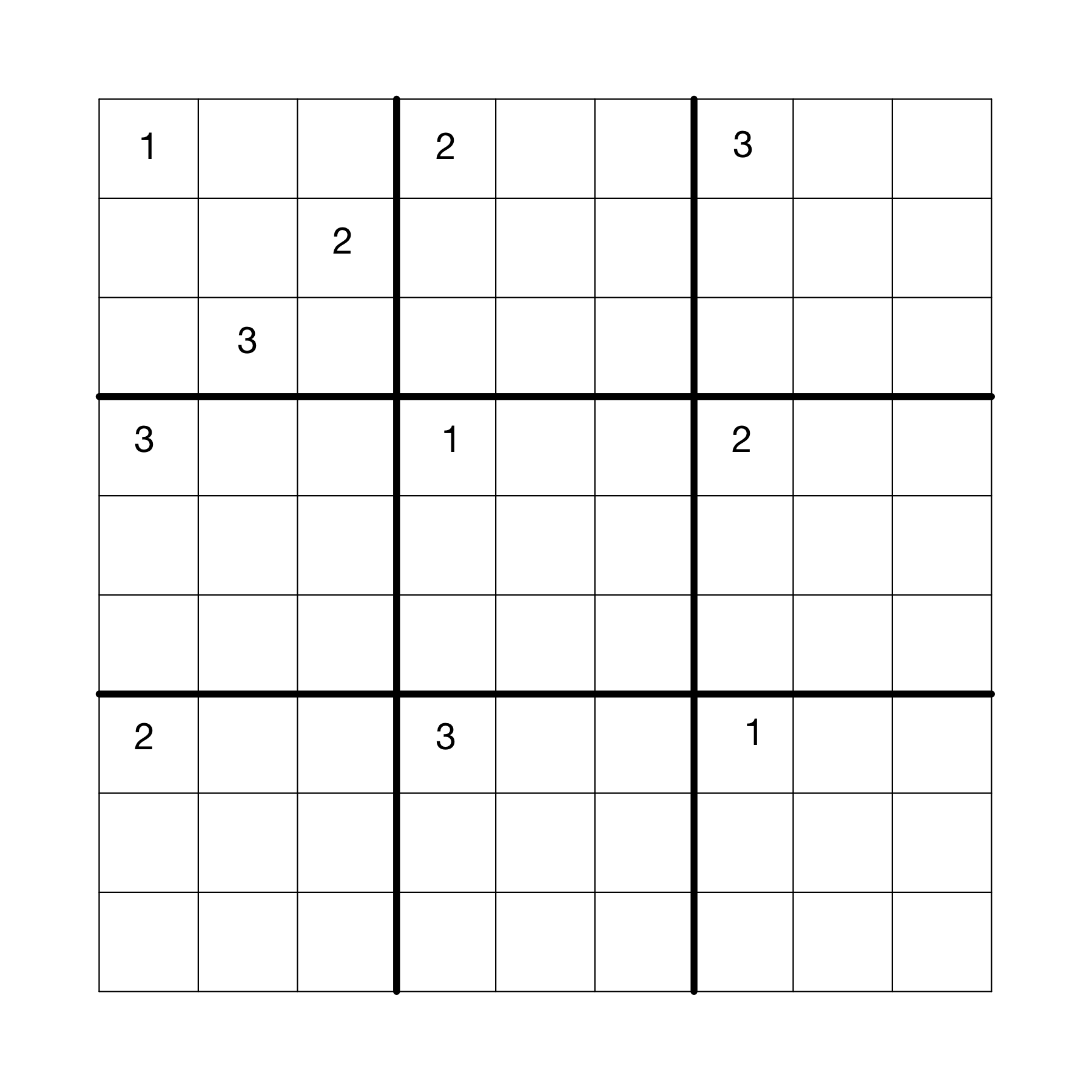 | 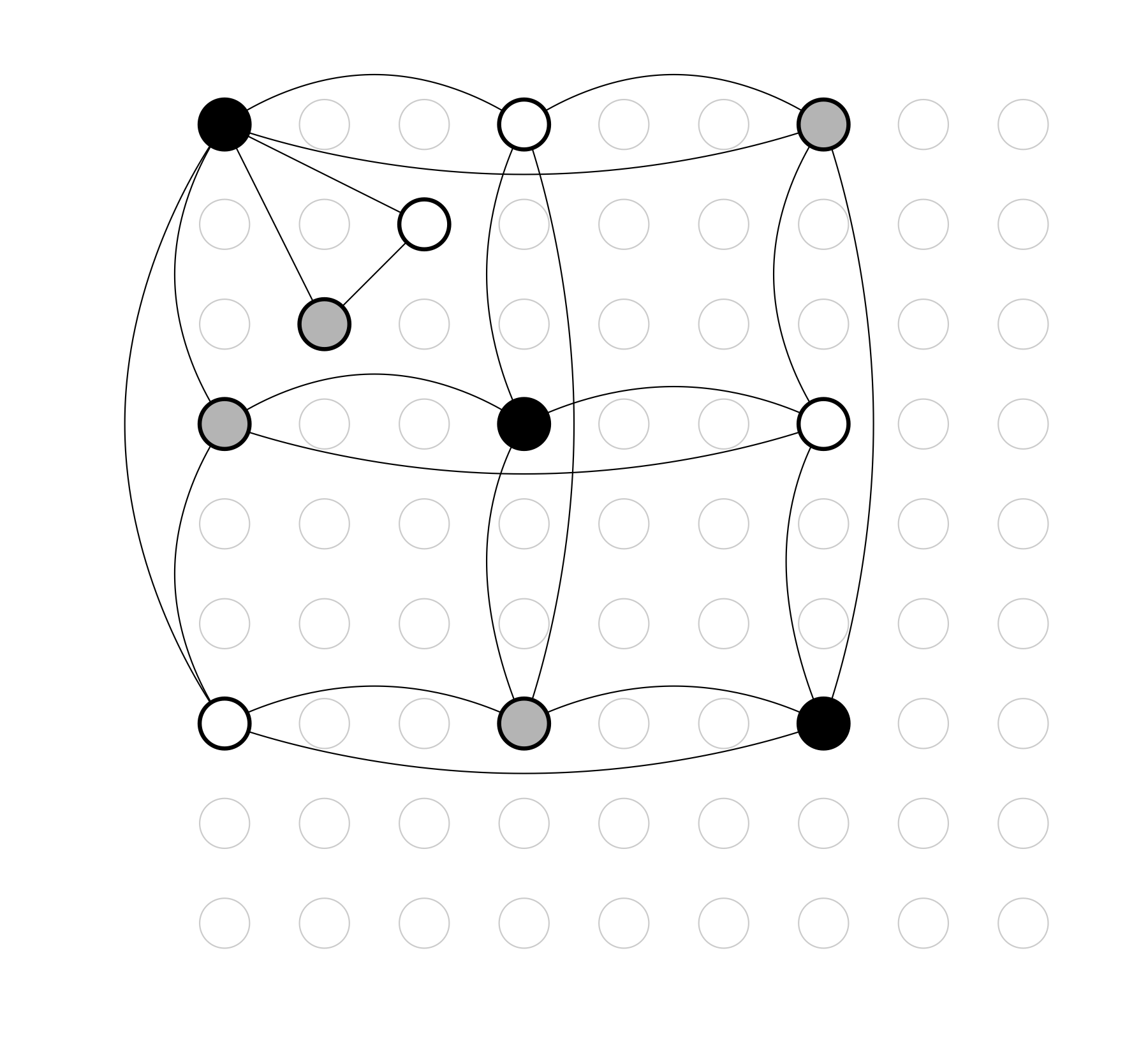 |
现在进入本章的核心:把 variables 映射到 registers 和 stack locations。彼此 interfere 的 variable 必须映射到不同 location。换成 interference graph 的说法,就是相邻 vertex 必须拥有不同颜色;如果把 location 看作 color,register allocation 就变成了 graph coloring problem。
读者可能比自己意识到的更熟悉 graph coloring:流行的 Sudoku game 就是 graph coloring 的一个实例。可以按以下方式从初始 Sudoku board 构造 graph:
- 每个 Sudoku square 对应一个 vertex。
- 如果两个 square 位于同一 row、column 或
3×3region,就在对应 vertex 之间添加 edge。 - 选择 9 种 colors,对应数字
1到9。 - 根据 board 中 square 的初始数字,为相应 vertex 指定 color。
如果能用这 9 种 colors 给剩余 vertex 着色,也就解出了对应的 Sudoku。Pencil Marks 技巧与 graph coloring algorithm 的 heuristic 相似:通过 elimination 确定一个 square 不再可用的数字,并把这些数字写在 square 中。如果一个 square 已经分配了数字 1,就在同 row、column 和 region 的 square 中写下 pencil mark 1。
Pencil Marks 对应由 Brélaz 提出的 saturation。在 Sudoku 术语中,vertex 的 saturation 是已经不可用的数字集合;在 graph 术语中:
$$ \mathrm{saturation}(u)={c\mid\exists v.\ v\in\mathrm{adjacent}(u)\land\mathrm{color}(v)=c} $$
其中 adjacent(u) 是与 u 共享 edge 的 vertex 集合。
如果一个 square 只剩一个可能的数字,就选择它。但如果没有 square 只剩一种可能呢?一种 brute-force 方法是全部尝试:先选第一个,如果最终得到 solution 就结束;否则 backtrack,再选择下一个可能性。Pencil Marks 可以减少 search tree 的 branching degree,但 backtracking 仍可能非常耗时。
减少 backtracking 的方法是 most-constrained-first heuristic,也称 minimum remaining values:选择 square 时,优先选择剩余可能性最少的 square,也就是 saturation 最高的 vertex。越早处理受限程度高的 square 越好,否则后面可能已经没有可用 possibility。
Register allocation 比 Sudoku 简单,因为 register 用完后可以 fallback 到 stack location。因此可以用 greedy search 替代 backtracking:每次做当下最好的选择,然后继续。为了尽量减少所需 colors,greedy search 仍使用 most-constrained-first heuristic。本章的算法大致等价于 DSATUR graph coloring algorithm:
Algorithm: DSATUR
Input:  graph G
Output: 每个 vertex v ∈ G 的 assignment color[v]

W ← vertices(G)
while W ≠ ∅ do
    从 W 中选择 saturation 最高的 vertex u;并列时随机打破
    找到不在 { color[v] : v ∈ adjacent(u) } 中的最小 color c
    color[u] ← c
    W ← W - {u}
算法用 integers 表示 colors。0 到 k-1 对应 register allocator 使用的 k 个 registers;k 及更大的 integer 对应 stack locations。没有用于 register allocation 的 register(例如 rax)被赋予 negative integer:rax 为 -1,rsp 为 -2。
从实现角度看,DSATUR 的核心循环可以直接写成下面这样;saturation(u) 应由当前已着色邻居的 color 集合重新计算或增量维护:
W ← vertices(G)
while W ≠ ∅ do
    u ← arg max { |saturation(v)| : v ∈ W }
    c ← 0
    while c ∈ { color(v) : v ∈ adjacent(u) 且 v 已着色 } do
        c ← c + 1
    color(u) ← c
    W ← W - {u}
完成 assign homes 后,一个含有 stack spill 的版本会把 color 映射为 memory operand。例如 running example 可以得到如下形态:
movq $1, -8(%rbp)
movq $42, %rcx
movq -8(%rbp), -8(%rbp)
addq $7, -8(%rbp)
movq -8(%rbp), -16(%rbp)
movq -8(%rbp), -8(%rbp)
addq %rcx, -8(%rbp)
movq -16(%rbp), %rcx
negq %rcx
movq -8(%rbp), %rax
addq %rcx, %rax
movq %rax, %rdi
callq print_int
这里 -8(%rbp) 和 -16(%rbp) 是不同的 stack locations;某些看似冗余的 memory-to-memory 形式在真正的 x86-64 指令选择中还需要经过 patching,因为 x86-64 不允许大多数 arithmetic instruction 直接以两个 memory operand 工作。
一个可行的 running example coloring 是:
rax ↦ -1    rsp ↦ -2
t   ↦ 0     z   ↦ 1
x   ↦ 1     y   ↦ 2
w   ↦ 0     v   ↦ 1
如果只使用一个 register %rcx,则 color 到 location 的映射为:
$$ {0\mapsto%rcx,\ 1\mapsto-8(%rbp),\ 2\mapsto-16(%rbp)} $$
所以 x 与 z 可以共享 -8(%rbp),因为它们不会同时 live;w 与 t 也可以共享 %rcx。
建议创建 auxiliary function color_graph,接收 interference graph 和 program 中的 variable list,并返回 variable 到 color 的 mapping。为了优先处理 saturation 高的 node,可以使用 priority queue,并维护 variable 到 priority queue handle 的 mapping,以便 saturation 变化时通知 queue。
完成 coloring 后,把前 k 个 colors 映射到 k 个 registers,其余 colors 映射到 stack locations。实现 allocate_registers,并创建覆盖 register allocation、包括 spilling 的 5 个 tests。
DSATUR 的逐步着色示例
在实际 coloring 中,先给 register vertices 固定颜色:rax ↦ -1、rsp ↦ -2。这些负数颜色不会被普通 variable 选择。随后维护每个未着色 vertex 的 saturation set:它的相邻 vertex 已经使用过的颜色集合。
以 Racket 版 running example 为例,t 同时与 rax、rsp interfere,因此初始 saturation 为 { -1, -2 },比其他 variable 更高;把 t 着成 0 后,z、rax 与 rsp 的 saturation 中加入 0。接着把 z 着成 1,再把 saturation 最高的 w 着成 0,因为它的邻居还没有使用 0。y 与颜色为 0 的 w 和颜色为 1 的 z 都相邻,所以只能使用 2。最后 v 与 x 可以使用 1,得到一种合法 coloring:
rax ↦ -1    rsp ↦ -2
t   ↦ 0     z   ↦ 1
x   ↦ 1     y   ↦ 2
w   ↦ 0     v   ↦ 1
如果只有一个 register %rcx 可供 allocator 使用,则 0 映射到 %rcx,1 映射到 -8(%rbp),2 映射到 -16(%rbp)。因此 x 与 z 可以共享 -8(%rbp),w 与 t 可以共享 %rcx;它们虽然在程序中都出现过,但在相同 program point 不会同时 live。
逐轮记录这个 Racket 示例的 coloring 过程如下。先固定 rax=-1、rsp=-2;随后每次选择 saturation 最大的未着色 vertex,并取不出现在邻居颜色集合中的最小 nonnegative color:
| 轮次 | 选择的 vertex | 选择依据 | 新颜色 | 受影响的邻居 saturation |
|---|---|---|---|---|
| 0 | t | 初始 saturation 为 {−1,−2},最高 | 0 | z、rax、rsp 加入 0 |
| 1 | z | saturation 最高;0 已被相邻 t 使用 | 1 | t、y、w、rsp 加入 1 |
| 2 | w | 与 y 并列最高;0 可用 | 0 | x、y、v、rsp 加入 0 |
| 3 | y | saturation 为 {0,1,−2} | 2 | w、z、rsp 加入 2 |
| 4 | v | 与 x 并列;1 是最小可用颜色 | 1 | w、rsp 更新 saturation |
| 5 | x | 只与 w、rsp 冲突,1 可用 | 1 | coloring 完成 |
最后的 mapping 为 t↦0、z↦1、w↦0、y↦2、v↦1、x↦1。例如 y 不能选择 0 或 1,因为它分别与 w、z interfere;而 x 可以使用 1,因为它不与颜色为 1 的 z 或 v 相邻。
Python 版示例的变量集合为 tmp_0、tmp_1、z、x、y、w、v。若从 tmp_0 开始并赋予颜色 0,则 z 可使用 1,w 使用 0,y 使用 2,最后 v、tmp_1 和 x 可使用 1。这说明 greedy coloring 的结果会受 tie-breaking 影响,但只要每次选择的颜色不在邻接 saturation set 中,结果就是合法的。
Priority queue 与颜色到 location 的映射
建议让 color_graph 接收 interference graph 和 program 中的 variable list,并返回 variable 到 color 的 mapping。为了高效取得 saturation 最高的 node,可以使用 priority queue;同时维护 variable 到 queue handle 的 mapping。每当某个已着色 vertex 的颜色加入邻居 saturation set,就通过对应 handle 更新邻居的 priority。
完成 coloring 后,把前 k 个 nonnegative colors 映射到 allocator 可用的 k 个 registers,其余 colors 按顺序映射到 stack locations。这个映射与 coloring 组合后就是 assign_homes 所需的 location map。allocator 还需要在 X86Program 的 info 中记录 used_callee,供后面的 prelude/conclusion 保存和恢复 callee-saved registers。
Racket support code 中的 priority queue 提供以下操作:make-pqueue 接收比较 predicate 并创建空 queue;pqueue-count 返回 item 数量;pqueue-push! 插入 item 并返回其 handle;pqueue-pop! 取出优先级最高(min queue 中是数值最小)的 item;pqueue-decrease-key! 在 item 的 priority 变小后通知 queue。color_graph 应为每个 variable 保存一个 handle,这样某个邻居获得新颜色、导致 saturation 改变时,就能更新 queue,而不必线性扫描所有未着色 variables。
完成 color assignment 后,allocate_registers 还要统计使用过的 callee-saved registers 与 spilled variables 数量,并把这些信息写入 program info。普通 spill 使用 procedure-call stack;tuple 或可能包含 tuple pointer 的 value 则需要由后续章节改为 root stack。这个 info contract 会被 prelude_and_conclusion 用来计算 frame size 和保存/恢复 register。
Patch Instructions
register allocation 后,仍需确保每条 instruction 最多只有一个 memory-access argument。movq -8(%rbp), -16(%rbp) 不合法;修复方式是先把 source move 到 rax,再把 rax move 到 destination:
movq -8(%rbp), %rax
movq %rax, -16(%rbp)
从 -8(%rbp) move 到 -8(%rbp) 的 instruction 是 trivial move,可以直接删除。一般来说,source 和 destination 是同一 location 的 trivial move 都应删除。running example 修复后的关键片段为:
movq $1, -8(%rbp)
movq $42, %rcx
addq $7, -8(%rbp)
movq -8(%rbp), %rax
movq %rax, -16(%rbp)
addq %rcx, -8(%rbp)
movq -16(%rbp), %rcx
negq %rcx
movq -8(%rbp), %rax
addq %rcx, %rax
jmp conclusion
实现 patch_instructions 的更新版本,删除 trivial move,并运行 tests 验证。
原文提出的进一步优化称为 move biasing。如果两个 variable p、q 一起出现在 movq p, q 或 movq q, p 中,就称它们 move related。普通 DSATUR 只根据 saturation 选择下一个 vertex;move biasing 在 saturation 相同的情况下,优先选择能够与 move-related variable 使用相同 color 的 vertex。选择 color 时也优先复用 move-related variable 已使用的 color,但这一偏好不能压过“register 优先于 stack location”的基本策略,只能作为同类候选之间的 tie breaker。
可以额外维护一个 move graph,其中每条 edge 表示一对 move-related variables。对本章 running example,主要的 move edges 是:
v — x — y — t
    |
    z
如果 v 与 x 不 interfere,则把它们着成同一 color,就能把 movq v, x 变成 trivial move;同理,让 x、y、t 尽可能共享 color,可以在 register allocation 后消除更多 movq。该优化改变的是 tie-breaking,不改变 interference constraint:任何有 interference edge 的两个 locations 仍然绝不能使用同一 color。
Prelude and Conclusion
这个 pass 生成满足 x86 calling convention 的 prelude 和 conclusion。加入 register allocator 后,allocator 使用的 callee-saved register 必须在 prelude 中保存,并在 conclusion 中恢复。
在 allocate_registers pass 中,向 X86Program 的 info 增加 used_callee entry,保存被分配给 variable 的 callee-saved register 集合。prelude_and_conclusion 根据它决定哪些 register 需要 save / restore。
计算 prelude 中调整 rsp 的数量时,要计入保存 callee-saved register 的空间,并确保 frame 是 16 的倍数。设 S 是 spilled variable 数量,C 是分配给 variable 的 callee-saved register 数量,align 把数字向上取整到最近的 16 bytes,则从 rsp 中减去的数量 A 为:
$$ A=\mathrm{align}(8S+8C)-8C $$
减去 8C 的原因是:prelude 使用 pushq 保存每个 callee-saved register,而 pushq 本身会从 rsp 减去 8。
完整的 register allocation pipeline 是:
flowchart LR
    L["LangVar"] --> U["uniquify"]
    U --> R["remove_complex_operands"]
    R --> E["explicate_control"]
    E --> S["select_instructions"]
    S --> L1["uncover_live"]
    L1 --> I["build_interference"]
    I --> A["allocate_registers"]
    A --> P["patch_instructions"]
    P --> PC["prelude_and_conclusion"]
    PC --> X["LangXInt"]
在 running example 中,只允许 allocator 使用 %rbx 和 %rcx,于是一个 variable 被 spill 到 -16(%rbp)。Prelude push %rbx,再从 rsp 减去 8 为 spilled variable 留空间;此时 rsp 仍按 16 bytes 对齐。Spilled variable 必须放在 saved callee-saved register 的更低地址,因此使用 -16(%rbp)。Conclusion 先把 stack pointer 向上移动 8 bytes,再 pop 旧的 %rbx 和 %rbp,最后用 retq 返回 operating system。
书中这个配置下的完整 Racket edition 输出如下:
start:
    movq $1, %rbx
    movq $42, -16(%rbp)
    addq $7, %rbx
    movq %rbx, %rcx
    addq -16(%rbp), %rcx
    negq %rbx
    movq %rcx, %rax
    addq %rbx, %rax
    jmp conclusion

    .globl main
main:
    pushq %rbp
    movq %rsp, %rbp
    pushq %rbx
    subq $8, %rsp
    jmp start

conclusion:
    addq $8, %rsp
    popq %rbx
    popq %rbp
    retq
pushq %rbx 保存 callee-saved register,subq $8, %rsp 为一个 spilled variable 预留空间;两者组合后使调用期间的 stack alignment 满足 16-byte 要求。conclusion 按相反顺序释放 spill space、恢复 %rbx 和 %rbp,再用 retq 把控制权交还给 operating system。
Challenge:Move Biasing
Move biasing 是 register allocator 的 enhancement。它的动机是:如果能把 move-related variable 放到相同 register,就可以删除更多 movq instruction。
如果两个 variable p 和 q 共同参与 movq p, q 或 movq q, p,就称它们 move related。决定下一个要 coloring 的 variable 时,如果多个 variable saturation 相同,应优先选择能够与 move-related variable 使用相同 color 的 variable。为 variable 选择 color 时,也应优先选择 move-related variable 已使用的 color,前提是它们不 interfere。
这个偏好不能覆盖 register 优先于 stack location 的规则;它只能在 registers 之间或 stack locations 之间选择时作为 tie breaker。建议像表示 interference 一样用 graph 表示 move relationship,称为 move graph。running example 中的 move relationships 包含:
v — x
x — y
x — z
y — t
如果 y 与 t move-related 且不 interfere,就优先让 y 使用与 t 相同的 color;类似地,让 x 使用与 y 相同的 color,可以删除更多 trivial move。
使用全部 general-purpose registers 时,普通 coloring 可能在 running example 中产生如下代码:
movq $1, %rdx
movq $42, %rcx
movq %rdx, %rdx
addq $7, %rdx
movq %rdx, %rsi
movq %rdx, %rdx
addq %rcx, %rdx
movq %rsi, %rcx
negq %rcx
movq %rdx, %rax
addq %rcx, %rax
jmp conclusion
其中两个 source 与 destination 相同的 movq 可以删除;如果把 t、v、x 和 y 更积极地放入同一个 register,则可以进一步删除三条 movq。这正是 move biasing 要利用的信息:它不放宽 interference constraint,而是改变相同 saturation 下的选择顺序与 color 偏好。
可以把 DSATUR 的选择规则扩展为下面的形式:
choose_vertex(W):
  先取 saturation 最高的 vertex
  若有多个候选:优先选择与已着色 vertex move-related 的候选

choose_color(u):
  forbidden = colors(adjacent(u))
  preferred = colors(move-neighbors(u)) - forbidden
  若 preferred 中存在 register color:选择其中一个
  否则选择最小的可用 register color
  若不存在可用 register color:在 stack colors 中优先复用 preferred
这里的 preferred 只能作为同一类 location 内的 tie breaker:即使 move-related variable 使用了 stack color,也不能因此放弃一个可用 register。只有在 register candidates 都不可用,或者多个 register candidates 同样可用时,才使用 move relationship 的偏好。
以源稿的 Racket running example 为例,y 与 t move-related 且不 interfere;若 t 已着为 color 0,则应优先把 y 着为 0。随后 x 又与 y move-related,因此也可以着为 0。原本的三条 move:x → y、y → t 以及相关的同色搬运,都可能在 patch 阶段被识别为 trivial move 并删除。
实现 move biasing,创建至少包含一个 move-biasing opportunity 的两个 tests,并检查生成的 x86 program,确保优化生效且所有 tests 仍通过。
本章练习
- 手工对 running example 做 liveness analysis,计算每条 instruction 的 live-before 与 live-after sets,并与书中结果比较。
- 实现
uncover_live,将每条 instruction 的 live-after set 存入Block的info,并正确处理callq的 caller-saved registers 与 argument-passing registers。 - 按本章算法实现
build_interference,把 interference graph 存入 programinfo的conflicts字段。 - 实现
allocate_registers,创建 5 个覆盖 register allocation 各方面(包括 spilling 到 stack)的 programs。 - 更新
patch_instructions以删除 trivial moves,并在allocate_registers之后测试该 pass。 - 更新
prelude_and_conclusion以支持 register allocation,运行完整 compiler tests。 - 修改
allocate_registers以考虑 move biasing;创建至少 2 个包含 move-biasing opportunity 的 tests,检查生成的 x86 program,并确认全部 tests 仍通过。
Further Reading
早期 register allocation algorithm 在 1950 年代为 Fortran compiler 开发。Graph coloring 在 1970 年代末和 1980 年代初被用于优化 compiler。Chaitin 的 algorithm 基于 Kempe 的观察:如果 graph G 有一个 degree 小于 k 的 vertex v,并且移除 v 后得到的 subgraph 可以用 k 种 colors 着色,那么 G 也可以用 k 种 colors 着色。
原因是:subgraph 完成 k-coloring 后,v 的 neighbors 最多使用少于 k 种不同颜色,因此至少剩下一种 color 可以分配给 v。
Chaitin 的 algorithm 移除 degree 小于 k 的 vertex,递归 coloring 剩余 graph,返回时再为该 vertex 选择 available color。如果没有 degree 小于 k 的 vertex,就随机选择一个 vertex,spill 它,移除后递归 coloring。
在 coloring 之前,可以把 move-related 且不互相 interfere 的 variable merge,这个过程称为 coalescing。Coalescing 会减少 move 数量,但可能让 graph 更难 coloring。Conservative coalescing 只在两个 variable 的 high-degree neighbor 数量低于 k 时 merge;biased coloring 则尽可能让 variable 与另一个 move-related variable 使用相同 color。
另一种 greedy coloring 是 offline algorithm:在分配 colors 前就确定 vertex order;本章的 saturation-based algorithm 是 online algorithm,它使用当前 color assignment 影响剩余 vertex 的处理顺序。我们采用 saturation-based coloring,是因为可以通过 Sudoku 有趣地引入 graph coloring。
Register allocator 可以把每个 variable 只映射到一个 location,也可以通过 live range splitting 把 variable 替换为多个 variable,使每个 variable 负责 live range 的一部分。如果 compile time 极其重要,例如在 just-in-time compiler 中,graph coloring 可能过于昂贵,此时 linear scan algorithm 可能更合适。
参考资料
评论 (0)